Hands-on plant science, simple experiments, and printable worksheet ideas for elementary classrooms and homeschool learning.
Have you ever noticed a houseplant with drooping leaves? Or watched a tiny seedling grow taller near a sunny window?
Plants are living things, and just like animals, they need certain things to survive and grow. But what exactly do plants need, and how can we help young learners understand why these things matter?
Teaching plant needs is an important part of elementary life science. For second and third graders, the best lessons combine simple explanations, real-world observations, hands-on investigations, and engaging activities.

In this guide, we will explore the five basic things plants need to grow and share five easy science activities that work in both classrooms and homeschool settings.
What Are the 5 Things Plants Need to Grow?
A simple way to introduce plant needs is with the word LAWNS.
Each letter represents something important for healthy plant growth.
L – Light
Plants use light energy to make their own food through a process called photosynthesis.
Their leaves capture light and help the plant produce the sugars it needs to grow.
A – Air
Plants need air to survive.
They take in carbon dioxide from the air to help make food. Plants also use oxygen to release energy from food.
W – Water
Water helps plants stay healthy and supports many important processes inside them.
Roots absorb water, which moves through the plant to its stems and leaves.
N – Nutrients
Plants need nutrients to grow and stay healthy.
In nature, roots usually absorb these nutrients from water in the soil.
S – Space
Plants need enough room for their roots, stems, and leaves to develop.
When plants grow too close together, they may compete for light, water, and nutrients.
Science note for teachers: Plants need nutrients, but they do not always need soil. Some plants can grow in water when the necessary nutrients are supplied. Plants also need suitable temperatures. LAWNS is a simple memory aid for introducing common growing needs, rather than a complete list of every condition plants require.

Activity 1: What Do I Already Know About Plants?
Before teaching new vocabulary, find out what your students already know.
Ask children to draw a plant they know. It could be a sunflower, a tomato plant, a tree, or even a small houseplant.
Encourage them to include as many plant parts as they remember.
Then ask two simple questions:
What does a plant need to grow?
What do you think happens after a seed sprouts?
Students can write short answers or explain their ideas aloud.
This activity is a useful starting point because it encourages children to connect new science concepts with their own experiences.
Teaching tip: Save the first drawings and revisit them at the end of your plant unit. Children can compare their ideas and see what they have learned.
Activity 2: Explore Plant Needs with a Diagram
Visual learning works especially well when introducing plant science vocabulary.
Show students a picture of a growing plant with its roots, stem, and leaves.
Ask them to identify where the plant gets its resources.
Discuss how sunlight reaches the leaves, how roots absorb water and nutrients, and how plants exchange gases with the air around them.
Next, have students connect each plant need with its function.
For example:
Sunlight: Provides energy for photosynthesis.
Water: Helps the plant stay healthy and grow.
Soil: Often provides support and a source of nutrients.
A simple matching worksheet can reinforce these connections without requiring long written explanations.
Homeschool idea: Use a real potted plant instead of a diagram. Let your child point to the leaves, roots (if visible), and soil while explaining what each part does.
Activity 3: What’s Missing? Help the Droopy Plant!
Why does a plant sometimes look wilted or unhealthy?
Show students a picture of a drooping plant and ask them to imagine that they are plant detectives.
What might be missing?
Could the plant need water? More light? Better growing conditions?
Let students examine the picture, discuss their ideas, and explain what they would check first.
Next, invite them to draw or write three things they think a plant needs to grow healthy and strong.
For an additional hands-on task, students can sort pictures of helpful and unhelpful items.
For example, sunlight, water, air, and nutrient-rich soil can support plant growth. Soda, gasoline, and fire are not appropriate things to give a plant.
Ask your students: How could we find out why a real plant is drooping?
This question introduces an important science skill: making predictions and looking for evidence instead of simply guessing.
Teacher note: Wilting can have several causes, including too little water, damaged roots, or excessive heat. A drooping plant does not automatically mean the soil is dry.

Activity 4: Turn Out the Lights! A Simple Leaf Experiment
One of the most interesting questions children can investigate is:
What happens when a leaf does not receive light?
This easy plant science experiment encourages students to make predictions, observe changes, compare results, and discuss what they have discovered.
Materials
You will need a healthy tomato plant, a small piece of aluminum foil, a paper clip, and a notebook or observation worksheet.
Step-by-Step Instructions
Step 1: Choose a healthy leaf. Find a healthy, green leaf on your tomato plant. Look closely at its color and shape. Draw it or take a photograph.
Step 2: Cover the leaf. Carefully cover one leaf with aluminum foil to block the light. Secure the foil gently without squeezing or damaging the leaf.
Step 3: Leave another leaf uncovered. Choose a similar leaf on the same plant and leave it exposed to light. Keep the plant in a bright location, away from excessive heat, and continue its normal care.
Step 4: Observe after 5–7 days. Carefully remove the foil and compare the covered leaf with the uncovered leaf.
What Did You Notice?
Ask students to compare the two leaves.
Did they look the same? Was one leaf lighter or more yellow? Did the covered leaf show no obvious change?
The results may vary depending on the plant and growing conditions. A leaf may remain green after only one week without light.
Explain that leaves use light energy during photosynthesis. Without light, the covered leaf cannot carry out photosynthesis while it remains covered.
Science discussion: Why did we leave one leaf uncovered? What other growing conditions stayed the same?
Students can record their observations using drawings, labels, and short sentences.
This investigation introduces the idea of a fair comparison and helps children understand the relationship between light and plant growth.


Activity 5: Review with Plant Science Games and Puzzles
After students have explored the five plant needs, reinforce the new vocabulary with simple games and puzzles.
A True or False activity is an easy way to check understanding.
Try these statements:
Plants need juice and soda to grow. False.
Leaves capture light that helps the plant make food. True.
Roots absorb water from the soil. True.
Plants can grow in complete darkness forever. False.
For another fun review, use a plant needs crossword puzzle.
Words such as water, air, light, soil, and space allow students to practice reading, spelling, and science vocabulary together.
These activities are especially useful for independent work, science centers, homeschool review, or the final lesson of a plant science unit.
How to Use These Activities in Your Classroom or Homeschool
You don’t need an elaborate science laboratory to teach plant needs effectively.
Start with a simple discussion and a drawing activity. Introduce the five plant needs with pictures, then use matching and sorting worksheets to reinforce the vocabulary.
Add a real plant or a hands-on investigation to help students connect what they have learned with the natural world.
Finally, use a short quiz or crossword puzzle to review the most important ideas.
For homeschool learners, these activities can be spread across several short lessons. In classrooms, they work well as part of a plant science unit, small-group investigation, or science center rotation.
The goal is not just to memorize five words. It is to help children understand how growing conditions affect living plants.
NGSS Connection: Plant Needs in Grade 2
These activities support important elementary science skills, including observing, asking questions, making predictions, and using evidence.
They connect particularly well with NGSS 2-LS2-1, which focuses on planning and conducting investigations to determine whether plants need sunlight and water to grow.
For a more complete investigation of this standard, students can compare similar plants while changing only one growing condition, such as light or water.
The activities also provide useful foundational knowledge for later studies of plant structures, growth, and life cycles.
Explore More Plant Science with My Workbook
If you’re planning a complete plant science unit, you may want more than a single worksheet or experiment.
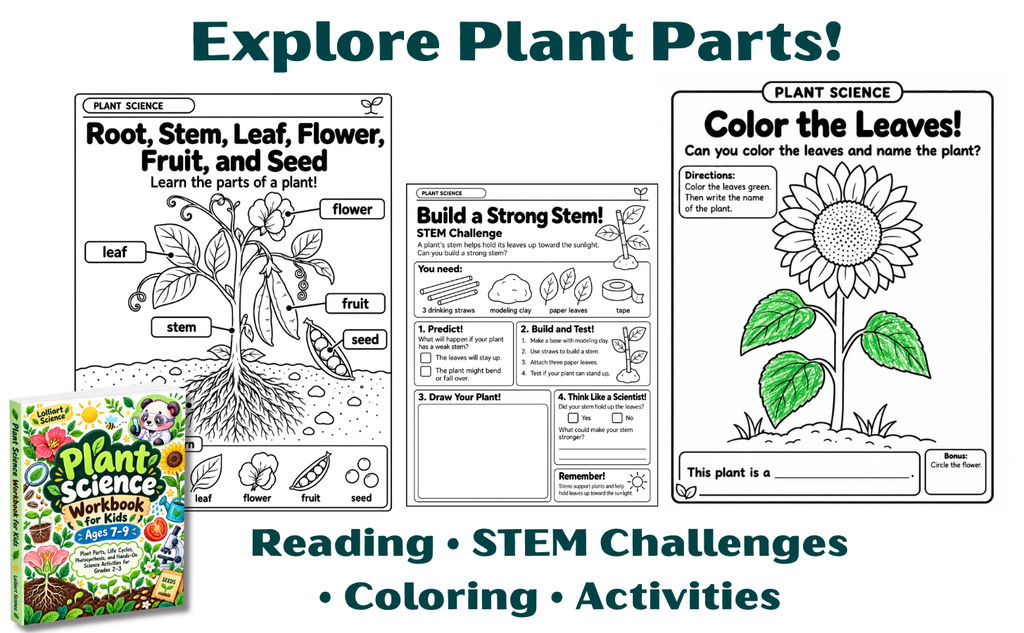
My Plant Science Workbook for Kids Ages 7–9 brings together a wide range of elementary plant science topics in a 120-page black-and-white activity book designed for Grades 2–3.
The workbook explores plant parts, growing needs, life cycles, photosynthesis, and different ways plants reproduce.
Children can reinforce their learning through reading activities, labeling, matching, cut-and-paste worksheets, observation tasks, science investigations, coloring, and puzzles.
The black-and-white illustrations are designed for children to color as they learn, making the workbook useful for classroom practice, homeschool lessons, and independent science activities.
Frequently Asked Questions
Plants need light, water, air, nutrients, and enough space to grow. They also need suitable environmental conditions, including temperature.
No. Many plants grow in soil, but some can grow without it when they receive water, nutrients, and support in other ways. Hydroponic gardening is one example.
Not always. Many seeds can germinate without light when they have enough moisture, oxygen, and a suitable temperature. Some seeds have specific light requirements. Once a seedling develops, it generally needs light to continue healthy growth.
A leaf-light comparison, a simple seed-growing investigation, or an experiment comparing plants under different growing conditions can help students practice making predictions and recording observations.
Yes. Most activities use simple materials and can be adapted for one child or a small group. They combine reading, drawing, observation, and hands-on learning.
Keep Growing and Exploring!
Learning what plants need to grow is one of the first steps toward understanding the amazing world of plants.
With a few simple materials, engaging worksheets, and a little curiosity, children can begin thinking like young scientists.
Encourage students to keep asking questions, making predictions, and observing the plants around them. Even a small plant on a windowsill can become a wonderful science lesson.A