With free coloring pages
Plant parts, the life cycle, garden visitors, and a simple regrowth investigation
How does a tiny lettuce seed become the crisp leaves in a sandwich? Lettuce gives students a familiar way to explore plant parts, growth, and where food comes from. This guide is written for Grades 2 and 3 and combines short explanations with classroom activities and a simple home investigation.

What Is Lettuce
Lettuce (Lactuca sativa) is a leafy vegetable that grows well in cool weather. We usually eat its leaves. A fun fact for students: lettuce is about 95% water. Many varieties also provide vitamins A and K, although amounts vary by type.
A lettuce plant has roots, a stem, leaves, and flowers that can make seeds. Each part has a different job.

The Four Main Parts of a Lettuce Plant
Roots. Most lettuce roots spread close to the soil surface. They take up water and nutrients and help hold the plant in place.
Stem. A short stem connects the roots to the leaves. In head lettuce, the firm base is often called the core.
Leaves. The leaves are the part we usually eat. They use sunlight, water, and carbon dioxide from the air to make sugars. This process is called photosynthesis.
Flowers and seeds. If lettuce keeps growing, it may send up a tall flower stalk and grow small yellow flowers. After pollination, the plant can make seeds for new lettuce plants.
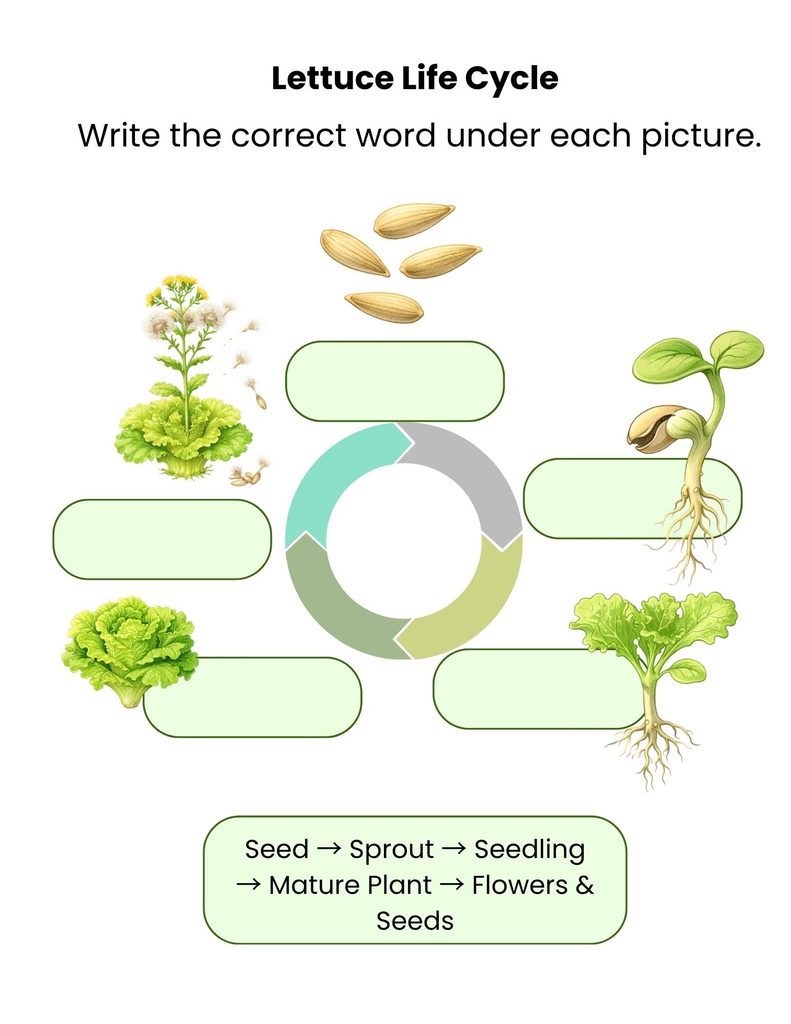
The Lettuce Life Cycle
A life cycle shows how a living thing grows and changes. Lettuce moves through five easy-to-follow stages:
Seed → Sprout → Seedling → Mature Plant → Flowers and Seeds
Seed. The life cycle begins with a seed.
Sprout. The seed begins to grow. A tiny root and shoot start to appear.
Seedling. The young lettuce plant grows its first small leaves.
Mature plant. The plant grows larger and develops the leaves people harvest.
Flowers and seeds. If the plant is left to grow, it can form a flower stalk and flowers, then make seeds. Those seeds can start the cycle again.
Gardeners usually harvest lettuce before it flowers. Following the full life cycle helps students see how seeds are made for the next generation of plants.
For a ready-to-use Grade 2 follow-up, explore my Lettuce Life Cycle Worksheets | Plant Life Cycle | Cut and Paste Sequencing. This 10-page K-3 printable includes a life cycle diagram, labeling, cut-and-paste sequencing, matching, drawing and coloring activities, a mini quiz, and an answer key.
What a Lettuce Plant Needs
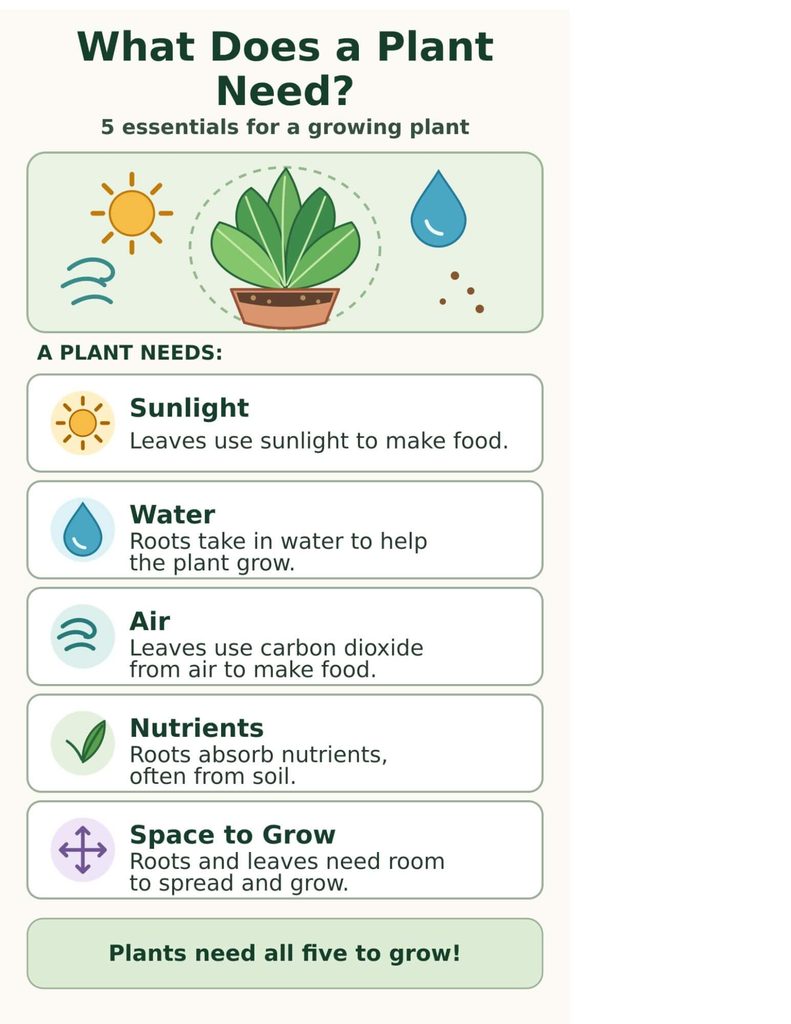
Lettuce needs the same basic resources as other plants. Ask students to connect each need to a plant part or job:
Sunlight. Leaves use light energy to make food.
Water. Roots take up water. Lettuce has a shallow root system, so its soil should not be allowed to dry out.
Air. Leaves take in carbon dioxide from the air during photosynthesis.
Nutrients. Roots absorb nutrients, often from the soil.
Space. Roots and leaves need room to spread and grow.
Try a simple investigation. Have students compare two similar seedlings. Give them the same water and growing space, but change one condition, such as the amount of light. Ask students to predict what they will observe, then draw or describe changes after several days.
Garden Visitors on Lettuce
| Garden visitor | What students may notice | Role |
|---|---|---|
| Caterpillar | Chews holes in lettuce leaves. | Can harm lettuce |
| Aphid | A tiny insect that feeds on plant sap. | Can harm lettuce |
| Whitefly | A tiny white insect that feeds on plant sap. | Can harm lettuce |
| Leafhopper | Feeds on plant sap and may make leaves curl or look yellow. | Can harm lettuce |
| Slug | May chew holes in lettuce leaves. | Can harm lettuce |
| Lady beetle | Eats aphids. | Helpful insect |
| Lacewing larva | Eats aphids and other small insects. | Helpful insect |
Teacher note. For Grade 2, it is enough to explain that aphids feed on plant sap and that lady beetles and lacewing larvae eat aphids.


A Plant Parts Salad
A Plant Parts Salad is a hands-on way to show that the foods we eat come from different parts of plants. Invite students to sort familiar foods before you combine them.
| Plant part | Food examples | Connection to lettuce |
|---|---|---|
| Root | Carrot, radish | Lettuce has roots, but we usually eat its leaves. |
| Stem or leaf stalk | Asparagus, celery | Asparagus is a stem. Celery is a leaf stalk. |
| Leaf | Lettuce, spinach | Lettuce leaves are the part we usually eat. |
| Flower | Broccoli, cauliflower | We eat flower buds and shoots from these plants. |
| Fruit | Tomato, cucumber, bell pepper | Fruits form from flowers and contain seeds. |
| Seed | Peas, corn, sunflower seeds | Seeds can grow into new plants. |
Teacher note. In botany, tomato, cucumber, and bell pepper are fruits because they develop from flowers and contain seeds. Keep this as an optional extension for older students. Not every part of every plant is safe to eat.
Food safety. Use only familiar, food-safe ingredients. Check school allergy rules, wash produce, and have an adult handle knives and food preparation.
Classroom note. Use the regrowth setup for observation. Do not eat new leaves unless an adult has checked that they were grown and handled safely.
The same kind of comparison can be tried with green onions or celery. Carrot tops may grow leaves, but they do not grow a new carrot root.
From Garden to Salad
Ask students to trace how lettuce reaches a lunch plate:
Seed → Seedling → Lettuce Plant → Harvest → Wash and Prepare → Salad
A grower plants seeds and cares for the young plants until they have leaves large enough to harvest. Lettuce is usually picked before it sends up a flower stalk. The leaves are then washed and prepared to eat. At school, students can name the plant part they see in a sandwich or salad.

At Home Science Regrowing a Lettuce Base
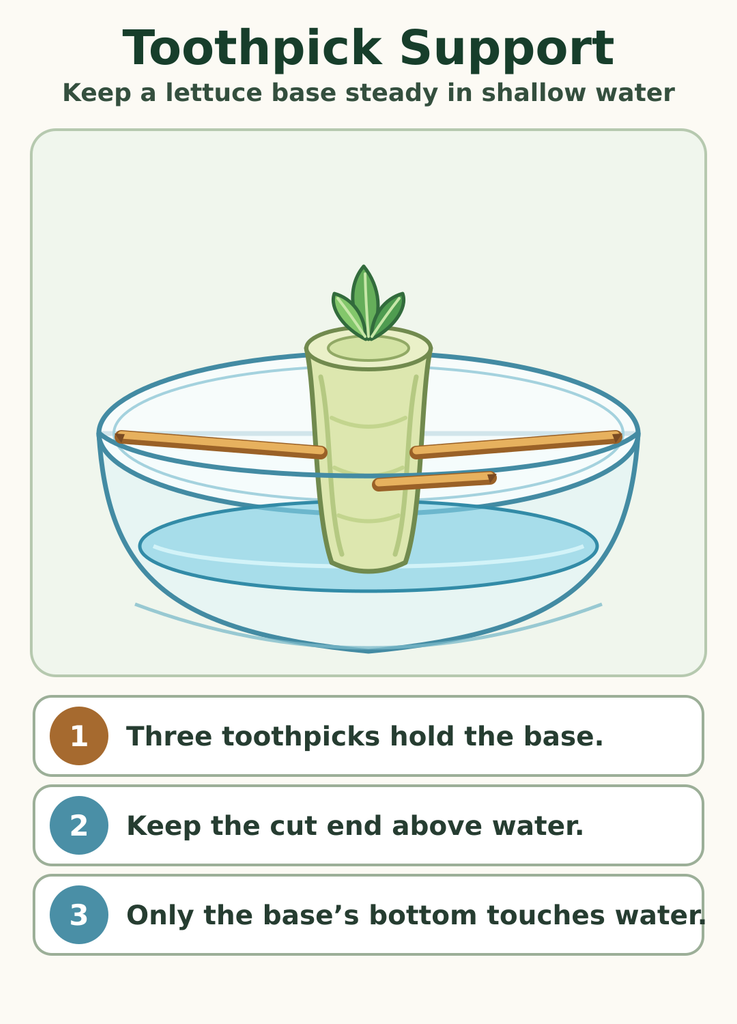
Turn a leftover lettuce base into a windowsill investigation. Students can make a prediction, observe changes, and keep a short science log.
You will need. An intact lettuce base, a shallow bowl or jar, water, a bright windowsill, and a notebook or observation sheet.
1. Save the base. With an adult’s help, cut off the leaves and keep about 1-2 inches (2.5-5 cm) of the base. Leave the center growing point intact.
2. Add shallow water. Stand the base in a bowl with the cut side facing up. Cover only the bottom inch or so with water; do not submerge the whole base.
3. Give it light. Place the bowl near a bright window. Change the water every 2-3 days.
4. Watch and record. Look for small new leaves in the center and possible roots at the bottom. Changes may appear after several days to a few weeks, and results vary.
Helpful Setup Tips for the Lettuce Base
Keep the base shallow. Only the bottom should sit in water. Remove loose leaf pieces that would stay underwater.
Steady the base. If it tips, gently press three toothpicks into the sides and rest them on the rim of the bowl.
Use the right expectation. A lettuce base may grow a few small leaves, but it usually will not make a full new head in a bowl of water.
Why Can a Lettuce Base Grow Again
The center of the base may still contain the plant’s growing point, where new leaves can form. With light and water, the living tissue may produce a few small leaves. This is new growth from part of an existing plant, not a new plant growing from a seed. Results depend on the condition of the leftover base. Iowa State University Extension describes similar regrowth with romaine lettuce and other leafy vegetables.
Bring Lettuce Science into the Classroom
Lettuce connects plant science with food students already know. They can follow a seed through the life cycle, identify the leaves they eat, sort foods by plant part, and use a leftover base to practice careful observation. Invite students to support each answer with a drawing, a label, or something they noticed in the plant.
Observation log
| Check-in | Look for | Record |
|---|---|---|
| Day 1 | What does the base look like? What do you predict will happen? | Draw the starting point. |
| Day 3 | Do you see a change in the center or the water? | Record what you notice. |
| Day 5 | Are there new leaves, roots, or no visible change yet? | Draw or describe the evidence. |
Why Can a Lettuce Base Grow Again
The center of the base may still contain the plant’s growing point, where new leaves can form. With light and water, the living tissue may produce a few small leaves. This is new growth from part of an existing plant, not a new plant growing from a seed. Results depend on the condition of the leftover base. Iowa State University Extension describes similar regrowth with romaine lettuce and other leafy vegetables.
Classroom note. Use the regrowth setup for observation. Do not eat new leaves unless an adult has checked that they were grown and handled safely.
The same kind of comparison can be tried with green onions or celery. Carrot tops may grow leaves, but they do not grow a new carrot root.
Quick Questions for Students
1. Which part of the lettuce plant do we usually eat?
2. What stage comes after a sprout?
3. Name two things a lettuce plant needs to grow.
4. Which garden visitors may harm lettuce leaves?
5. What changed in your lettuce-base investigation?
Quick-check answers for teachers. Leaves; seedling; possible answers include sunlight, water, air, nutrients, and space; caterpillars, aphids, whiteflies, leafhoppers, and slugs; the final answer depends on each student’s observations.

Sources for Teachers
University of Minnesota, Lettuce nutrition facts
University of Florida IFAS Extension, Nutritional Benefits of Lettuce
University of Minnesota Extension, Growing Lettuce, Endive, and Radicchio
KidsGardening, Plant Parts Salad
Iowa State University Extension and Outreach, Growing Vegetables from Kitchen Scraps
North Carolina State University Extension, Pests of Lettuce
Want all 19 of these life cycles ready to print and go? Check out my [Insert Your Bundle Name / Link Here]. It includes comprehensive activity packs for everything from Apples to Ferns, complete with diagrams, matching games, and black-and-white pages for easy coloring!

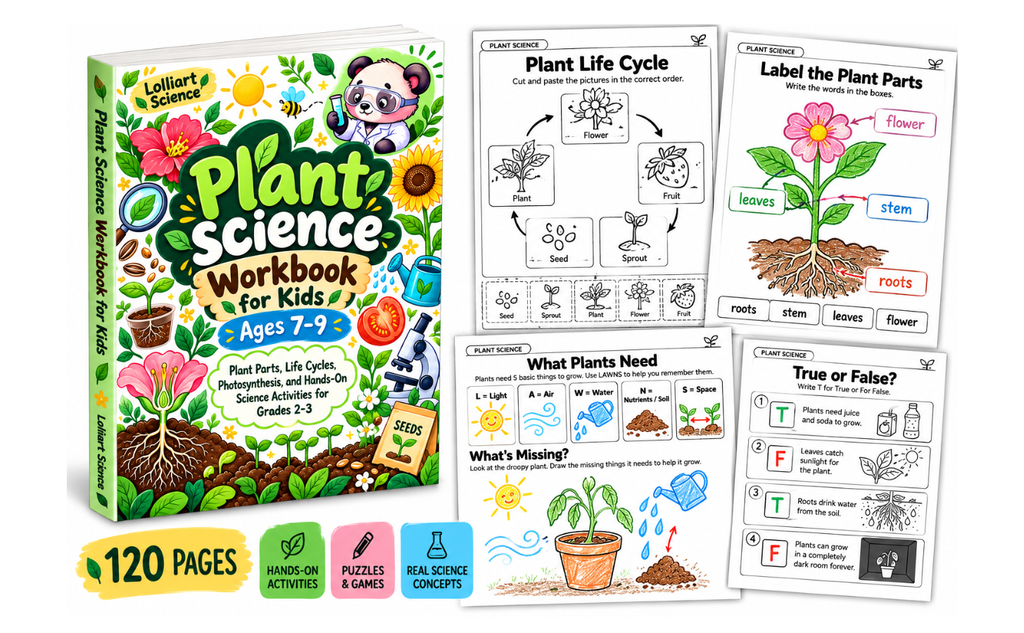
Discover how roots, stems, leaves, and flowers help plants grow! Through illustrated worksheets, creative STEM challenges, and coloring activities, children ages 7–9 can explore plant structures and their functions while developing observation, problem-solving, and science skills.