
Teaching animal adaptations to 2nd and 3rd graders can sometimes feel abstract. How do you help young learners understand why animals look and behave the way they do based on their environment?
The secret: Turn them into Astrobiologists! 🚀👽
By combining science, critical thinking, and creativity, this “Design an Alien Animal” activity takes kids on an exciting mission to a fictional ice world called Gliese-8. Instead of just memorizing real-world polar adaptations, students get to apply those same scientific concepts to invent their own creature!
How This Activity Works in 4 Easy Steps:
1. Set the Mission & Read the Environment Brief
Students take on the role of an astrobiologist (a scientist studying life in the universe). Their task is to explore planet Gliese-8, a harsh ice world covered in snow, freezing temperatures, high winds, and scarce food.
- Vocabulary Focus: Astrobiologist, Environment, Scarce Food, Adaptation.
- 2. Create the Creature Profile
- Next, kids build the foundation of their new alien species!
- Name the creature: Encourages creative ownership.
- Determine its diet: Is it a Herbivore, Carnivore, or Omnivore? (Great way to review food chain vocabulary!).
- Movement: How does it travel across ice, snow, or through freezing water?
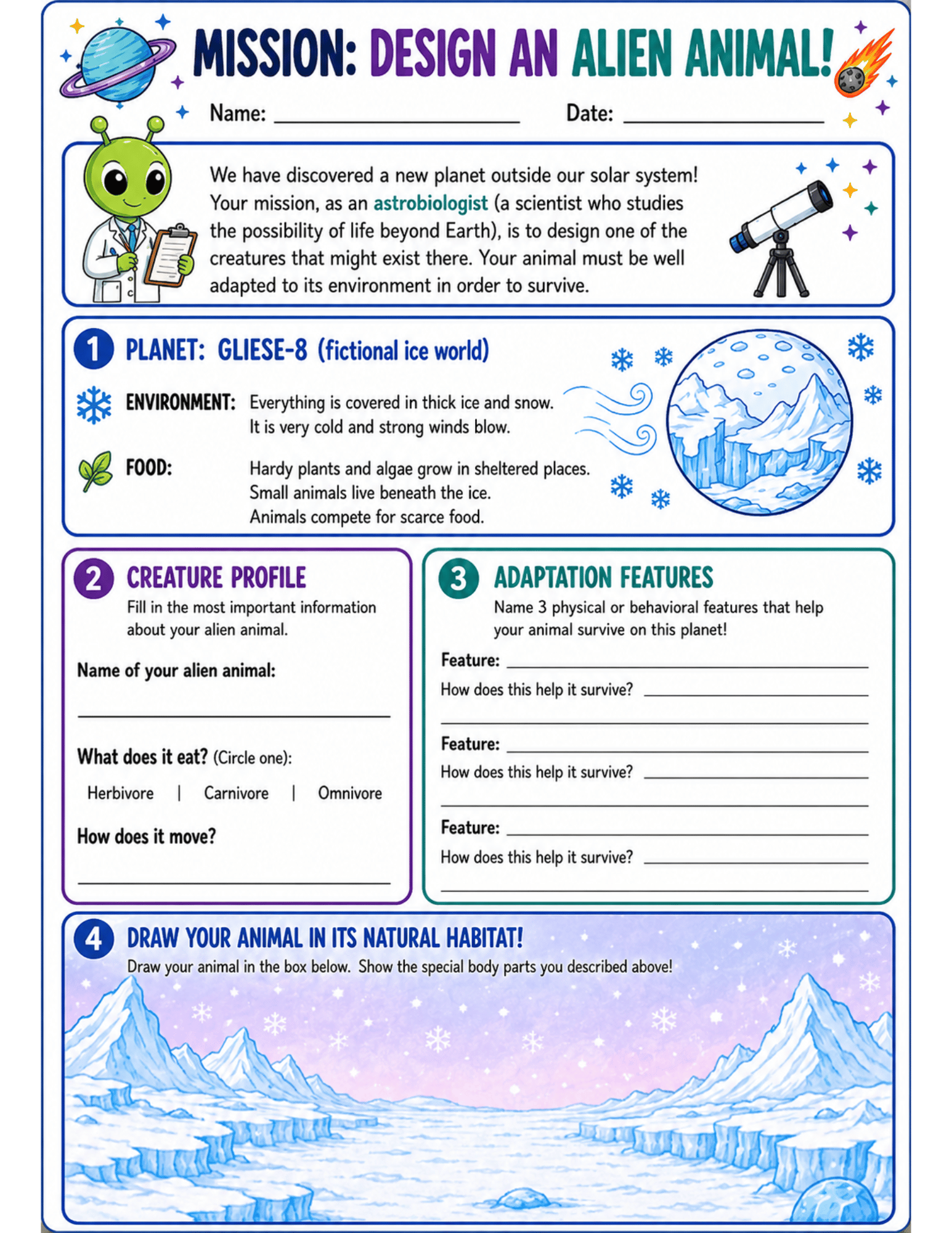
3. Brainstorm Physical & Behavioral Adaptations
This is where the core science happens! Students must choose 3 specific physical or behavioral features and explain how each feature helps the creature survive on Gliese-8.
- Example idea: Thick insulated fur or blubber to resist freezing temperatures.
- Example idea: Sharp claws or ice-crampon feet to walk on slippery terrain without falling.
- Example idea: Long snout or subterranean digging tools to hunt small animals living beneath the ice.
4. Bring the Alien to Life (Art Integration!)
Finally, students get to draw their alien right inside its snowy, icy habitat, making sure to highlight the special adaptation features they described above!
Why Teachers and Homeschoolers Love This Printable:
- Cross-Curricular: Combines Science (NGSS aligned for life science/adaptations), Vocabulary/Writing, and Art!
- High Engagement: Kids are naturally curious about space and aliens. Framing adaptations as an “Alien Design Challenge” keeps every student fully immersed.
- Differentiated Learning: Perfect for 2nd and 3rd grade — open-ended enough for advanced students to write detailed explanations, yet simple and visual enough for English language learners and reluctant writers.
Tips for the Classroom / Lesson Idea:
- Class Brainstorm: Before handing out the sheet, discuss extreme environments on Earth (like Antarctica or the Arctic tundra). Ask kids: “What features do polar bears, seals, or penguins have to survive there?”
- Gallery Walk: After finishing, hang up the completed alien worksheets on a bulletin board and let students walk around to discover all the new species created by their fellow scientists!