When children learn about a plant life cycle, they often see the same familiar pattern:
seed → sprout → plant → flower → fruit → seeds
Strawberry plants can follow this pattern too. But strawberries give elementary students an opportunity to discover something extra: a strawberry plant can make new plants in more than one way.
It can grow a new plant from a seed, but it can also spread by growing a long stem called a runner, or stolon.

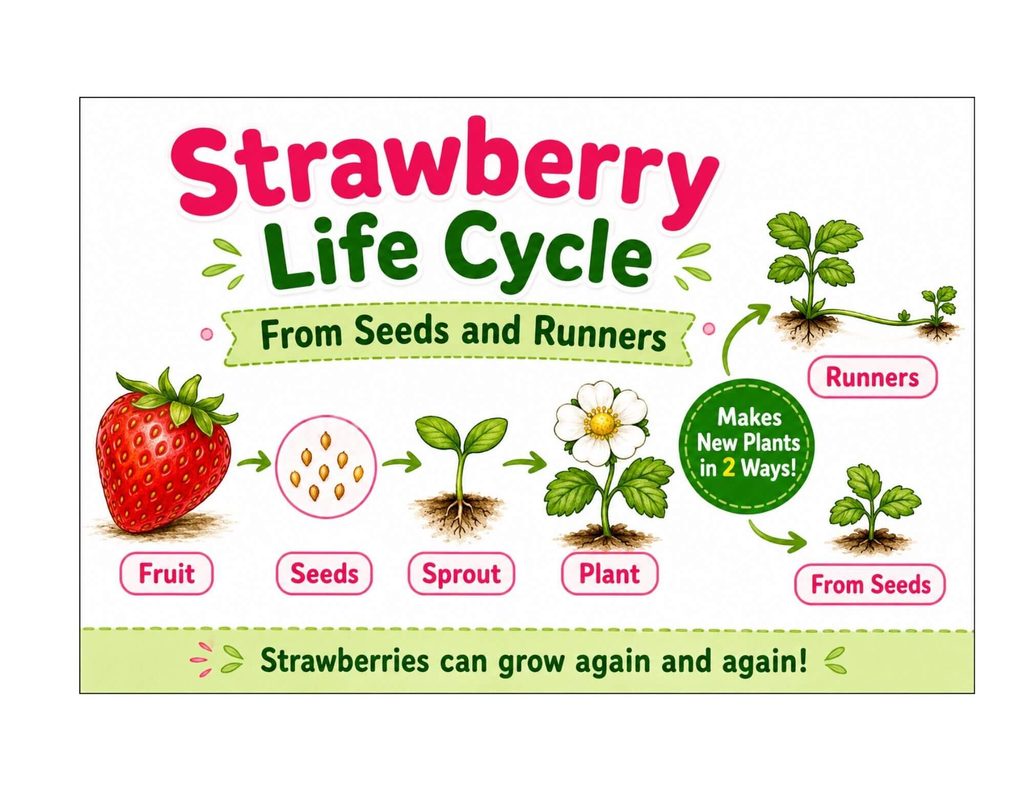
That makes the strawberry plant life cycle a useful topic for teaching not only plant growth, but also two different ways plants can reproduce.
In the classroom, students can compare these two pathways side by side:
From Seeds:
Flower → Strawberry/Fruit → Seeds → Germination/Sprout → Young Plant → Mature Plant
From Runners:
Mother Plant → Runner (Stolon) → Rooting Node → New Plant/Daughter Plant → Independent Plant
The resource used in this lesson introduces both pathways visually so young learners can compare how each one produces a new strawberry plant
How Does a Strawberry Plant Grow From a Seed?
The seed-based strawberry life cycle begins with a seed.
When conditions are right, the seed begins to germinate. A small sprout appears, followed by a young plant with leaves.
As the plant grows, it becomes a mature strawberry plant. The mature plant produces flowers. A flower can then develop into a strawberry.
The strawberry contains the structures that hold seeds, allowing the cycle to begin again. The learning sequence in the resource presents the progression as:
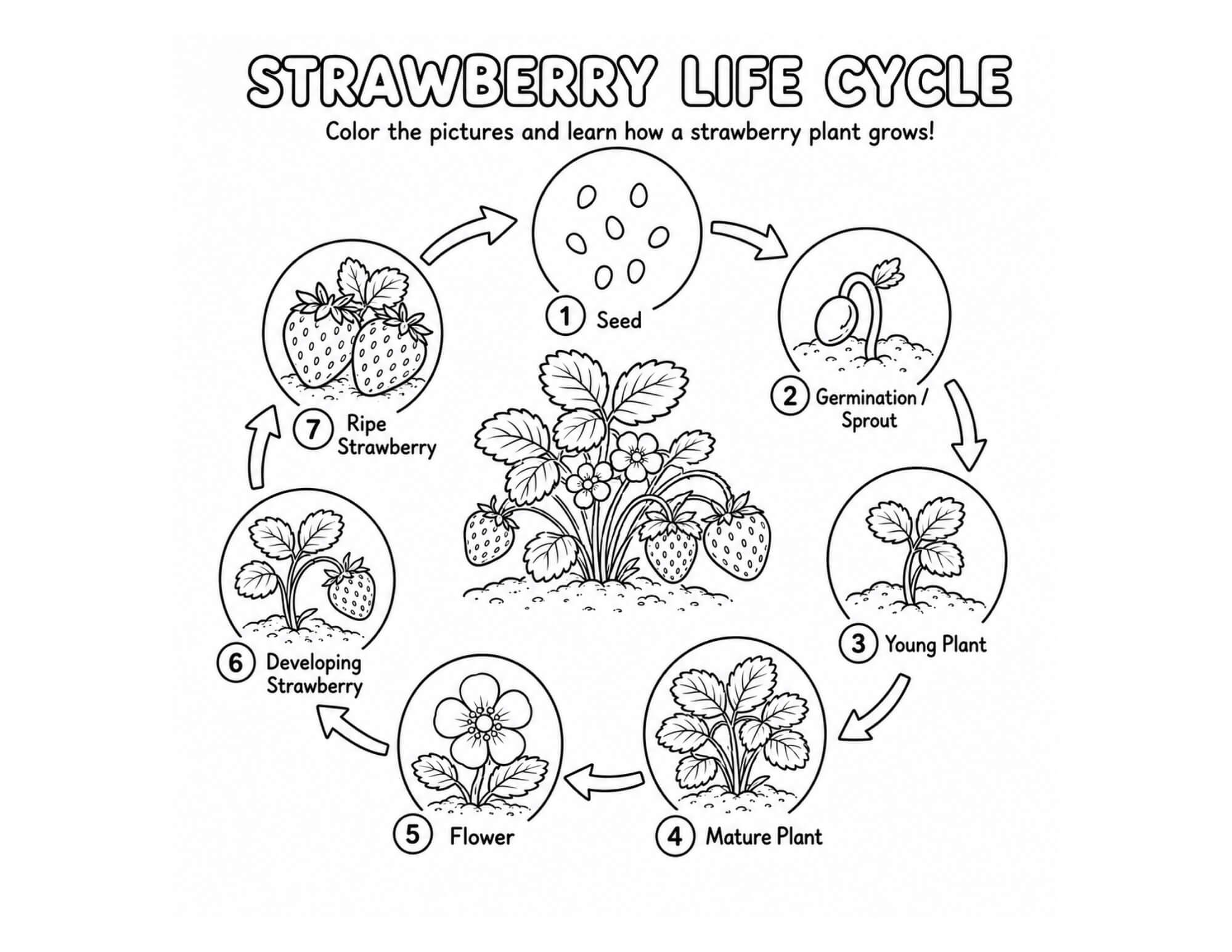
Seed → Germination/Sprout → Young Plant → Mature Plant → Flower → Strawberry/Fruit → Seeds.
For elementary students, it can help to break this into simple observations.

1. Seed
The life cycle can begin with a tiny seed.
Ask students:
What does a seed need before it can begin growing?
This is a natural place to connect the strawberry lesson to earlier learning about plant needs.
2. Germination and Sprouting
During germination, the seed begins to grow.
Students do not need a complicated definition. A simple explanation works well:
Germination is when a seed starts to grow and sprout.
3. Young Plant
The young strawberry plant develops leaves.
At this stage, students can compare the young plant with the mature plant and look for differences in size, number of leaves, and overall structure.
4. Mature Plant
The plant becomes larger and stronger.
A mature strawberry plant can produce flowers.
5. Flower
The flower is especially important because it can develop into a strawberry.
This connection helps children understand that flowers are not simply decorations on a plant. They have an important role in the plant’s reproductive cycle.
6. Strawberry Fruit
The flower develops into the familiar strawberry.
Students may be surprised to learn that the tiny seed-like structures on the outside of a strawberry are called achenes. Each achene contains a seed. This vocabulary distinction is also introduced in the resource
But Strawberry Plants Can Also Make New Plants Without Seeds
This is the part of the lesson that often surprises elementary students.
A strawberry plant does not always need to begin a new plant with a seed.
It can also grow a long horizontal stem called a runner or stolon.
The runner extends away from the original plant. At certain places along the runner, a new plant can begin to form.
Eventually, the new plant develops roots and can become an independent strawberry plant.
The sequence can be taught as:
Mother Plant → Runner (Stolon) → Rooting Node → New Plant (Daughter Plant) → Independent Plant
The resource separates this runner pathway from the seed-based life cycle so students can see the two processes clearly.

What Is a Strawberry Runner?
A runner is a long, thin stem that grows along the ground from the mother plant.
Another word for runner is stolon.
Instead of growing straight upward like many stems, the runner spreads outward.
This makes it possible for the strawberry plant to produce new plants nearby.
A simple student-friendly definition is:
A runner is a long stem that grows along the ground and can help make a new plant.
What Is the Mother Plant?
The mother plant is the original strawberry plant from which the runner grows.
As the runner extends outward, a small new plant begins to form.
This new plant is sometimes called a daughter plant.
These terms give students useful real science vocabulary while still describing something they can easily see in a diagram.
The vocabulary section of the resource introduces mother plant, runner, stolon, new plant/daughter plant, flower, and fruit alongside illustrations.
What Is a Rooting Node?
As the runner grows along the ground, a new plant can begin to develop at a node.
Roots grow downward into the soil.
Once the new plant has developed its own roots and can grow independently, it can become an independent plant.
This gives students a very different plant-growth pathway to compare with germination from a seed.
Two Ways Strawberry Plants Make New Plants
A simple comparison chart can make the difference especially clear.

Both pathways can result in a new strawberry plant.
But the starting point is different.
That is the main concept students should understand.
Why Teach Both Strawberry Reproduction Pathways?

If students see only:
seed → plant → flower → fruit → seed
they may leave with the impression that every new strawberry plant must start from a seed.
Showing runners expands their understanding of how plants can reproduce and spread.
The comparison also gives students practice with several important science skills:
- observing changes in living things,
- identifying stages in a sequence,
- comparing two biological processes,
- using diagrams as evidence,
- learning accurate plant vocabulary,
- explaining how one plant can produce new plants.
The resource reinforces these concepts through separate diagrams and student activities for both the seed and runner pathways
Strawberry Life Cycle Activities for Elementary Students
1. Compare the Two Life Cycles
Begin with two visual sequences.
On one side, show:
Seed → Germination → Young Plant → Mature Plant → Flower → Strawberry
On the other, show:
Mother Plant → Runner → Rooting Node → Daughter Plant → Independent Plant
Ask:
What is the same about these two pathways?
and:
What is different?
The most important observation is that both can result in a new strawberry plant, but they begin differently.
2. Label the Strawberry Life Cycle
Give students pictures of the seed-based stages and a mixed word bank.
Students identify:
- Seed
- Germination/Sprout
- Young Plant
- Mature Plant
- Flower
- Strawberry/Fruit
This is useful after the initial teaching diagram because students must recognize the stages rather than simply repeat their order.
3. Label How Strawberry Plants Spread by Runners
Students can then repeat the same type of activity with the second reproduction pathway.
Important vocabulary includes:
- Mother Plant
- Runner (Stolon)
- Rooting Node
- New Plant/Daughter Plant
- Independent Plant
This makes the comparison between the two processes much more concrete.
4. Cut and Paste the Strawberry Life Cycle
Sequencing activities work particularly well for younger students.
Students cut out the stages and arrange them in order:
Seed → Germination/Sprout → Young Plant → Mature Plant → Flower → Strawberry/Fruit.
For an additional challenge, ask students to explain one transition orally:
How does a seed become a young plant?
or:
What happens after the plant makes a flower?
5. Match Each Stage to Its Meaning
Once students recognize the pictures, move from visual identification to simple definitions.
For example:
Seed → Tiny seeds from a strawberry.
Germination/Sprout → The seed starts to grow and sprout.
Young Plant → A small plant with leaves grows.
Mature Plant → The plant grows bigger and stronger.
Flower → The part of the plant that can develop into a fruit.
Strawberry/Fruit → The fruit contains seeds.
The resource includes this type of matching activity as another way to check understanding
6. Draw Both Reproduction Pathways
Drawing is a useful way to determine whether students actually understand the sequence.
Students can draw the seed-based life cycle:
Seed → Sprout → Young Plant → Mature Plant → Flower → Strawberry
Then they can draw the runner pathway:
Mother Plant → Runner → Rooting Node → Daughter Plant → Independent Plant
This requires more thinking than simply labeling a finished diagram because students must create their own representation of each stage.
A Simple Classroom Discussion
After students have explored both pathways, ask:
How can a strawberry plant make a new plant?
A strong elementary answer might be:
A strawberry plant can make a new plant from a seed or from a runner.
Follow with:
How are the two ways different?
Students may explain:
A seed sprouts and grows into a plant. A runner grows from a mother plant and makes a new plant.
That simple comparison captures the central science idea of the lesson.
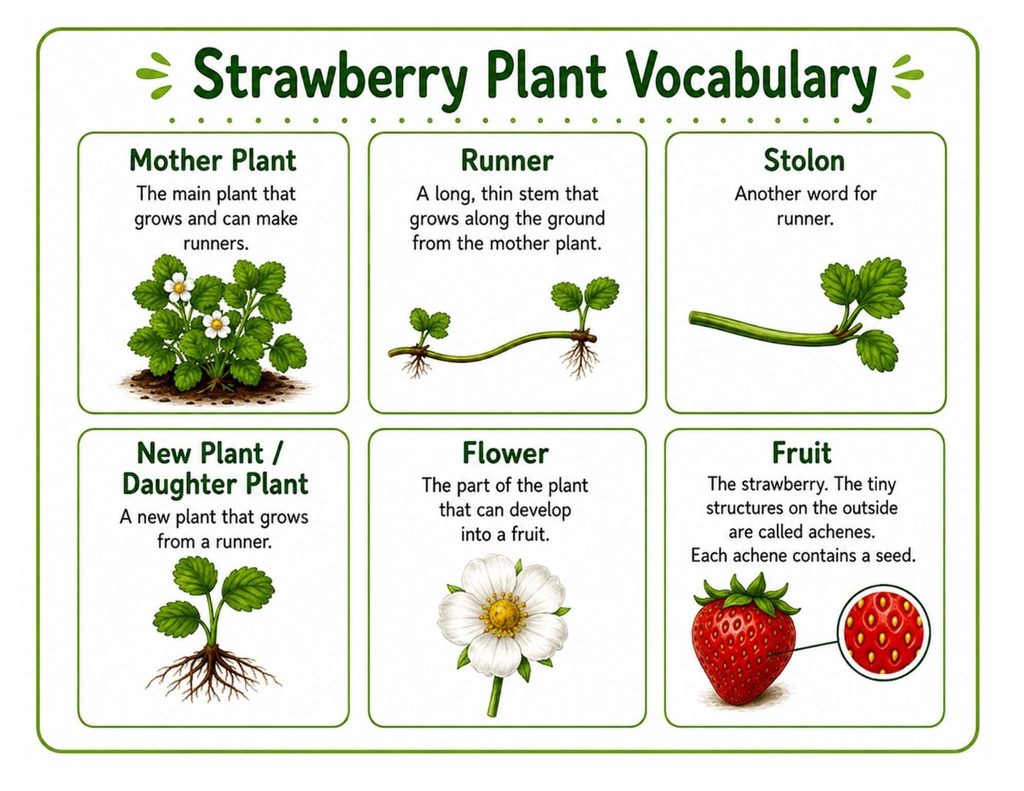
Strawberry Plant Vocabulary
A short vocabulary review can include:
Seed – a structure that can grow into a new plant.
Germination – when a seed begins to grow.
Mother Plant – the original plant that grows a runner.
Runner – a long stem that grows along the ground.
Stolon – another word for runner.
Rooting Node – a place along the runner where roots and a new plant can develop.
Daughter Plant – a new plant that grows from a runner.
Flower – the part of the plant that can develop into fruit.
Fruit – the strawberry that develops from the flower.
Achene – one of the tiny seed-like structures on the outside of a strawberry; each achene contains a seed.
Quick Check for Understanding
1. What are two ways a strawberry plant can make a new plant?
From seeds and from runners.
2. What is another word for a strawberry runner?
Stolon.
3. What grows from a strawberry flower?
A strawberry.
4. What can form along a runner?
A new or daughter plant.
5. What happens when a seed begins to grow?
It germinates and sprouts.
Teaching the Strawberry Life Cycle as More Than a Simple Sequence
The strawberry life cycle is a useful elementary science topic because it shows students that plant reproduction is not always a single straight pathway.
A strawberry plant can grow from a seed, following the familiar sequence from germination to flowering and fruit production.
But an established strawberry plant can also spread vegetatively through runners, producing new daughter plants that develop their own roots and eventually become independent plants.
Teaching these two pathways together gives students a more complete picture of how strawberry plants grow, reproduce, and spread.
And for young scientists, that makes the strawberry much more than a familiar fruit—it becomes a clear, visual example of how plants can make new plants in different ways.
Ready to explore both ways strawberry plants make new plants? Use the complete Strawberry Life Cycle: From Seeds and Runners resource for diagrams, vocabulary, sequencing activities, drawing pages, a coloring page, mini quiz, and answer key
Free Coloring Page
Frequently Asked Questions About the Strawberry Life Cycle
A simple strawberry life cycle can be taught as:
Seed → Germination/Sprout → Young Plant → Mature Plant → Flower → Strawberry/Fruit → Seeds
This helps children see how a strawberry plant can grow from a seed and eventually produce fruit and new seeds.
Yes. Strawberry plants can make new plants from seeds and from runners. Runners allow the plant to produce new plants without starting from a seed.
A runner is a long, thin stem that grows outward from the mother plant along the ground. A new strawberry plant can develop along the runner.
Another name for a runner is a stolon. Both terms describe the horizontal stem that helps a strawberry plant spread.
A daughter plant is a new plant that develops from a runner connected to the mother plant. As it grows roots of its own, it can eventually become an independent plant.
A rooting node is a place along the runner where roots can begin to grow into the soil. A new daughter plant can develop at this point.
A seed must germinate and grow into a young plant. A runner grows from an already established mother plant and can form a new plant along its stem.
Yes. A strawberry flower can develop into a strawberry fruit. This helps students connect the flower stage with the fruit stage in the plant life cycle.
The tiny seed-like structures on the outside of a strawberry are called achenes. Each achene contains a seed.
Use clear diagrams, sequencing activities, vocabulary cards, cut-and-paste tasks, and drawing activities. It is especially helpful to show the seed pathway and the runner pathway side by side so students can compare the two ways strawberry plants make new plants.
References for Teachers
- Penn State Extension – Growing Strawberries
Growing Strawberries – Penn State Extension - Oregon State University Extension – Growing Strawberries in Your Home Garden
Growing Strawberries in Your Home Garden – Oregon State University Extension - Oregon State University Extension – Vegetative Plant Parts
Vegetative Plant Parts – Oregon State University Extension - University of Minnesota Extension – Strawberry Production Systems
Choosing a Strawberry Production System – University of Minnesota Extension - NC State Extension – Plant Propagation by Layering
Plant Propagation by Layering – NC State Extension
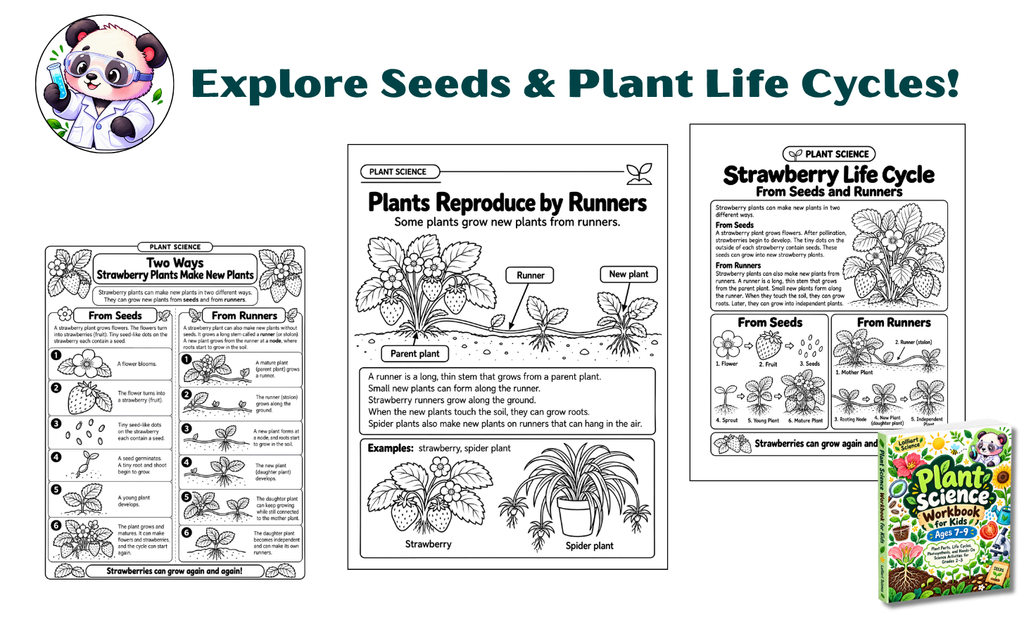
Discover the fascinating ways plants grow and reproduce! This 120-page Plant Science Workbook helps children ages 7–9 explore familiar seeds, learn how potatoes grow from tubers, and follow the lettuce life cycle from seed to mature plant. Engaging illustrations, sequencing exercises, and interactive worksheets make plant science fun and easy to understand.