
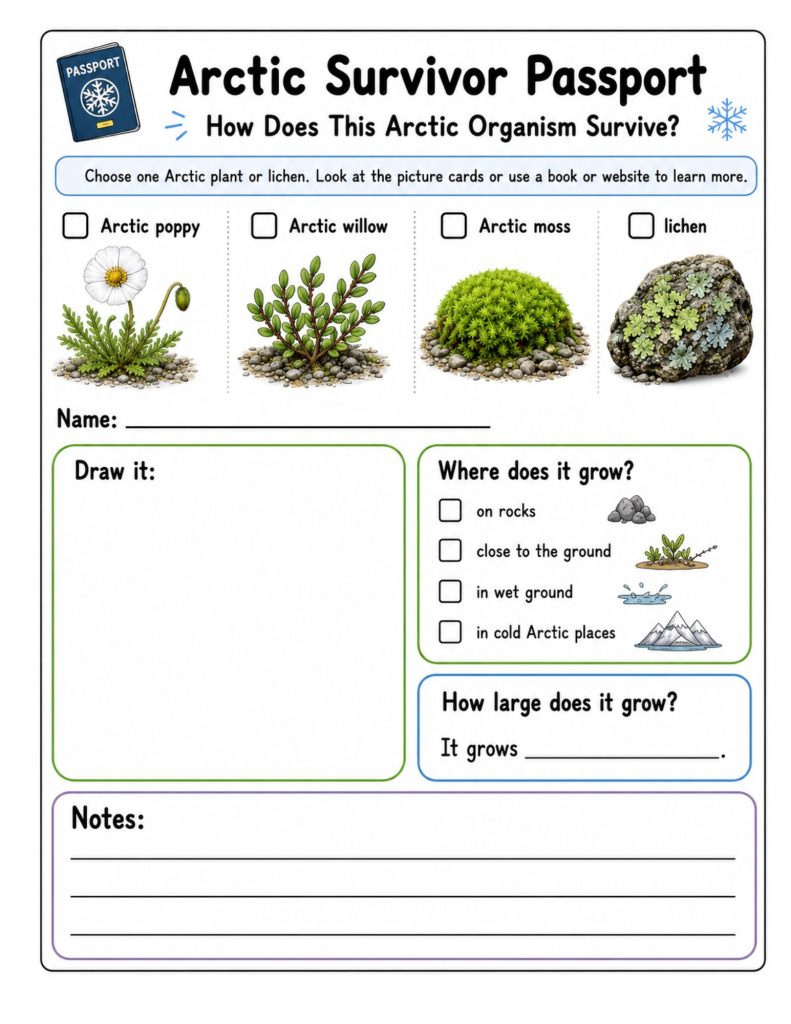
How can a delicate flower or a tiny patch of moss survive in the icy Arctic, where freezing winds howl for most of the year? For 2nd and 3rd graders, concepts like adaptation and extreme environments can feel a bit abstract. However, with the “Arctic Survivor Passport” activity sheet, your students can step directly into the shoes of young polar researchers!
This worksheet seamlessly blends visual observation, categorization, and simple research into an engaging, hands-on learning experience.
🎨 What’s Inside the “Survivor Passport”?
The activity highlights four resilient Arctic organisms:
- Arctic Poppy – The sun-tracking flower,
- Arctic Willow – The ground-hugging dwarf tree,
- Arctic Moss – The warm, water-storing carpet,
- Lichen – The tough survivor of bare rocks.
💡 4 Playful Classroom Activity Ideas:
1. 🔍 “Little Botanists’ Expedition” (Station Rotation)
cards, books, or tablet stations featuring the 4 organisms around the room. Handing out their “passports,” students travel from station to station in pairs or individually. They pick an organism, sketch it (Draw it), check off its habitat (Where does it grow?), and note down its height (How large does it grow?).
To extend the lesson, explore how Arctic tundra plant coloring activities can help young learners recognize the special adaptations that allow plants to survive in this extreme environment.
For a broader introduction to the topic, read [Introducing Arctic Plants and Lichen] to help students explore the hardy organisms that survive in the Arctic environment.
22. “I Am a Survivor!” (Role-Play & Sharing)
After completing the passport and jotting down a fun fact in theNotessection (e.g., “Grows low to avoid strong winds” or “Tracks the sun for warmth”), have students introduce their organism to a classmate in the FIRST PERSON:
“I am an Arctic Poppy! My yellow petals act like a tiny satellite dish to capture every bit of sunlight!”
3. 🧩 Matching & Categorizing Game
Reinforce science concepts by exploring habitat adaptations:
- Which one grows on bare rocks? (Lichen)
- Which one thrives in wet ground? (Arctic Moss)
- Which ones grow very close to the ground? (All of them!) Checking the boxes keeps young learners engaged while building fine motor skills and analytical thinking.
4. 🇬🇧 CLIL / ESL Integration
Because the worksheet uses clear, simple English, it’s an excellent resource for ESL/EFL classrooms or bilingual programs. Students naturally pick up vocabulary (rocks, cold, wet ground, close to the ground, plant) while learning fundamental science concepts.
🌟 Why Students Love It:
- Personalized Learning: The drawing section (Draw it) allows for creative expression and ownership over their work.
- Low-Frustration Design: It doesn’t require heavy writing, making it accessible for emerging readers and writers.
- Immersive Theme: The “Passport” concept gives children the exciting feeling of embarking on a real scientific expedition!
Give it a try in your classroom and turn your next science lesson into an unforgettable Arctic adventure! ❄️🌱

Frequently Asked Questions About Arctic Plant Activities
The activity is designed primarily for students in 2nd and 3rd grade. It can also be adapted for advanced 1st graders or used as a review activity in 4th grade.
Students learn how Arctic organisms survive cold temperatures, strong winds, rocky ground, and short growing seasons. They also practice observation, categorization, research, drawing, and simple science communication.
The Arctic Survivor Passport features the Arctic poppy, Arctic willow, Arctic moss, and lichen. Each organism provides a different example of how living things can survive in a cold polar environment.
Lichen is not technically a plant. It is a partnership between a fungus and an alga or cyanobacterium. However, it is often studied alongside Arctic plants because it grows in similar habitats and plays an important role in polar ecosystems.
The activity usually takes 30–45 minutes. A station-rotation version may take longer, especially if students use books or digital resources to research each organism.
Students need a copy of the Arctic Survivor Passport, pencils, and crayons or colored pencils. Teachers may also provide Arctic plant picture cards, nonfiction books, or tablets for research.
Introduce key vocabulary with pictures and provide simple sentence frames such as “It grows on…,” “It stays warm by…,” or “It survives because….” Students can also share their discoveries orally before completing the written sections.
The activity can support NGSS 2-LS4-1 as students observe and compare living things found in a particular habitat. It can also contribute to 3-LS4-3 when students use evidence to explain why certain organisms are able to survive successfully in the Arctic environment.
Students can complete their passports, introduce an Arctic organism through role-play, or answer an exit-ticket question such as: “What is one feature that helps an Arctic organism survive?” Their responses can be used as a quick formative assessment.
Further Reading and Professional References
Explore these reliable resources to learn more about Arctic plants, tundra adaptations, and classroom standards:
- Plants of the Arctic and Antarctic – The Ohio State University
An educator-friendly introduction to polar plant life and the environmental challenges plants face in cold regions. - Tundra Ecology – Alaska Department of Fish and Game
An overview of tundra ecosystems and the adaptations that help plants survive cold temperatures, strong winds, and limited nutrients. - Arctic Willow – Bering Land Bridge National Preserve
Information from the National Park Service about the Arctic willow’s low-growing structure, shallow roots, and other tundra adaptations. - Arctic Moss – NASA Science for Kids
A short, student-friendly resource explaining how Arctic moss survives freezing temperatures and strong winds. - About Lichens – USDA Forest Service
A clear scientific explanation of lichens and the partnership between a fungus and an alga or cyanobacterium. - 2-LS4-1: Biological Evolution—Unity and Diversity
The official NGSS performance expectation for observing and comparing the diversity of living things in different habitats. - 3-LS4-3: Biological Evolution—Unity and Diversity
The official NGSS performance expectation addressing how well different organisms can survive in a particular habitat.