How can I teach rainforests to 2nd and 3rd grade students?
Begin with a specific rainforest, such as the Borneo Rainforest, rather than introducing every tropical rainforest at once. Maps, animal photographs, rainforest-layer diagrams, food-chain models, and cut-and-paste activities help young learners understand abstract ecosystem concepts through concrete visual examples.
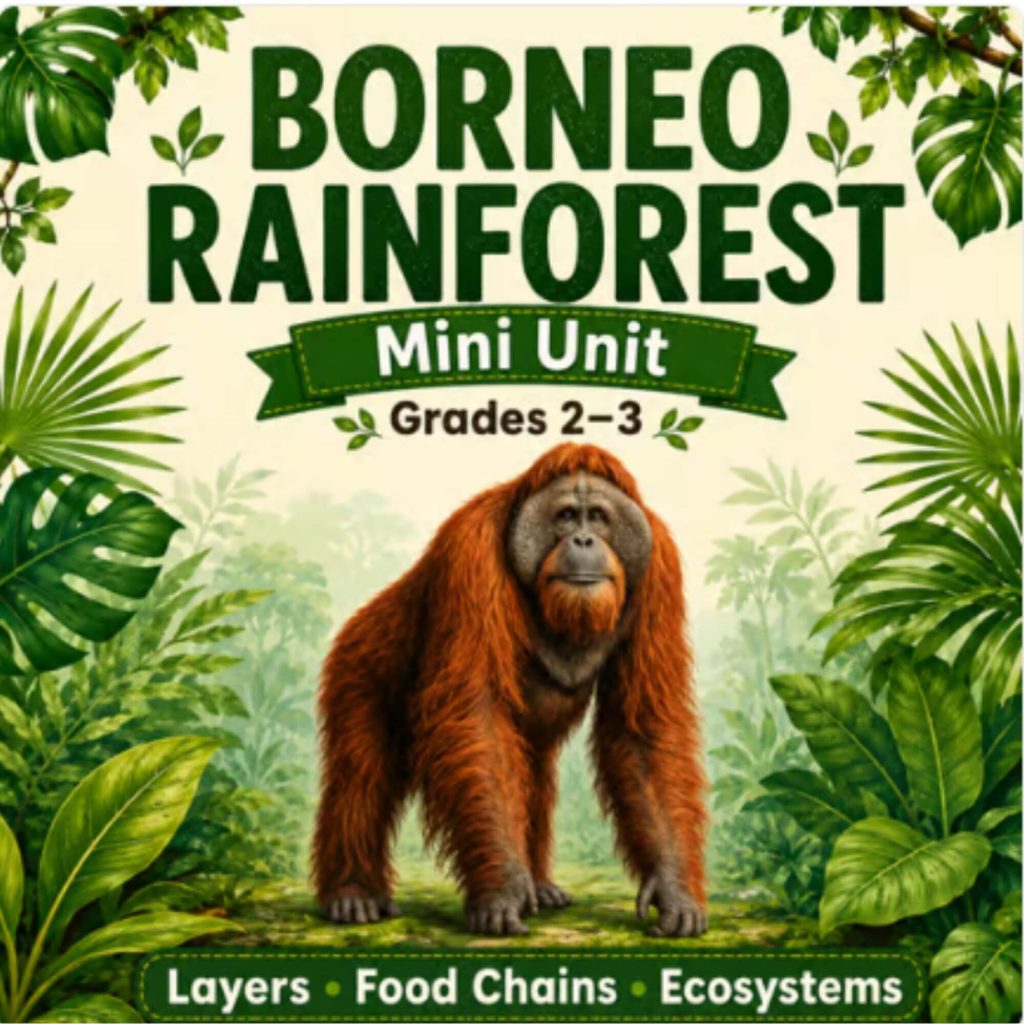
Teaching ecosystems to young learners can sometimes feel overwhelming. How do you take massive global concepts—like climate, biodiversity, food chains, and conservation—and make them accessible and engaging for 7- to 9-year-olds?
The secret is focus and hands-on interaction.
Instead of trying to cover all the world’s rainforests at once, zooming in on one specific, highly biodiverse ecosystem—like the Borneo Rainforest in Southeast Asia—gives students a clear, concrete context. Pair that with interactive cut-and-paste activities, visual sorting, and creative writing, and your science block practically runs itself!
Below is a complete, step-by-step guide on how to teach an engaging 5-day Borneo Rainforest unit using our no-prep Borneo Rainforest Mini Unit printable packet
🌴 Why Focus on Borneo?
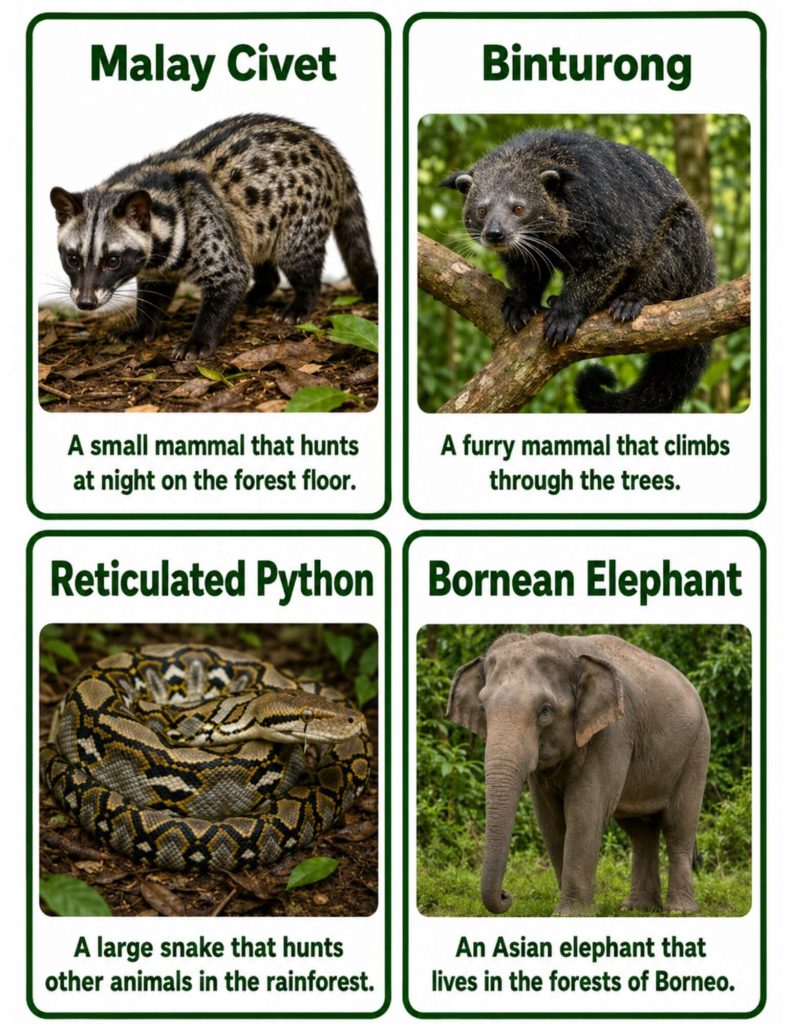
Borneo is home to one of the oldest rainforests on the planet. The island supports remarkable wildlife, including species found only on Borneo—such as the Bornean Orangutan and Proboscis Monkey—as well as wider-ranging Southeast Asian species such as the Sun Bear and Reticulated Python. The WWF Heart of Borneo program provides additional information about the island’s biodiversity and conservation.
Using Borneo as your anchor allows you to seamlessly integrate multiple science concepts for 2nd and 3rd grade.
Using Borneo as your anchor allows you to seamlessly integrate multiple Next Generation Science Standards (NGSS) for 2nd and 3rd grade:
- Geographical context & Climate: Equatorial positioning and sun ray intensity.
- Habitats & Ecosystems: The vertical layers of a tropical rainforest.
- Energy Flow: Producers, consumers, and simple food chains.
- Conservation: Understanding threatened species and human impact
📅 The 5-Day Lesson Plan Breakdown
Here is how you can sequence the worksheets and activities across a 5-day science week:
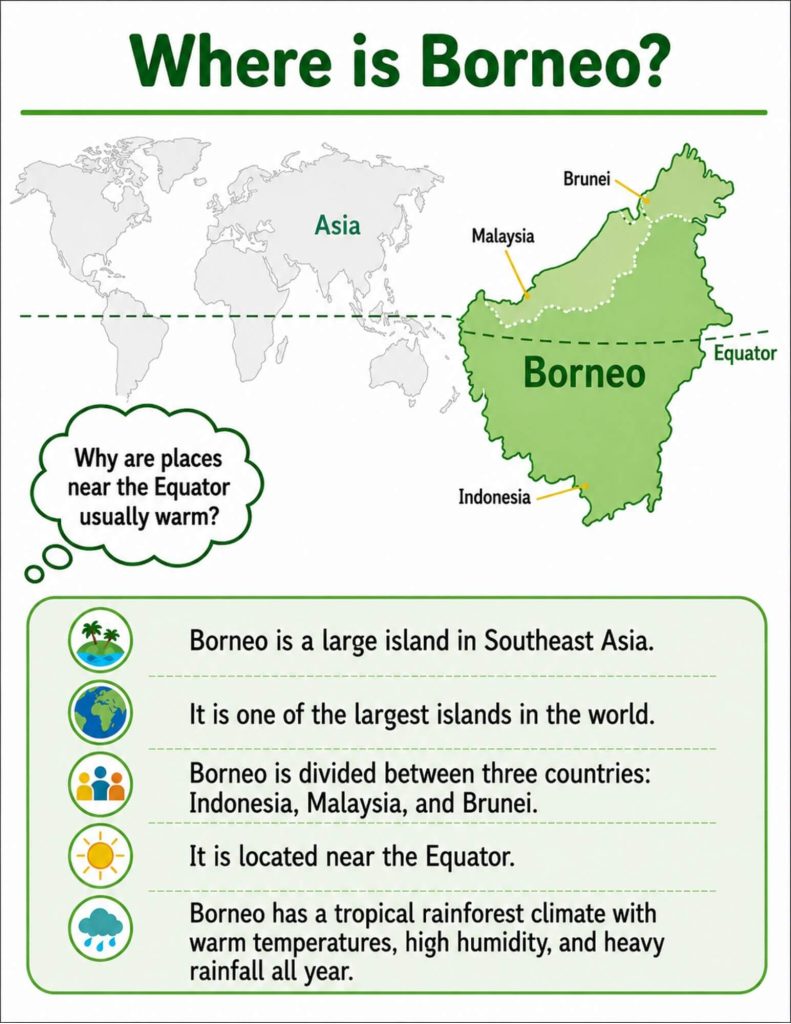
Day 1: Geography & Climate – Where in the World is Borneo?
Start your lesson with a globe or world map. Ask students: “Why are some places on Earth hot and rainy all year long?”
Core Activity: Use the “Where Is Borneo?” and “Borneo Rainforest Climate” reading and visual sheets. Key Concepts Covered:
- Borneo is a large island in Southeast Asia shared by three countries: Indonesia, Malaysia, and Brunei.
- Places near the Equator receive more concentrated solar energy throughout the year. This helps keep equatorial regions consistently warm and contributes to the patterns of evaporation, rising air, and rainfall that create a humid tropical climate. NASA explains how the Sun heats equatorial regions more strongly than polar regions.
Teacher Tip: Have students use yellow colored pencils to trace the Equator and draw direct sun rays reaching the center of the globe. This simple visual model helps students compare the more direct sunlight near the Equator with the less direct sunlight received at higher latitudes.
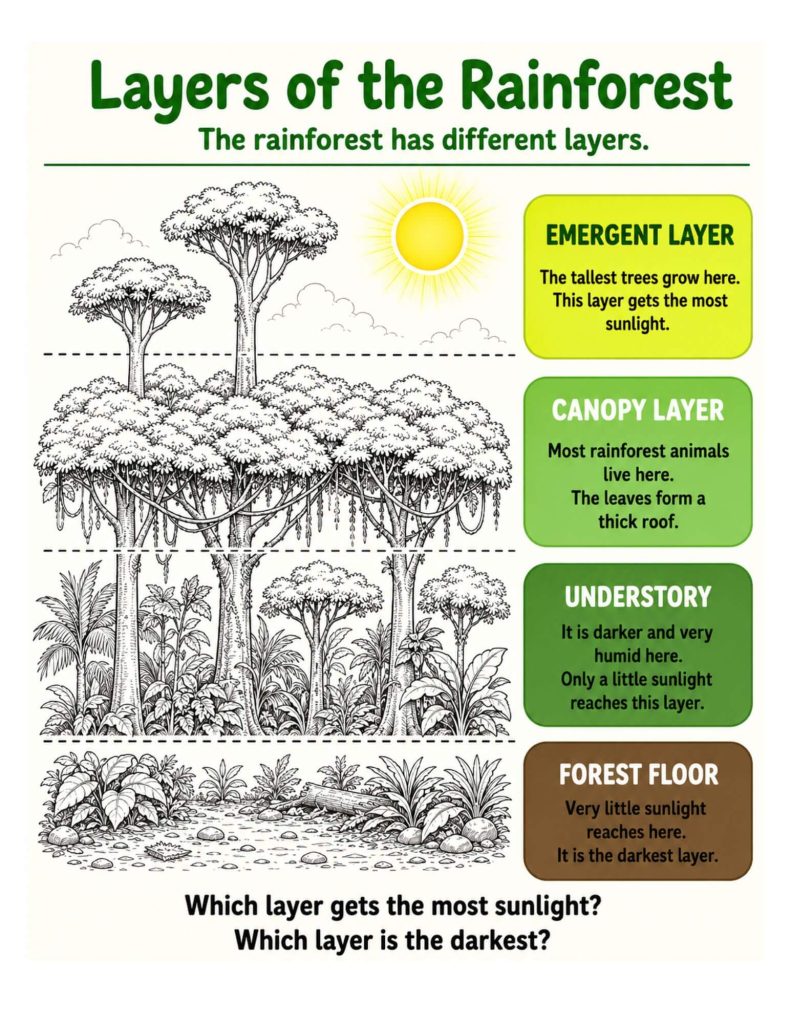
Day 2: Rainforest Layers – Exploring the Vertical Jungle
Rainforests aren’t just flat woods; they are multi-story biological apartment buildings!
- Core Activity: “Layers of the Rainforest” informative guide & “Cut and Paste: Rainforest Layers” diagram.
- The 4 Layers to Highlight:
- Emergent Layer: The tallest trees soaking up full sunlight.
- Canopy Layer: The dense leafy roof where most animals live.
- Understory Layer: Dark, humid, with filtered light.
- Forest Floor: Darkest layer covered in leaf litter and root systems.
- Hands-On Task: Students cut out the layer labels, glue them onto the correct section of the forest drawing, and finish by coloring the page.
Day 3: Wildlife & Adaptation – Who Lives Where?
Now comes every kid’s favorite part: the animals!
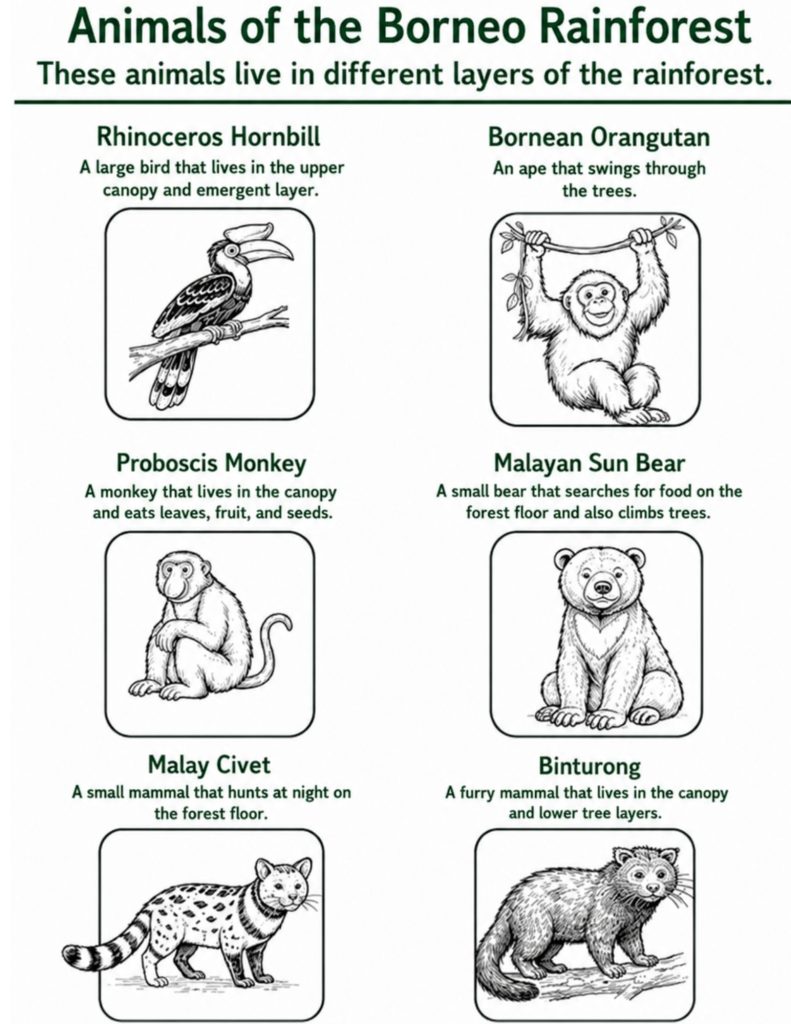
- Core Activity: “Animals of the Borneo Rainforest” reference sheet + “Match the Animals to the Rainforest Layers” cut-and-paste activity.
- Animals Included: Rhinoceros Hornbill, Bornean Orangutan, Proboscis Monkey, Binturong, Malayan Sun Bear, and Malay Civet.
- Discussion Prompt: “Why doesn’t a Malay Civet live in the Emergent Layer?” or “How is a Proboscis Monkey adapted for living high up in tree canopies?”
- Activity: Students match animal cut-outs to their primary layer. (Remind them that some flexible creatures like the Sun Bear or Binturong move between layers!)
Day 4: Energy & Food Chains – Who Eats Whom?
Introduce the flow of energy through an ecosystem.
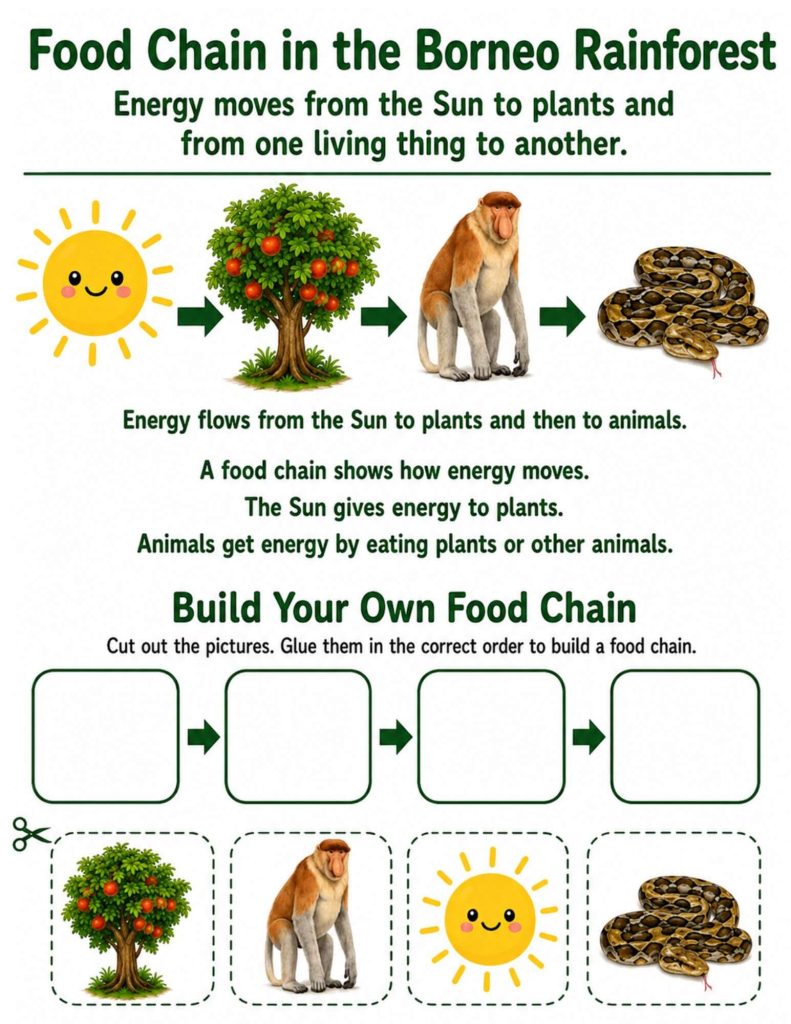
- Core Activity: “Food Chain in the Borneo Rainforest” & “Build Your Own Food Chain” cut & paste.
- Key Vocabulary: Sun (Energy Source) $\rightarrow$ Producer (Durian Tree/Plants) $\rightarrow$ Primary Consumer (Proboscis Monkey / Orangutan) $\rightarrow$ Secondary Consumer / Apex Predator (Reticulated Python).
- Matching Exercise: Use the “Match the Animals to Their Food” worksheet to connect animals with their diet (e.g., Orangutan $\rightarrow$ Durian, Sun Bear $\rightarrow$ Termites).
Day 5: Conservation, Synthesis & Assessment
Wrap up the week by tying science knowledge to real-world conservation and creative expression.
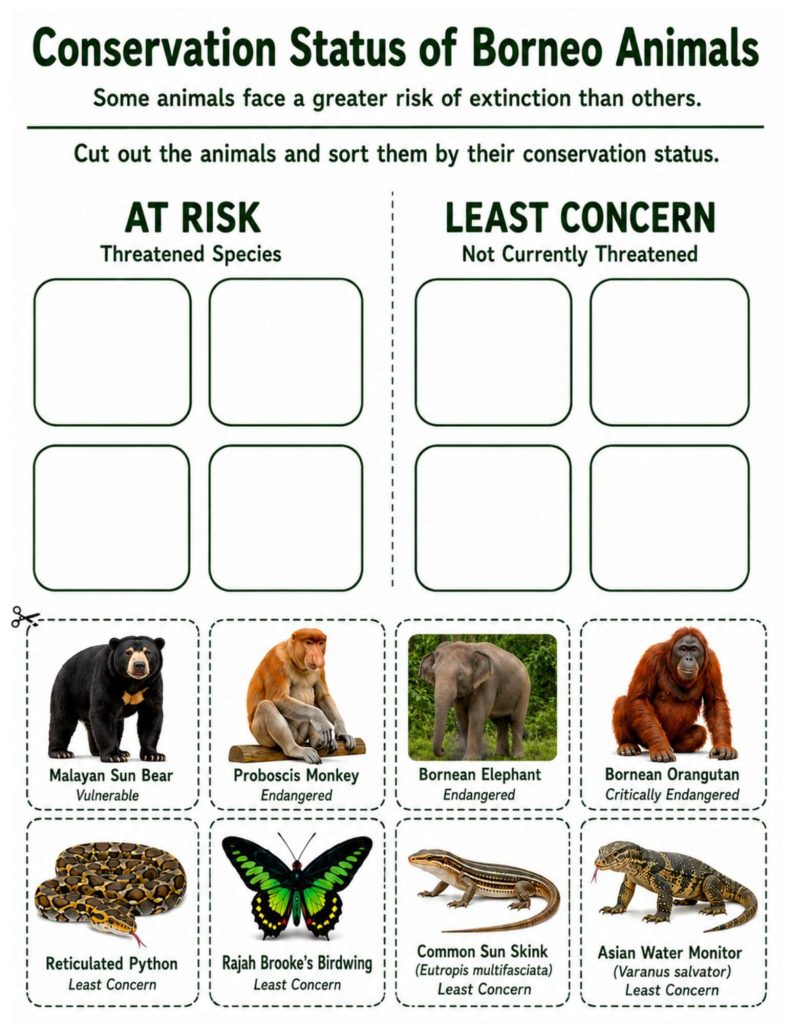
- Conservation Sorting: Use the “Conservation Status of Borneo Animals” worksheet. Students sort animals into At Risk (Critically Endangered Orangutans, Endangered Elephants) vs. Least Concern (Sun Skink, Pythons). Discuss how deforestation impacts animal homes.
- Creative Writing & Persona: Hand out “If I Lived in the Borneo Rainforest…” prompts. Students draw themselves in the jungle and complete fill-in-the-blank sentences using the word bank.
- Quick Assessment: End with the Borneo Rainforest Exit Ticket to evaluate comprehension of location, layers, and basic food chains in under 5 minutes!
Top 3 Classroom Tips for Teachers
- Build a Vocabulary Wall: Use the vocabulary flashcards included in the packet (Equator, Climate, Canopy, Habitat, Emergent Layer) to create a dedicated science display board.
- Color-Coded Layers: Encourage students to use gradient greens—bright yellowish-green for the Emergent layer (lots of sun!) down to deep, dark forest green for the Forest Floor.
- Early Finisher Options: Keep the detailed animal flashcards and coloring pages in an “Early Finisher Bin” for students who finish their cut-and-paste tasks ahead of time
Hands-On Extension: Make a Rafflesia Flower
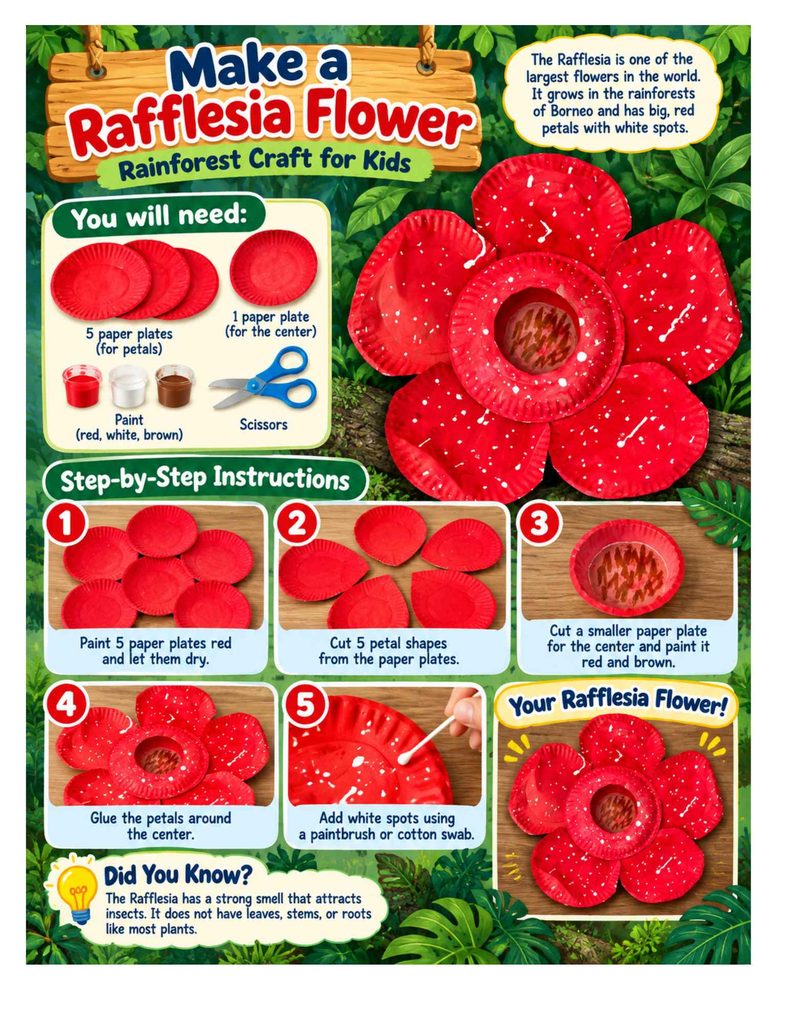
Add a creative hands-on activity to your Borneo Unit Study with this simple paper plate Rafflesia craft. Students can learn about one of Borneo’s most unusual rainforest plants while creating its large red petals, spotted pattern, and distinctive center.
It works well as a follow-up to lessons about Borneo rainforest plants, biodiversity, and unique adaptations.

Extend your Borneo rainforest unit with this collaborative poster activity, where students can explore rainforest animals, plants, and habitat connections while creating one large classroom display together. : https://lolliartscience.com/2026/09/20/borneo-rainforest-collaborative-poster/
Frequently Asked Questions About Teaching the Borneo Rainforest
What should an elementary rainforest unit include?
A well-rounded elementary rainforest unit can cover location and climate, the four rainforest layers, native plants and animals, adaptations, food chains, and conservation. For Grades 2–3, these concepts are most effective when presented through short readings, visual models, sorting activities, coloring, discussion, and simple writing tasks.
What are the four layers of a tropical rainforest?
The four main rainforest layers are the emergent layer, canopy, understory, and forest floor. Each layer receives a different amount of sunlight and provides a distinct habitat. However, students should understand that many rainforest animals move between layers rather than remaining in only one place.
Why is Borneo a good rainforest to study in elementary school?
Borneo provides a clear geographical focus and introduces students to an exceptionally diverse tropical ecosystem. Its distinctive animals—including Bornean orangutans, proboscis monkeys, rhinoceros hornbills, sun bears, and binturongs—make lessons about habitats, adaptations, food chains, and conservation especially engaging.
How long does the Borneo Rainforest mini-unit take?
The unit is designed for five science lessons, with one main topic covered each day. Teachers can complete each lesson in approximately 30–45 minutes or extend the activities over two weeks by adding read-alouds, videos, research, art, and collaborative projects.
What materials are needed for the rainforest activities?
Students need the printable worksheets, scissors, glue, pencils, and colored pencils or crayons. A globe or world map is helpful for the geography lesson, while rainforest books, photographs, and short classroom-safe videos can provide additional visual context.
How can students learn about rainforest food chains?
Use a simple model beginning with the Sun, followed by a producer, an herbivore or omnivore, and a predator. Students can arrange picture cards to show how energy moves through the ecosystem and use arrows to represent the direction of energy flow. Remind them that real rainforest food webs are more complex than a single food chain.
Is this rainforest unit connected to NGSS?
The activities support several NGSS-related elementary concepts, including habitats, plant and animal needs, adaptations, environmental changes, and the movement of matter and energy through food chains. Teachers can connect individual lessons to their grade-level performance expectations, although the packet should be described as NGSS-aligned or NGSS-supporting, rather than officially NGSS-certified.
How can I differentiate this unit for different learners?
Provide picture-supported vocabulary cards, read the informational passages aloud, and allow students to answer orally or through drawings when needed. Advanced learners can research an additional Borneo animal, compare two rainforest layers, or create a more complex food web.
How can I teach rainforest conservation without frightening young students?
Focus on positive, age-appropriate actions. Explain that habitat loss can make it harder for animals to find food and shelter, then discuss how protected forests, responsible choices, scientific research, and conservation organizations can help. End the lesson by asking students to suggest one way people can care for rainforest habitats.
References and Further Reading
- Borneo – The Nature Conservancy
- Heart of Borneo – World Wildlife Fund
- Climate and Earth’s Energy Budget – NASA Science
- Rainforest Structure and Layers – National Geographic Education
- Orangutan Facts and Conservation – Smithsonian’s National Zoo
- Getting to Know the Sun Bear – Bornean Sun Bear Conservation Centre
- Bornean Elephant Listed as Endangered – IUCN Red List
- 2-LS4-1: Biodiversity in Different Habitats – NGSS
- 3-ESS2-2: Climates in Different Regions – NGSS
- 3-LS4-3: Organisms and Their Habitats – NGSS
- 3-LS4-4: Environmental Change and Organisms – NGSS
Looking for another hands-on way to explore habitats? Try this https://lolliartscience.com/2026/08/07/aquarium-habitat-activity-k-3/ interactive aquarium habitat activity for K–Grade 3.