This tundra insulation STEM experiment helps students in Grades 2–3 investigate how insulating materials can protect living things from the cold Arctic environment.
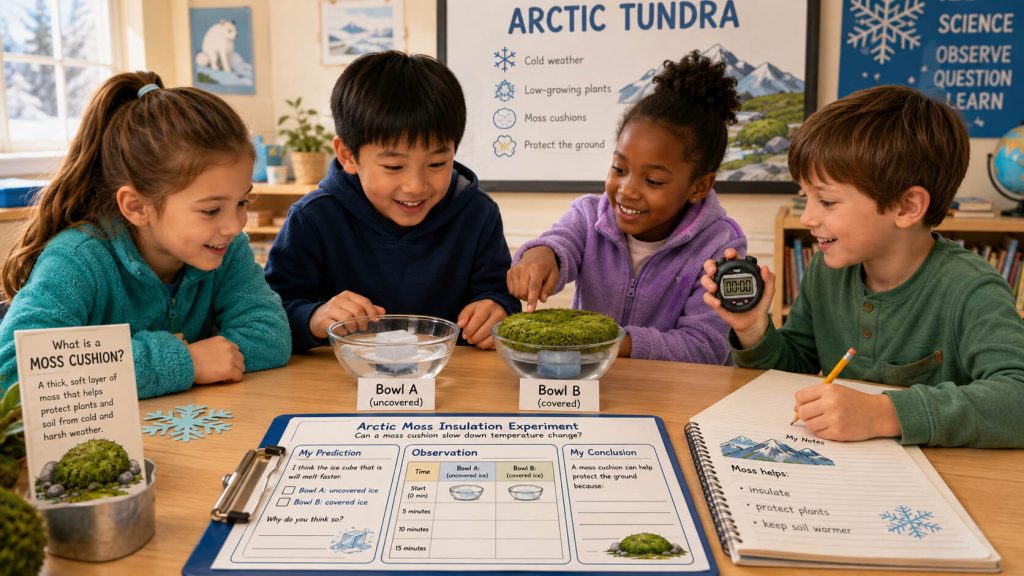
How do we teach complex scientific concepts like adaptation and thermal insulation to second and third graders without losing their attention? The answer is simple: bring the chill of the Arctic right into your classroom!
This hands-on STEM activity requires minimal prep, uses everyday items, and provides a powerful visual anchor for young learners. Best of all, it maps beautifully to the Next Generation Science Standards (NGSS).
🍏 Why This Lesson Works: Standards Alignment
This inquiry-based lab packs a punch by checking off several critical foundational standards at once:
- 2-LS4-1 Biological Evolution (Unity and Diversity): Make observations of plants and animals to compare the diversity of life in different habitats.
- 3-ESS2-2 Earth’s Systems: Obtain and combine information to describe climates in different regions of the world.
- 3-5-ETS1-1 Engineering Design: Define a simple design problem reflecting a need or a want that includes specified criteria for success.

🛠️ Supply List: Budget-Friendly Classroom Materials
No expensive science kits or specialized lab gear required. Here is what you will need per student group (3–4 students):
- 2 identical small bowls or paper trays (labeled Bowl A and Bowl B).
- 2 ice cubes of the exact same size (uniform size is crucial for a fair test!).
- Insulation material: Preserved sheet moss (from a craft store), wool yarn, felt scraps, or the ultimate budget alternative: standard cotton balls/pads.
- 1 timer (a stopwatch or your classroom smartboard timer).
- Paper towels for quick cleanups, pencils, and the printed observation worksheet.
📝 Step-by-Step Lesson Plan
1. Engage – 10 Minutes
Hook your students by displaying photos or a short video clip of the freezing, windswept Arctic tundra. Ask a guiding question: “If you were a tiny plant growing in this freezing, harsh weather, how would you protect your roots from freezing?” Introduce the concept of Arctic moss cushions—thick, low-growing mats that hug the ground. Scientific research shows that the depth of an Arctic moss layer can influence soil temperature, moisture, and other below-ground conditions. In a field study conducted in the High Arctic, Gornall and colleagues examined how different moss depths affected the tundra soil environment.
2. Predict – 5 Minutes
Distribute the worksheets. Before setting up the experiment, have students work independently to fill out the “My Prediction” section.
Which ice cube will melt faster? The uncovered one, or the one covered by our moss cushion model (cotton/felt/moss)? Why do they think so?
3. Investigate – 20 Minutes
- Have students place one ice cube into Bowl A and one into Bowl B.
- Leave Bowl A completely uncovered.
- Have students completely cover the ice cube in Bowl B with their insulation material.
- Start the timer! Students will check under the cover at the 5, 10, and 15-minute marks, recording what they see in the “Observation Table”. (Tip: Younger students can sketch the shrinking ice cube, while older students can write descriptive words like “mostly water” or “barely melted”).
4. Explain & Wrap-Up – 10 Minutes
Once the 15 minutes are up, bring the class together to discuss the “What Happened?” section. Students will clearly see that the covered ice cube melted at a much slower rate.
Solidify the lesson with these key vocabulary terms:
- Insulation: A material or layer that slows the transfer of heat. It does not produce heat or cold. In this experiment, the covering reduced the rate at which heat moved from the warm classroom air toward the cold ice. The U.S. Department of Energy’s explanation of insulation provides additional background on conduction, convection, and radiation.
- Adaptation: A physical feature or behavior that helps a living thing survive in its habitat.Growing close to the ground is one of several characteristics that can help tundra plants reduce exposure to cold, drying winds. Moss and other organic surface layers can also influence the temperature of the soil beneath them.. Many tundra plants grow close to the ground, where wind speeds are lower and temperatures may be slightly warmer. The National Park Service explains how the low growth form of tundra plants reduces exposure and allows snow to provide winter insulation.
Teacher-to-Teacher: Guiding Questions for Deeper Thinking
To maximize student reflection and push past surface-level observation, use these prompts during your class discussion:
- “If our model insulation protected the ice from the warm classroom air, how does real moss protect the ground from the freezing winter air?” (This question helps students understand that insulation slows heat transfer in either direction. Research models indicate that moss cover can significantly affect tundra soil temperature and active-layer depth. However, the classroom investigation is a simplified model of a much more complex tundra system.).
- “What other examples of insulation can we find in nature?” (Prompt them to think about a polar bear’s thick fur, whale blubber, or a bird’s down feathers).
🚀 Differentiation and Extension Ideas
- For Grade 2: Focus heavily on qualitative observations. Keep data entry simple by allowing students to draw the changes or use simple relative terms (“big cube” vs. “tiny cube”).
- For Grade 3: Sneak some math integration into your science block! Have students pour the melted water from each bowl into a graduated cylinder to measure the volume in milliliters, then create a class bar graph.
Frequently Asked Questions About the Tundra Insulation Experiment
This experiment demonstrates that insulation slows the movement of heat. In a warm classroom, the insulating material reduces the amount of heat reaching the covered ice cube, so it usually melts more slowly than the uncovered ice cube.
No. Insulation does not create heat or cold. It slows heat transfer between an object and its surroundings. This is why insulation can help keep something cold in a warm room or reduce heat loss from something warm in a cold environment.
Students can test preserved moss, cotton balls, wool yarn, felt, fabric scraps, shredded paper, feathers, or other safe classroom materials. Comparing several materials creates a stronger engineering investigation because students can determine which material provides the most effective insulation.
Use ice cubes of the same size, identical bowls, equal amounts of insulating material, and the same observation times. Both bowls should remain in the same classroom location so they experience similar temperatures, light, and airflow.
Check whether the ice cubes were the same size, whether both bowls were placed in the same location, and whether the insulating material completely surrounded the covered cube. Small differences in ice size, material thickness, airflow, or handling can affect the results. Unexpected results provide an opportunity to discuss variables and repeat the investigation.
The covered ice cube represents a cold surface protected by an insulating layer. Real tundra vegetation, moss, soil, snow, fur, feathers, and body fat interact with heat in more complex ways, so the classroom setup is a simplified model rather than an exact copy of Arctic conditions.
The strongest connection is 2-PS1-2 when students test different materials and analyze which one is best suited for insulation. The activity can also support 3-5-ETS1-1 when students define an insulation problem with criteria and constraints. Research and discussion about tundra climates and organisms can provide additional connections to 3-ESS2-2 and 2-LS4-1.
The investigation usually takes approximately 45 minutes, including the introduction, prediction, setup, three observation periods, and class discussion. Teachers can extend it by testing additional materials or collecting measurements over a longer period.
Second graders can draw the ice cubes and use words such as “large,” “smaller,” or “mostly melted.” Third graders can measure the melted water, record data in milliliters, compare results, and create a simple bar graph.
Wipe up melted water promptly to prevent slippery surfaces. Use only clean, nonirritating insulation materials, and remind students not to taste the ice or place any experimental materials in their mouths.
Comments