How ocean zones worksheets, deep-sea animal clipart, and a real snailfish discovery can support a Grades 2–3 lesson
Could a fish live miles below the ocean’s surface, where sunlight never reaches?
That question gives children a reason to explore the hadal zone. It also opens a lesson about habitats, animal survival, and how scientists gather evidence in places that are difficult to visit.
For Grades 2–3, start with the five ocean zones, then take a closer look at one real animal: the Mariana snailfish. Combine the ocean zones activities with carefully selected deep-sea illustrations and a short discovery story. Children can build a model, discuss what they notice, and explain what they have learned using evidence.
Begin with the five ocean zones
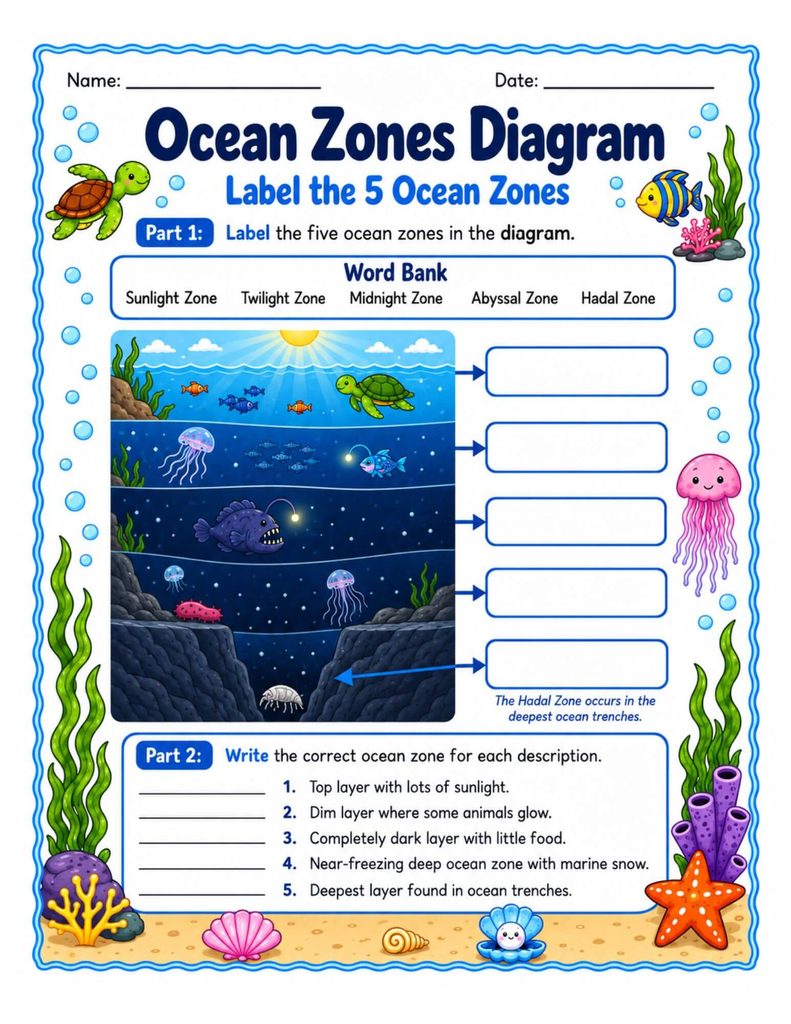
Before focusing on the deepest ocean, help students locate it within the larger ocean system. Introduce the zones in this order: Sunlight, Twilight, Midnight, Abyssal, and Hadal.
Use the reading passage and Ocean Zones Diagram in The 5 Ocean Zones resource to establish this sequence. Read together, point to each zone, and invite children to predict how conditions might change farther below the surface.
Build background knowledge before exploring the hadal zone with The 5 Ocean Zones worksheets, featuring reading, sorting, and drawing activities that help students compare ocean habitats from the surface to the deepest trenches.https://www.teacherspayteachers.com/Product/Ocean-Zones-Worksheets-5-Layers-of-the-Ocean-Activities-Grades-2-3-Science-16591658
The hadal zone begins at about 6,000 meters and extends to nearly 11,000 meters in the deepest ocean areas. It is associated especially with deep trenches. It does not form a continuous bottom layer beneath every part of the ocean. Sunlight does not reach it, the water is cold, and pressure is extreme. Background: Woods Hole Oceanographic Institution.
Ask students to sketch a seafloor with a deep trench. This adds an important feature that a diagram of five equal boxes cannot show. Explain that the worksheet boxes organize information; they do not represent equal depths or the actual shape of the seafloor.
Introduce a real discovery with the Mariana snailfish
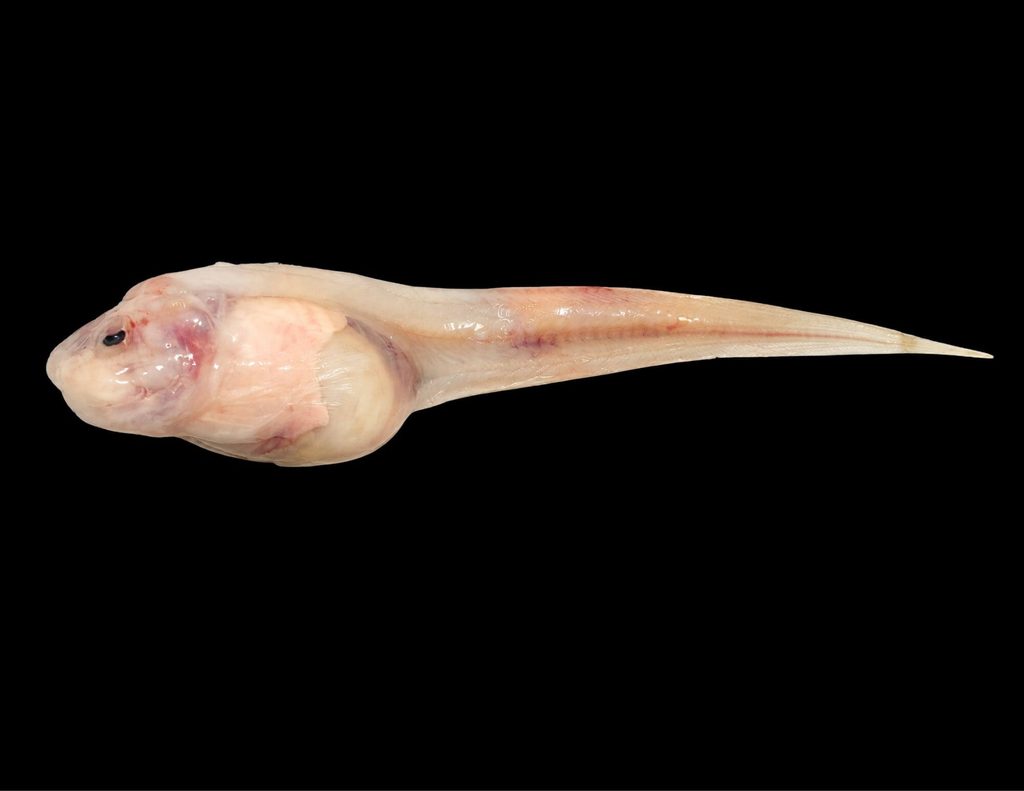
Craig Welch’s 2017 National Geographic article, “New Fish Species Lives 5 Miles Underwater—a Record,” offers an engaging teacher background story. It describes the formal identification of the Mariana snailfish, Pseudoliparis swirei.
The original scientific paper reported specimens collected between 6,898 and 7,966 meters in the Mariana Trench. For children, the central idea is simple: scientists collected and studied a fish living far below the sunlit ocean. Original species description, Gerringer and colleagues, 2017.
Retell the discovery in a few sentences rather than assigning the full adult article as independent reading:
“Scientists found a pale fish living deep in an ocean trench. They studied it carefully and gave the species a scientific name. Their discovery helped people learn more about animals living in the deep ocean.”
Invite children to ask what the scientists needed to find out. Where was the fish living? How did they know its depth? What could a collected specimen reveal that a photograph could not?
Add an update to the 2017 story
Present the National Geographic headline as a record reported at that time. During a 2022 expedition, announced in 2023, researchers filmed a Pseudoliparis snailfish at 8,336 meters in the Izu-Ogasawara Trench. They also collected Pseudoliparis belyaevi at 8,022 meters in the Japan Trench. The filmed fish was not identified to species in that announcement. University of Western Australia expedition report.
Put “filmed” and “collected” on the board. Discuss how both provide evidence, while allowing different kinds of investigation. A new observation can extend what scientists know. It does not make the earlier discovery unimportant.
Explain pressure in language children can use
Students do not need pressure calculations to understand the main relationship: water pressure increases with depth. Water presses on an underwater animal from all directions. NOAA explanation of ocean pressure.
Draw arrows pointing toward a fish from above, below, and both sides. Use this drawing to correct the idea that pressure only pushes downward.
The National Geographic article explains that hadal snailfish have adaptations that help their cells function under these conditions. A useful child-friendly sentence is: “This fish has body features and internal adaptations that help it live under very high pressure.” Its soft appearance alone does not explain how it survives.
Ask children to complete: “A hadal habitat is challenging because ___.” Accept darkness, cold, or high pressure when the explanation matches the information studied.
Connect the deep ocean to food from above
The Ocean Vocabulary Match and Think Like a Scientist pages provide an opening for discussing marine snow.
Explain that marine snow is sinking material that can include tiny pieces of dead organisms, animal waste, and other particles. It is not frozen snow. This falling material supplies food to many deep-sea organisms. NOAA guide to marine snow.
Have students draw small particles moving downward through their ocean model. Then ask, “How can something that happens near the surface affect animals much deeper down?”
For an extension, distinguish animals that eat sinking material from predators that eat other animals. The National Geographic snailfish story describes small crustaceans found in the fish’s stomach. This helps children see that deep-sea animals obtain food in different ways.
Use deep-sea clipart to build observation and evidence skills
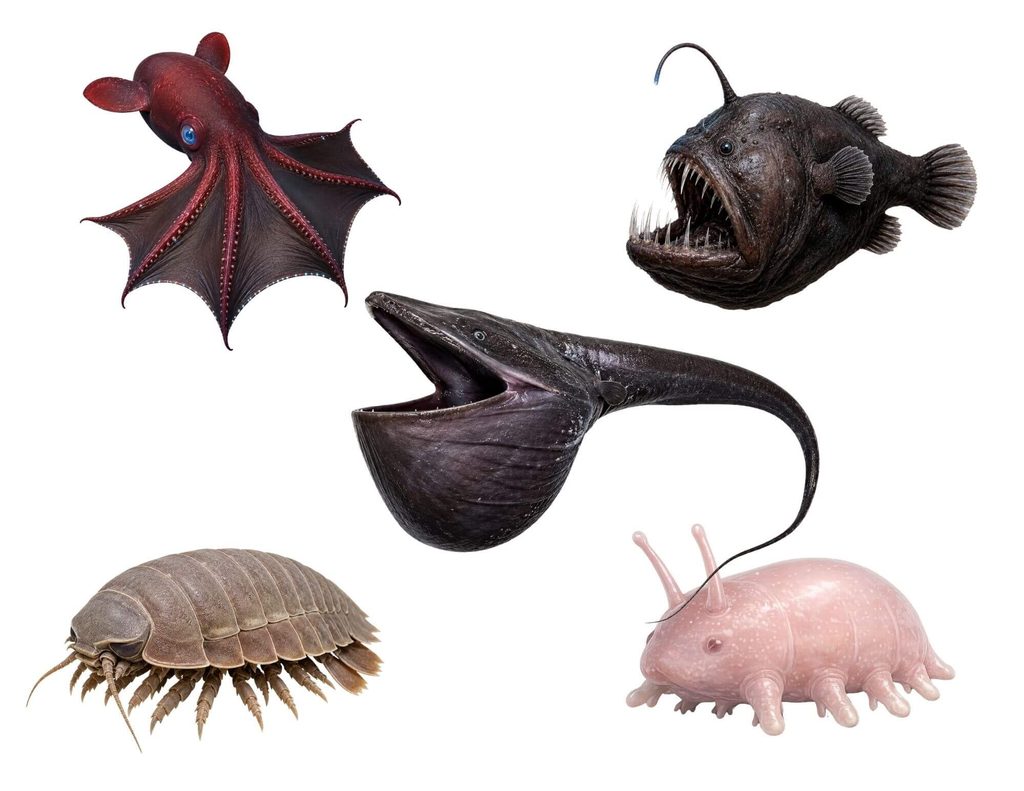
The accompanying deep-sea illustration collection includes an anglerfish, lanternfish, fangtooth, gulper eel, dumbo octopus, giant isopod, sea pig, and other subjects. These images can support vocabulary cards, observation prompts, and a class display about ocean life.
A picture labeled “deep sea,” however, does not establish that the animal lives in the hadal zone. Broad names may also cover multiple species with different depth ranges. Give children teacher-checked habitat information alongside images before asking them to assign zones.
Try a two-column notebook response: “What I can see” and “What I need to research.” With the dumbo octopus illustration, students might notice fins beside the head and ask how deep that particular kind of octopus lives. The illustration starts an investigation; the source information supports the habitat claim.
For a hadal display, use a verified Mariana snailfish image and a clearly identified hadal amphipod example. These are not supplied as separate subjects in the attached deep-sea clipart collection, so add them separately. Keep the broader collection available for comparison rather than placing every animal in the trench.
Bring ocean learning to life with our Deep Sea Animal Clipart, perfect for creating vocabulary cards, observation activities, and classroom displays as students investigate which animals live in different ocean habitats.https://www.teacherspayteachers.com/Product/Deep-Sea-Animals-Clipart-Realistic-Ocean-Life-PNGs-Marine-Biology-Science-16366052
Build a short lesson sequence with the worksheets
The resource can support several short sessions. Select pages to match the learning goal instead of completing the whole packet at once.
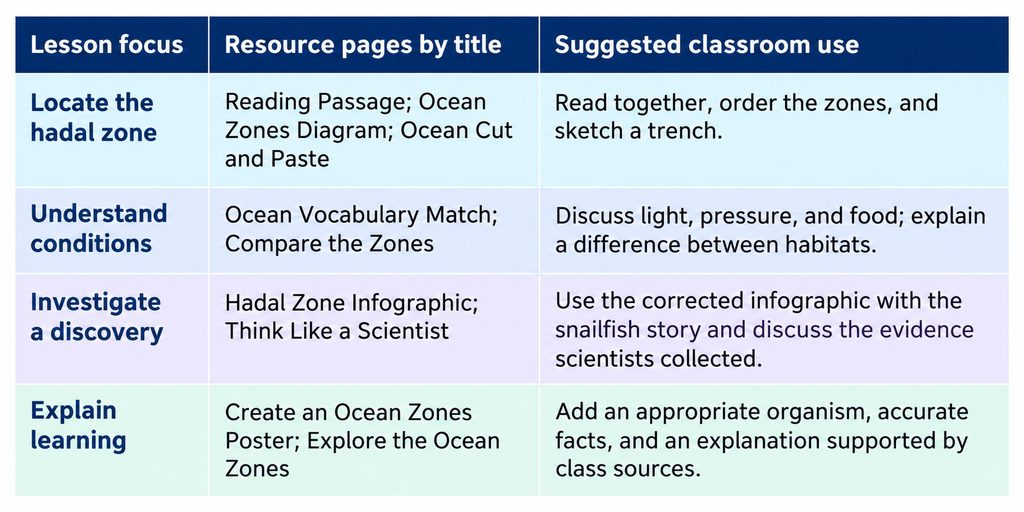
Use the color pages for shared discussion and the black-and-white versions for individual work. The reference cards can provide vocabulary support during partner talk. For sorting activities, make sure the reading or accompanying fact cards contain the information children need to justify each placement.
Finish with a small research display
Invite pairs to create a hadal-zone panel with a trench drawing, one verified animal example, and three short facts. Beside the panel, place selected clipart under the broader heading “Other Ocean Animals to Investigate.”
Offer these sentence starters:
- “The hadal zone is located ___.”
- “One challenge for animals there is ___.”
- “Scientists learned about this animal by ___.”
- “Our source supports this idea because ___.”
For children who need writing support, allow an oral explanation with labeled drawings. For students ready for a challenge, ask them to compare the 2017 discovery with the expedition announced in 2023.
An exit ticket can ask children to explain why an interesting-looking deep-sea animal cannot be placed in the hadal zone from its appearance alone. A successful response connects a habitat claim to information about where the animal has actually been observed.
The 5 Ocean Zones worksheets provide the structure for this exploration. Deep-sea clipart supplies observation and discussion material, while the snailfish discovery adds a real example of science in progress. Together, they give children practice moving from curiosity to a question, and from a question to an explanation supported by evidence.
The hadal zone is the deepest part of the ocean, beginning at about 6,000 meters below the surface and reaching nearly 11,000 meters. It is found mainly in deep ocean trenches, where there is no sunlight and water pressure is extreme.
Certain snailfish, amphipods, sea cucumbers, and other organisms live in hadal habitats. Different species occupy different depths, so an animal found in one part of a trench may not live at its deepest point.
No. “Deep sea” describes a much broader part of the ocean. An anglerfish, giant isopod, or other deep-sea animal should not automatically be placed in the hadal zone. Check the species and its known depth range before using it in a habitat-sorting activity.
Some animals eat sinking organic material or scavenge dead organisms, while others hunt prey. Marine snow carries material from upper waters into the deep ocean, connecting deep-sea food webs to life closer to the surface.
No fish has been confirmed living at the deepest point of the Mariana Trench. Hadal snailfish live in shallower parts of these deep trench environments. Scientists filmed a snailfish at 8,336 meters in the Izu-Ogasawara Trench during a 2022 expedition, reported in 2023. University of Western Australia.
Start by locating it within the five ocean zones. Focus on a few key ideas: depth, darkness, pressure, and animal survival. Use a real discovery story, labeled drawings, and simple questions that encourage children to explain their ideas with evidence.
The 5 Ocean Zones worksheets help students organize information through reading, vocabulary practice, comparisons, sorting, and drawing. Introduce the zones with the diagram, then use the writing and poster activities to check students’ understanding.
Use clipart for vocabulary cards, observation prompts, and classroom displays. Pair each image with checked habitat information when asking students to sort animals by zone. Pictures show appearance, but they cannot establish an animal’s depth range on their own.
References and Further Reading
Woods Hole Oceanographic Institution — Hadal Zone
An introduction to ocean trenches, extreme conditions, and the technology scientists use to explore hadal habitats. NOAA — How Does Pressure Change with Ocean Depth?
A short explanation of why water pressure increases with depth, useful background for classroom discussions. NOAA — What Is Marine Snow?
Learn how sinking material from upper waters provides food for many deep-sea organisms. National Geographic — New Fish Species Lives 5 Miles Underwater—a Record
Craig Welch’s 2017 account of the Mariana snailfish discovery. Read alongside the later expedition report below to put the historical record in context. University of Western Australia — Scientists Break New Record After Finding World’s Deepest Fish
This 2023 report describes a snailfish filmed at 8,336 meters and specimens collected at 8,022 meters, offering a useful example of how new evidence extends scientific knowledge. Gerringer and Colleagues — Original Mariana Snailfish Species Description
The original 2017 scientific paper describing Pseudoliparis swirei. Best suited to teachers seeking the primary source behind the discovery story.