
How can a fox stay cool in a scorching desert?
Why does a cactus look like a water bottle with armor?
A desert habitat is a giant survival puzzle. Water is scarce. Shade is limited. Temperatures may change quickly.
Yet deserts are full of life.
This desert habitat lesson for Grades 2-3 connects climate and survival. Students learn how nonliving conditions shape life in a habitat. They also explore the adaptations that help organisms meet those challenges.
Here is the big idea: The habitat sets the challenge. Adaptations provide the survival tools.
What Makes a Habitat a Desert?
A desert is defined by dryness, not heat.
Many deserts receive less than 10 inches of precipitation yearly. That equals about 250 millimeters. Despite the dryness, deserts can support remarkable biodiversity. The U.S. Geological Survey explains desert ecosystems and their diverse living things.
Weather and Climate Are Different
Weather describes what happens outside today.
Climate describes usual weather patterns over many years.
A rainy desert afternoon does not change the desert climate. One wet day is only weather.
Students can remember the difference with this analogy:
- Weather is one page in a book.
- Climate is the whole story.

Deserts Can Be Hot or Cold
The Sahara is a hot desert. Antarctica is a cold desert.
Antarctica receives very little rain or snowfall. That dryness makes it a desert. NASA explains why Antarctica is considered a desert.
Many hot deserts have scorching afternoons and cool nights. Dry air holds little moisture. Clear skies also let heat escape after sunset.
Not every desert follows the same temperature pattern. Rainfall remains the defining clue.
Deserts Are Not Always Sandy
Some deserts have sweeping sand dunes. Others are rocky, gravelly, salty, or icy.
A desert habitat may include:
- dry soil
- rocky ground
- mountains
- sand dunes
- dry riverbeds
- scattered plants
- temporary water sources
This variety makes desert comparison activities especially useful.

Desert Plant Adaptations: Saving Every Drop
Desert plants behave like careful water managers. They collect water quickly. They store it. They slow its escape.
Thick Stems Store Water
Many cacti store water inside thick, fleshy stems. The stem expands after rainfall. It supplies water during dry periods.
Think of the stem as a refillable water tank.
Waxy Coverings Reduce Water Loss
A waxy outer surface slows water loss into dry air. It acts like a protective raincoat.
The coating is not plastic. It is a living plant structure called a cuticle. The National Park Service describes cactus plant adaptations, including waxy stems and shallow roots.
Spines and Small Leaves Conserve Water
Cactus spines are modified leaves. Their tiny surface area loses less water.
Spines can also shade the stem. They may slow drying air near its surface. They also discourage thirsty animals.
Wide, Shallow Roots Catch Brief Rain
Desert rain may arrive quickly and disappear quickly.
Many cacti have broad, shallow root systems. These roots absorb water near the surface. They work before the soil dries again.
Not every desert plant uses the same strategy. Some grow deep roots. Others drop leaves during drought.


Desert Animal Adaptations: Avoiding Heat and Saving Water
Animals also carry survival toolkits. Some tools are body structures. Others are behaviors.
Nocturnal Animals Change Their Schedule
Many desert animals rest during the hottest hours. They become active after sunset.
This behavior is called nocturnal activity. Nighttime movement can reduce heat stress and water loss.
Some animals are most active near sunrise or sunset. These cooler periods are called dawn and dusk.
Burrows Create Cooler Shelters
A burrow works like an underground climate shelter.
Soil blocks direct sunlight. Underground temperatures are often steadier. Animals can rest there during dangerous heat.
Kangaroo rats, desert tortoises, and many reptiles use protected spaces.
Body Features Help Release or Reflect Heat
Large ears can work like small radiators. Warm blood moves through the ears. Heat then escapes into cooler air.
The fennec fox uses large ears for hearing and heat release. The National Park Service offers classroom examples of desert adaptations.
Light-colored fur or scales can reflect some sunlight. Long legs may lift a body above hot ground.
Some Animals Get Water From Food
Kangaroo rats get much of their needed water from food. They lose very little water through their bodies.
Camels have a different strategy. Their humps store fat, not water. Stored fat provides energy when food is scarce.
Looking for another hands-on way to explore habitats? Try our Sahara Desert Collaborative Art Project for Grades 2–3, which combines desert habitats, camel adaptations, creative writing, and collaborative classroom art.

A Simple Desert Habitat Teaching Sequence
The following sequence moves from observation to explanation. It also matches the attached worksheet set.
1. Begin With a Desert Scene
Display a desert habitat picture. Ask students to notice details.
Create two class lists:
- living things
- nonliving things
Then ask, “Which nonliving factor creates the biggest challenge?”
Students will usually notice heat first. Guide them toward limited rainfall.
2. Compare Climate Data
Use simple temperature and rainfall graphs.
Ask students to find patterns:
- When is the temperature highest?
- How much does it change?
- Which habitat receives less rainfall?
- How could that rainfall pattern affect plants?
Students should connect data with water availability.
3. Match Challenges With Adaptations
Present one desert challenge at a time.
For example:
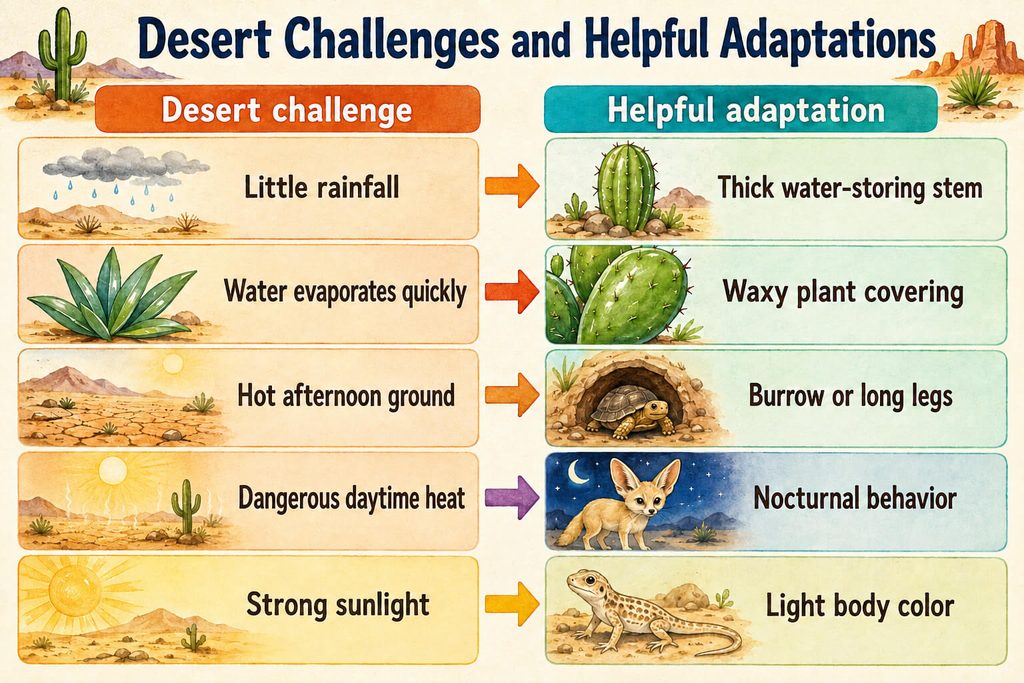
Ask students to explain each match. Do not accept the match alone.
4. Design a Desert Animal
Invite students to invent a realistic desert animal.
Require at least two adaptations. One should be structural. One should be behavioral.
Students might design large ears and nighttime activity. They must explain each feature.
This task reveals whether students understand cause and effect.
NGSS Connections for a Desert Habitat Lesson
This topic supports several elementary performance expectations.
| Standard | Classroom connection |
| 2-LS4-1 | Students observe plants and animals from desert and rainforest habitats. They compare biodiversity. |
| 3-ESS2-2 | Students combine maps, rainfall data, and temperature information. They describe desert climates. |
| 3-LS4-3 | Students use habitat conditions and organism traits as evidence. They explain why some organisms survive well. |
For full 3-LS4-3 alignment, include an evidence-based argument. A simple matching page is helpful practice. It does not complete the entire performance expectation.
Try this claim prompt:
A fennec fox can survive better in a hot desert than an Arctic fox. Use two pieces of evidence.
This prompt moves students beyond naming adaptations. They must connect evidence with survival.
Common Desert Misconceptions
Misconception 1: All Deserts Are Hot and Sandy
Students often picture the Sahara first. That image is only one desert type.
Gentle correction: Show Antarctica beside the Sahara. Ask students to find the shared feature. Both receive very little precipitation.
Then compare sandy, rocky, and icy desert images.
Misconception 2: A Camel Stores Water in Its Hump
The hump stores fat. It is not a water tank.
Gentle correction: Call the hump an energy lunchbox. Camels also have other water-saving body functions.
Avoid saying an animal “decided” to grow an adaptation. Describe adaptations as helpful inherited traits or behaviors.
Frequently Asked Questions About Desert Habitats
No. Deserts can be hot or cold. Antarctica is a cold desert.
Nighttime is often cooler. Activity after sunset can reduce overheating and water loss.
Examples include water-storing stems, waxy coverings, spines, and specialized roots.
Extend the Lesson With Ready-to-Use Desert Activities
Students need several ways to practice the same big idea.
The complete desert habitat resource includes:
- hot and cold desert sorting
- continent and desert mapping
- temperature and rainfall graphs
- day-and-night comparisons
- desert plant and animal adaptations
- living and nonliving things
- a desert food chain
- desert and rainforest comparison
- vocabulary practice
- a desert animal design challenge
- a mini quiz and answer key
- color and black-and-white student pages
Teacher-Friendly Science Sources
- U.S. Geological Survey: Deserts
- NASA Space Place: What Is Antarctica?
- National Park Service: Plant Adaptations
- National Park Service: Desert Adaptations
- Next Generation Science Standards: 3-ESS2-2
3-Question Quick Quiz
1. What feature defines a desert?
A. It is always hot.
B. It receives very little precipitation.
C. It is completely covered with sand.
2. Which cactus adaptation helps slow water loss?
A. A waxy outer covering
B. Bright flowers
C. A tall shadow
3. Which example is a behavioral desert adaptation?
A. Having large ears
B. Storing water in a thick stem
C. Resting in a burrow during the hot day
Answer key: 1. B; 2. A; 3. C
Comments