With free sample
Food chains and food webs can feel like difficult science concepts for young learners. The best way to introduce them in Grades 2–3 is through clear pictures, simple vocabulary, and hands-on activities.
The Polar Food Web Worksheets help students see how energy moves through an ecosystem. Learners begin with a simple food chain, such as:
sunlight → phytoplankton → krill → fish → seal → polar bear
This visual sequence helps children understand that food chains begin with an energy source and a producer before moving to consumers and top predators.
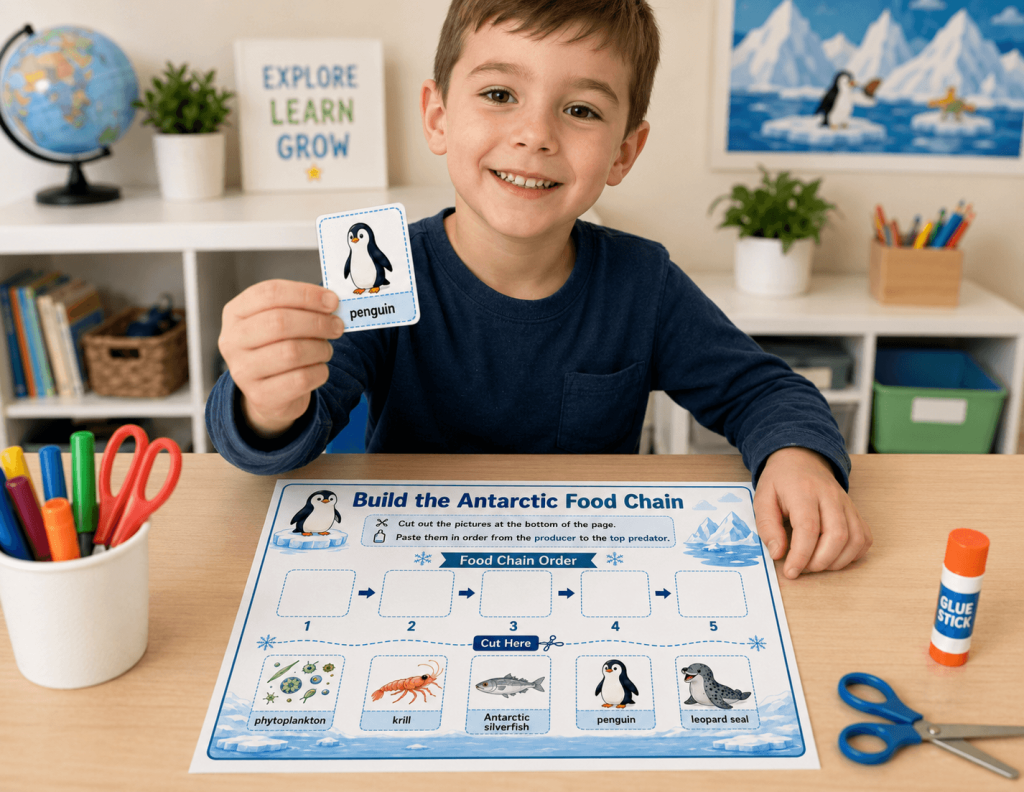
Cut, Order, and Paste
One of the easiest ways to teach a food chain is with a cut-and-paste activity. Students cut out the organism cards and arrange them from the producer to the top predator. After checking the order, they glue the pictures into the numbered boxes.
This activity combines science with fine motor practice and makes the direction of energy flow easier to remember.
Build a Classroom Food Web
After students understand one food chain, use the cut-out cards to create a larger food web. Place the organism cards on a table or bulletin board and connect them with arrows. Explain that arrows point from the food to the animal that receives energy from it.
Students can also discover that one animal may have more than one connection. For example, a seal may provide energy to both a polar bear and a killer whale, creating branches within the food web.
Explore “What If?” Questions
Encourage deeper thinking by removing one card from the food web. Ask:
What would happen if krill disappeared?
Students may notice that fish would have less food, seals could then have fewer fish to eat, and polar bears might have greater difficulty finding food. This helps children understand that organisms in an ecosystem depend on one another.

Frequently Asked Questions
A food chain shows one pathway through which energy moves from one organism to another. A food web connects several food chains and shows the many feeding relationships within an ecosystem.
Begin with a simple visual sequence that includes sunlight, a producer, and several consumers. Picture cards and cut-and-paste activities help young learners see and physically arrange the order in which energy moves through an ecosystem.
Arrows point from the organism being eaten to the organism that receives energy from it. For example, in the relationship krill → fish, the arrow shows that energy moves from the krill to the fish.
Producers, such as phytoplankton, use sunlight to make their own food. Consumers cannot make their own food, so they obtain energy by eating plants or other animals. Krill, fish, seals, polar bears, and killer whales are examples of consumers.
Food webs help students understand that most animals eat more than one type of food and may also have more than one predator. They provide a more realistic picture of how organisms in an ecosystem depend on one another.
Removing one organism can affect many other parts of the ecosystem. If krill numbers decrease, for example, animals that eat krill may have less food. These changes can also affect predators farther along the food web.
Students can order organism cards, build food chains with cut-and-paste worksheets, connect pictures with arrows, create a classroom food web, or investigate “What if?” scenarios by removing one organism at a time.
Yes. The activities use clear illustrations, age-appropriate vocabulary, and manageable hands-on tasks. They can be used during whole-group science lessons, small-group instruction, science centers, or independent practice.
Professional References and Further Reading
- NOAA Education: Aquatic Food Webs – An accessible scientific overview of producers, consumers, trophic levels, and energy transfer in aquatic ecosystems.
- NOAA Ocean Service: What Are Plankton? – Explains how phytoplankton use sunlight and form the foundation of marine food webs.
- A Framework for K–12 Science Education: Life Sciences – Provides the research-based learning progression for understanding how animals obtain food from plants and other animals.
- NGSS 2-LS2-1: Ecosystems—Interactions, Energy, and Dynamics – Connects the activity to students’ developing understanding that plants require sunlight and water to grow.
- NGSS 3-LS4-4: Environmental Change and Organisms – Supports discussions about how changes in food availability and other ecosystem resources can affect living organisms.
- NGSS 5-LS2-1: Matter and Energy in Ecosystems – Describes the later elementary expectation for modeling the movement of matter among plants, animals, decomposers, and the environment.
- Polar Bears International: Diet and Prey – Offers reliable background information about the feeding relationship between polar bears and Arctic seals.
Food Chains and Food Webs: Teacher-Friendly Glossary
Use this glossary to introduce essential ecosystem vocabulary or review key terms before students build their own polar food chains and food webs.
Core Vocabulary
Organism
An individual living thing, such as a plant, animal, fungus, or bacterium.
Habitat
The place where an organism lives and finds the food, water, shelter, and space it needs.
Ecosystem
A community of living organisms interacting with one another and with nonliving parts of their environment, such as water, sunlight, air, and temperature.
Energy source
The original source of energy in a food chain. Most ecosystems depend directly or indirectly on energy from the Sun.
Producer
An organism that makes its own food, usually by using energy from sunlight. Phytoplankton are important producers in marine food webs.
Consumer
An organism that obtains energy by eating plants, animals, or other organisms.
Food chain
A model showing one pathway through which energy moves from one organism to another.
Food web
A model made from several connected food chains. It shows that organisms usually have more than one feeding relationship within an ecosystem.
Energy flow
The movement of energy from a source to producers and then to consumers.
Energy-flow arrow
An arrow showing the direction in which energy moves. It points from the organism being eaten toward the organism that eats it. For example, krill → fish means that energy moves from the krill to the fish.
Predator
An animal that hunts, catches, and eats another animal.
Prey
An animal that is hunted and eaten by a predator.
Herbivore
A consumer that eats plants, algae, or other producers.
Carnivore
A consumer that eats other animals.
Omnivore
A consumer that eats both plants or algae and animals.
Decomposer
An organism that breaks down dead plants, animals, and waste materials. Fungi and many bacteria are decomposers.
Interdependence
A relationship in which organisms depend on one another. A change affecting one organism may also affect other members of its food web.
Polar Food Web Vocabulary
Phytoplankton
Tiny photosynthetic organisms that drift in sunlit water. They form the base of many marine food webs.
Zooplankton
Small drifting animals and animal-like organisms that feed on phytoplankton or other plankton.
Krill
Small, shrimp-like crustaceans that provide food for many fish, seabirds, seals, and whales. Some krill feed on phytoplankton.
Seal
A marine mammal that may eat fish, squid, and crustaceans. Arctic seals are important prey for polar bears and may also be eaten by killer whales.
Polar bear
A top Arctic predator that primarily hunts seals from the surface of the sea ice.
Killer whale or orca
A marine predator that may feed on fish, seals, and other marine animals, depending on the population and habitat.
Extension Vocabulary
Primary consumer
A consumer that eats producers. Some krill act as primary consumers when they eat phytoplankton.
Secondary consumer
A consumer that eats primary consumers. A fish that eats krill may act as a secondary consumer.
Top predator or apex predator
A predator near the top of a food web that has few or no regular natural predators within that ecosystem.
Trophic level
An organism’s feeding position in a food chain or food web, such as producer, primary consumer, or secondary consumer.
Population
All the members of one species living in the same area.
Ecosystem change
A change in an ecosystem—such as reduced food, changing temperatures, or habitat loss—that may affect several connected organisms.
Helpful Classroom Language
When explaining food-web arrows, remind students:
“The arrow points toward the organism receiving the energy.”
For example:
sunlight → phytoplankton → krill → fish → seal → polar bear
Students can read this sequence as:
“Sunlight gives energy to phytoplankton. Phytoplankton gives energy to krill. Krill gives energy to fish.”
Comments