Help young learners explore sunlight, depth, ocean habitats, and animal adaptations through visual, hands-on science activities.

Use reading, labeling, animal sorting, and evidence-based activities to help young learners explore depth, light, ocean habitats, and adaptations.
The ocean may look like one enormous body of water from the surface, but conditions change dramatically as we travel deeper. Sunlight fades, the water becomes colder, and pressure increases. These changes create different habitats for ocean organisms.
For second and third graders, learning about the layers—or zones—of the ocean is an engaging way to connect Earth science and life science. Students can compare habitats, observe patterns, and use evidence to explain why particular animals are well suited to different ocean environments.
The printable resource featured in this lesson, Ocean Zones Worksheets | 5 Layers of the Ocean Activities for Grades 2–3, provides a ready-to-use learning sequence in both full-color and black-and-white formats. Its reading passage, ocean-zone diagram, vocabulary and comprehension activities, animal sorts, flashcards, creative response pages, Hadal Zone infographic, and answer key make it easy to move from teacher modeling to independent practice.
What Is the Best Way to Teach Ocean Zones to Second and Third Graders?
The best way to teach ocean zones in Grades 2–3 is to begin with the familiar ocean surface and then take students on a visual journey downward. Use a large vertical diagram, gradually darkening colors, simple habitat clues, and recognizable animals. Instead of asking children to memorize every depth, focus first on four patterns: light decreases, temperature generally decreases, pressure increases, and living things have different adaptations at different depths.
Hands-on activities such as labeling, coloring, cutting and sorting animal cards, and building a layered ocean model make these invisible changes easier to understand. Students should also explain their choices—for example, why an animal that depends on camouflage in darkness might live deeper than an animal that needs sunlight or surface air.
The activities in this ocean-zones resource follow that progression. Students first gain background knowledge from a short reading passage and illustrated diagram. They then practice the concepts through vocabulary matching, true-or-false statements, fill-in-the-blank sentences, zone comparisons, animal placement, open-ended science questions, and a final quick check.
What Are the Five Zones of the Ocean?
Scientists divide the ocean’s water column into zones based largely on depth and the amount of available light. These are not solid layers with walls between them, and some animals move from one zone to another. However, the five-zone model gives elementary students a useful way to compare ocean habitats.
According to the National Oceanic and Atmospheric Administration’s overview of ocean layers, the zones are commonly described as follows.

1. The Sunlight Zone
The sunlight zone, also called the epipelagic zone, extends from the surface to about 200 meters (660 feet). This is the brightest and generally warmest ocean zone.
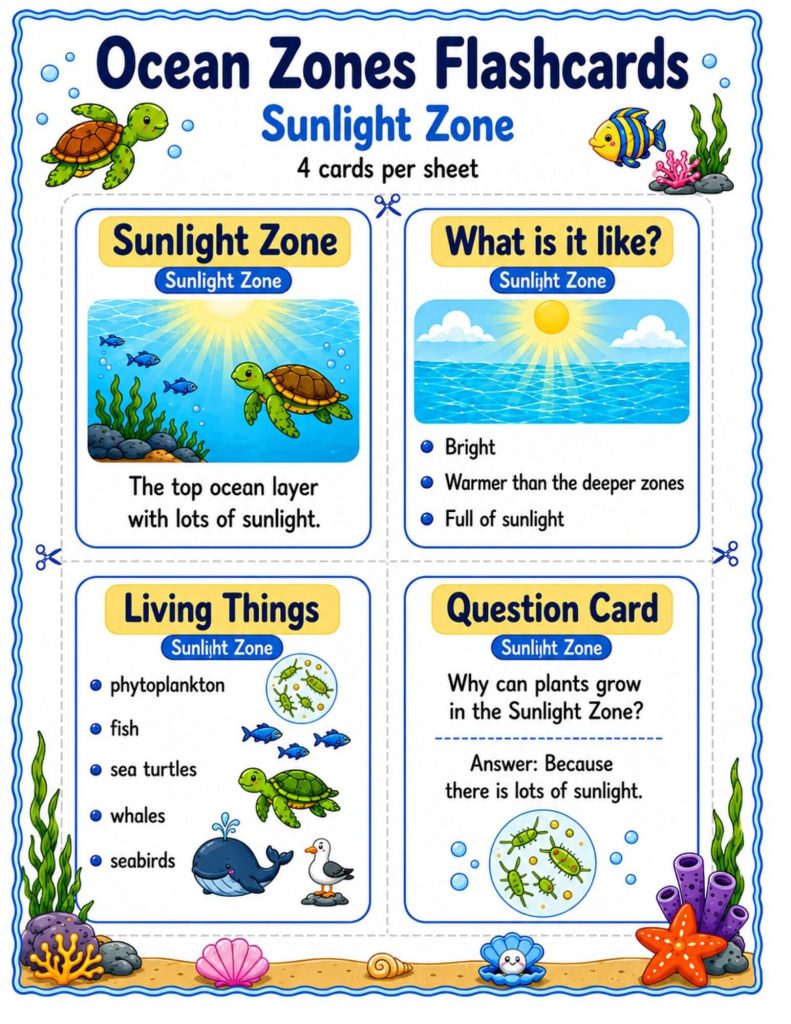
There is enough light for photosynthesis, so microscopic phytoplankton and many algae can make food here. Because food is more readily available, this zone supports a wide variety of life. Students may associate it with animals such as sea turtles, dolphins, many sharks, tuna, jellyfish, and colorful fish.
Student-friendly clue: Bright, warmer, and full of life.
2. The Twilight Zone
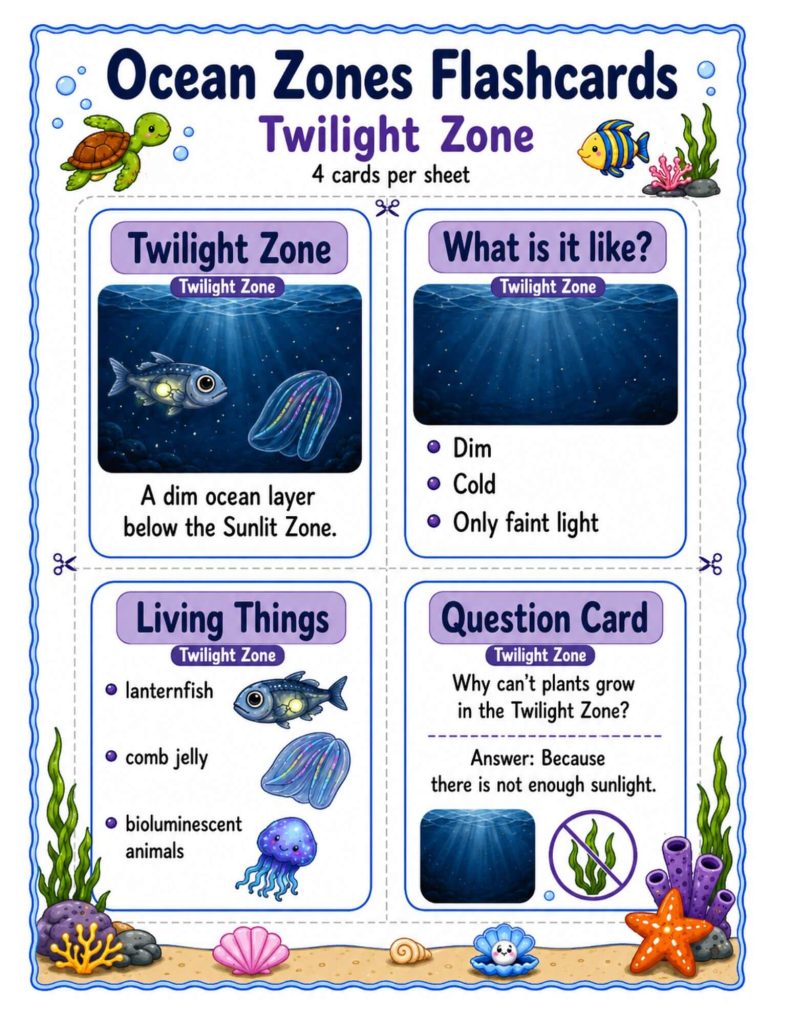
The twilight zone, or mesopelagic zone, reaches from about 200 to 1,000 meters (660 to 3,300 feet). Only a small amount of sunlight reaches this zone, and there is not enough light for photosynthesis.
Some animals have large eyes to collect limited light. Others produce their own light through bioluminescence. Lanternfish, hatchetfish, squid, and some jellyfish are useful examples for young learners. Many twilight-zone animals also travel upward at night to find food.
Student-friendly clue: Dim light, cooler water, and glowing animals.
3. The Midnight Zone
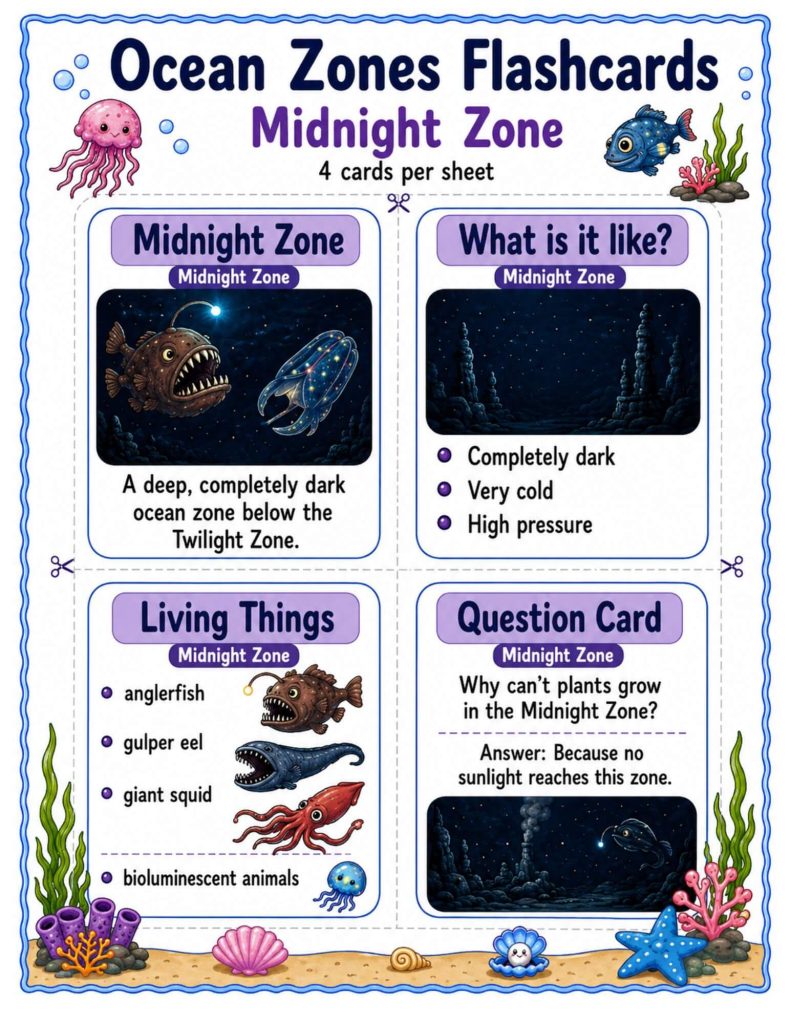
The midnight zone, or bathypelagic zone, extends from about 1,000 to 4,000 meters (3,300 to 13,100 feet). Sunlight does not reach this far, so the water is completely dark except for light made by living organisms.
The water is cold, food is limited, and pressure is high. Anglerfish, gulper eels, and some deep-sea squid have structures and behaviors that help them find food in darkness.
Student-friendly clue: No sunlight, cold water, and very high pressure.

4. The Abyssal Zone
The abyssal zone, or abyssopelagic zone, lies about 4,000 to 6,000 meters (13,100 to 19,700 feet) below the surface. It is dark, extremely cold, and under enormous pressure.
Food from the upper ocean may slowly sink into this zone as small particles sometimes called “marine snow.” Sea cucumbers, brittle stars, and other deep-sea organisms can be found on or near the seafloor.
Student-friendly clue: Near-freezing water, darkness, and life adapted to scarce food.
5. The Trenches

The hadal zone, often introduced to children as the trenches, begins at about 6,000 meters (19,700 feet) and includes the deepest ocean trenches. The deepest places reach almost 11,000 meters, or approximately 36,000 feet.
Although this environment is dark, cold, and under crushing pressure, it is not lifeless. Amphipods, microbes, and specially adapted snailfish are among the organisms scientists have observed in deep trenches.
Student-friendly clue: The deepest parts of the ocean, found inside trenches.
NOAA explains that light decreases rapidly with depth: very little light remains between 200 and 1,000 meters, and sunlight does not reach below approximately 1,000 meters. This simple light pattern is an excellent anchor for the entire lesson.
Start With a Question Students Can Investigate
Begin the lesson by displaying an ocean photograph or a simple picture of a boat floating on the water. Ask:
What do you think changes as we travel from the sunny ocean surface to the deepest trench?
Record student predictions without immediately correcting them. Learners may suggest that it becomes darker, colder, quieter, or more difficult for animals to live. Return to these ideas at the end of the lesson and ask students which predictions were supported by evidence.
A flashlight demonstration can make the central concept more concrete. Shine a flashlight through one sheet of blue tissue paper or transparent plastic, then add several more layers. Students will observe that less light passes through as the number of layers increases. Explain that ocean water absorbs light as depth increases. Make it clear that the model represents one pattern and is not an exact copy of the ocean.
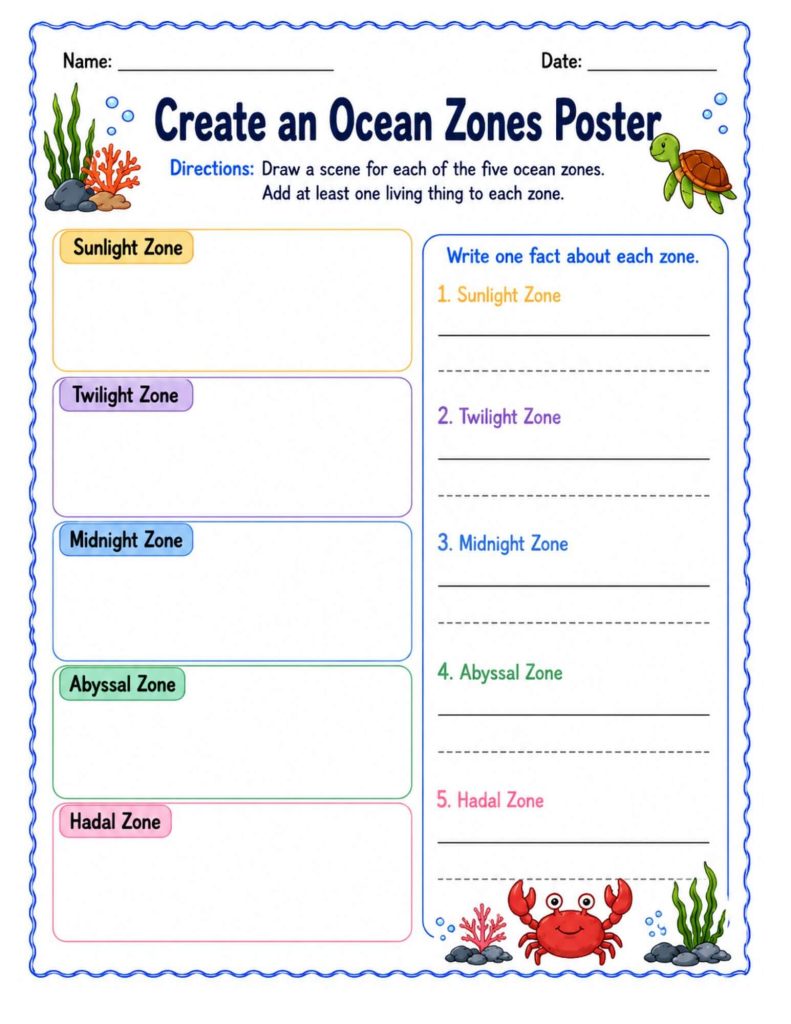
Build a Visual Ocean-Zone Model
A floor-to-table or wall-sized model helps children understand vertical order. Create five horizontal sections using paper that changes from light blue at the top to nearly black at the bottom. Add the zone names one at a time instead of showing the completed diagram immediately.
For each zone, have students identify three kinds of information:
- Light: bright, dim, or absent
- Conditions: generally warmer or colder, with lower or higher pressure
- Life: examples of organisms and the features that help them survive
Students can then place animal cards in likely zones. The most valuable part of the activity is not simply finding the expected box; it is explaining the evidence behind each choice.
For example:
“I placed the lanternfish in the twilight zone because only a little sunlight reaches that depth, and the fish can produce light.”
Remind students that real animals do not always remain inside one neat classroom category. Some travel through several zones, and a species’ range may vary. The cards represent a habitat in which an organism is commonly found, not an unbreakable boundary.
Use a Gradual Teaching Sequence
Second and third graders learn complex vocabulary more successfully when it is introduced in small steps.
Step 1: Compare Light Levels
Teach sunlight, twilight, and no sunlight before introducing all five scientific zone names. Ask students to order three color cards from brightest to darkest and predict where photosynthesis can occur.
Step 2: Add the Five Zone Names
Introduce the everyday names first: sunlight, twilight, midnight, abyssal, and trenches. The scientific terms—epipelagic, mesopelagic, bathypelagic, abyssopelagic, and hadal—can be included as enrichment rather than required spelling words.
Step 3: Match Organisms to Habitat Clues
Give students animal pictures and short clues. Ask them to look for evidence such as large eyes, light-producing body parts, surface breathing, camouflage, or a body suited to high pressure.
Step 4: Read, Label, and Color
A short reading passage followed by labeling and coloring gives students repeated exposure to the vocabulary. Encourage them to use progressively darker shades from the surface to the trenches so the finished page also functions as a visual model.
Step 5: Explain With Evidence
Finish with a sentence frame that requires reasoning:
The ______ could survive well in the ______ zone because ______.
This turns a simple sorting activity into an evidence-based science task.
How to Use the Ocean Zones Worksheets in a 45–60 Minute Lesson
Learning Objectives
- The 5 Ocean Zones reading passage and diagram;
- ocean-zone flashcards and organism cards from the printable resource;
- blue paper or coloring tools in several shades;
- scissors and glue;
- flashlight and translucent blue material for an optional demonstration; and
- a student activity page or science notebook
Lesson Flow
- Engage—5 minutes: Ask what might change during a journey to the bottom of the ocean. Record predictions about light, temperature, pressure, food, and animals.
- Explore—10 minutes: Use the flashlight model to compare bright, dim, and dark conditions. Display the five illustrated zone flashcards in vertical order.
- Explain—10 minutes: Read The 5 Ocean Zones passage together, then label the Sunlight, Twilight, Midnight, Abyssal, and Hadal zones on the diagram.
- Apply—15 to 20 minutes: Choose the Ocean Animal Homes page or the cut-and-paste Ocean Organism Sort. Students place phytoplankton, lanternfish, comb jelly, anglerfish, sea cucumber, and shrimp-like amphipod in the most appropriate zones and explain their evidence.
- Evaluate—5 to 10 minutes: Use Compare the Zones, Think Like a Scientist, or the five-question Ocean Quick Check to assess understanding.
Ocean Zone Activities Included in the Printable Resource
Begin With the Illustrated Reading Passage
The one-page reading introduces all five zones in a manageable format. Students learn how sunlight, temperature, pressure, available food, and living things change from the surface to the trenches. Read it aloud first, pause after each zone, and ask students to underline one important habitat clue.
Label and Sequence the Five Zones
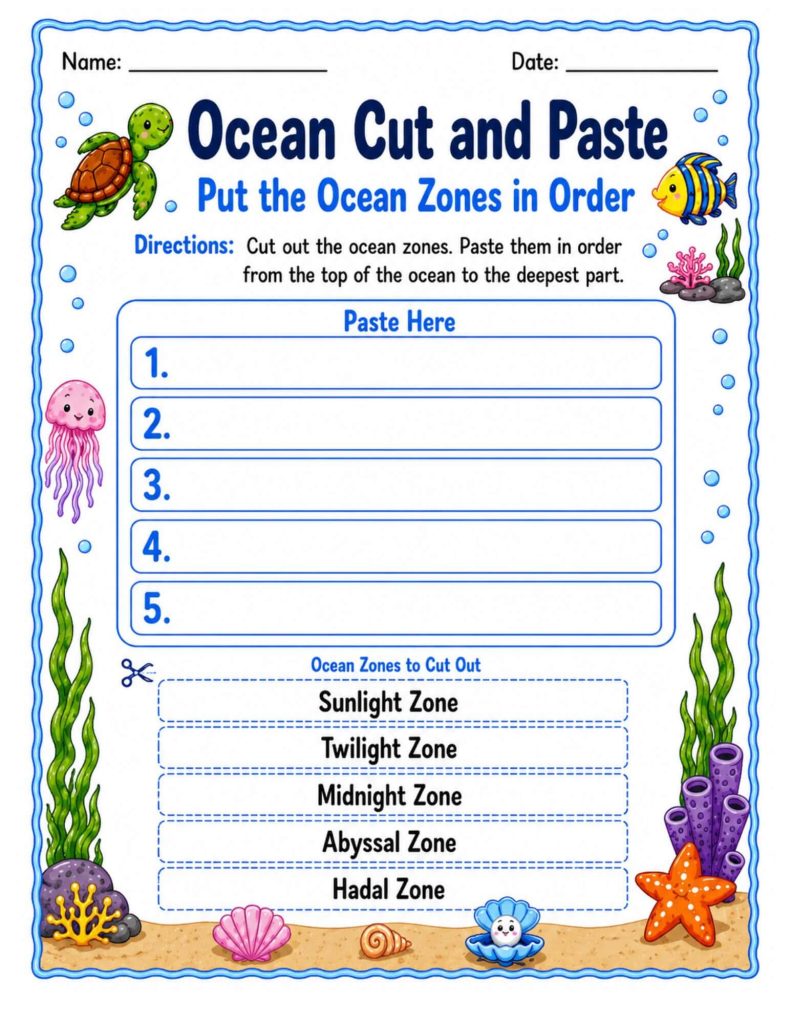
The Ocean Zones Diagram asks students to label the illustrated zones and connect short descriptions to the correct layer. The separate Ocean Cut and Paste page reinforces the order from the surface downward. These activities help students build a visual model before they work with more detailed animal examples.
Strengthen Science Vocabulary
The Ocean Vocabulary Match focuses on five useful terms: phytoplankton, marine snow, trench, pressure, and glow. Follow it with the true-or-false and fill-in-the-blank pages so students meet the same ideas in several different contexts.
Instead of correcting an incorrect sentence immediately, ask students to explain which word makes it false and how they would rewrite it. This adds reasoning and oral-language practice to a quick worksheet task.
Sort Organisms by Ocean Habitat
The resource provides two levels of organism placement. Ocean Animal Homes asks students to name the zone associated with each organism, while Ocean Organism Sort adds a hands-on cut-and-paste format. The featured organisms are phytoplankton, lanternfish, comb jelly, anglerfish, sea cucumber, and a shrimp-like amphipod.
Have partners discuss each card before they write or glue. Encourage a complete explanation:
“I placed the anglerfish in the Midnight Zone because no sunlight reaches that depth, and its glowing lure helps it catch scarce prey.”
Explain that the activity shows a zone where each organism is commonly found. Ocean animals may move, and real habitat ranges do not always fit perfectly inside classroom categories.
Compare the Sunlight and Midnight Zones
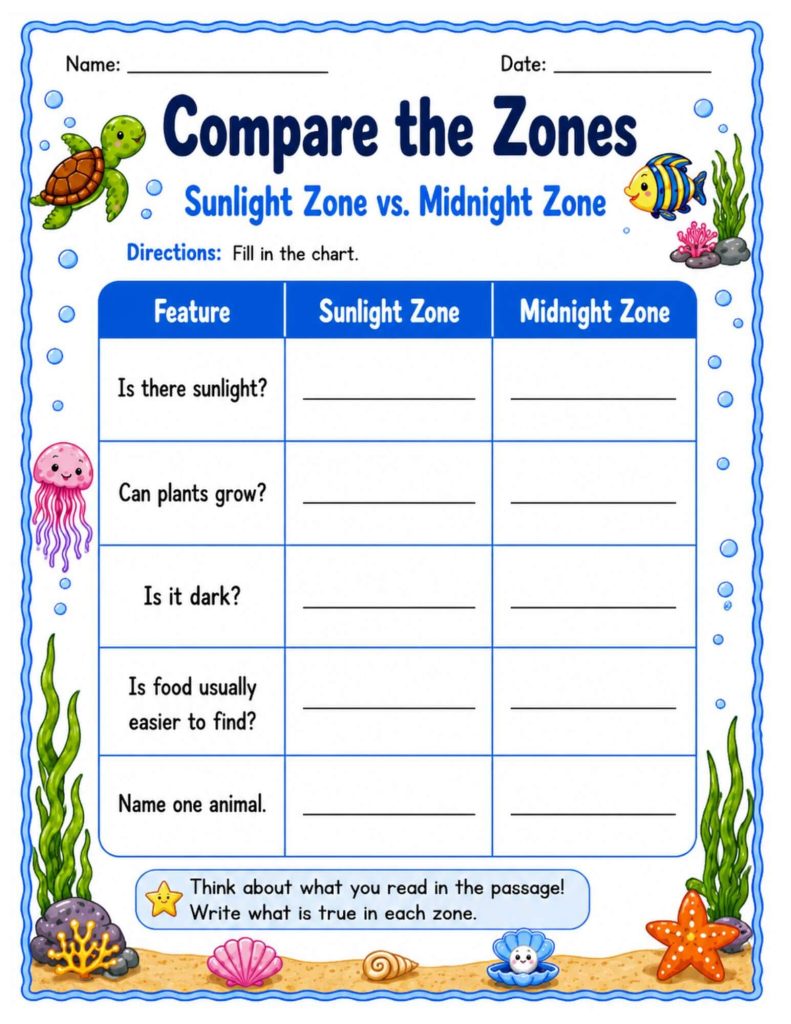
The comparison chart directs students to examine sunlight, plant growth, darkness, food availability, and animal life. This contrast makes the effect of depth especially clear and prepares students for evidence-based explanations.
Move From Recall to Scientific Thinking
The Think Like a Scientist page asks why plants grow in the Sunlight Zone, why food is difficult to find in the Midnight Zone, what marine snow is, and why scientists use robotic submersibles to explore the Hadal Zone. These open-ended prompts are particularly useful for NGSS-connected instruction because students must explain relationships rather than simply recall labels.
Add a Creative Synthesis Task
Students can complete the Create an Ocean Zones Poster page or choose one habitat on Explore the Ocean Zones. The writing page asks for three accurate facts and an explanation of how an animal survives in the selected zone. The full-color version supports visual instruction, while the black-and-white version can double as a coloring and review activity.

Review With Flashcards and the Hadal Zone Infographic
The five flashcard pages provide a zone name, habitat conditions, examples of living things, and a question card. Use them for a science center, partner review, whole-class questioning, or small-group intervention. The Hadal Zone infographic offers an engaging extension about deep-sea trenches, crushing pressure, unusual organisms, and robotic exploration.
Vocabulary to Keep Simple
For Grades 2–3, focus on a small set of useful terms:
- ocean zone: a part of the ocean grouped by depth and conditions;
- depth: the distance below the water’s surface;
- sunlight: light energy from the Sun;
- pressure: a pushing force that increases as ocean depth increases;
- habitat: the place where a living thing gets what it needs;
- adaptation: a structure or behavior that helps an organism survive;
- bioluminescence: light made by a living organism; and
- phytoplankton: tiny, drifting organisms that use sunlight to make food.
At this age, conceptual understanding is more important than memorizing all five Greek-derived scientific names or exact depth boundaries.
NGSS Connections
An ocean-zones lesson can support NGSS learning when students do more than recall names.
- 2-LS4-1: Students make observations of plants and animals and compare the diversity of life in different habitats. The official performance expectation emphasizes comparing living things in different places on land and in water. See 2-LS4-1 on the NGSS website.
- 3-LS4-3: Students use evidence to explain why some organisms survive well in a particular habitat while others do not. Animal-to-zone placement becomes a stronger NGSS-connected task when students support it with habitat conditions and adaptations. See 3-LS4-3 on the NGSS website.
- Science and Engineering Practices: Making observations, developing and using simple models, and constructing explanations or arguments from evidence.
- Crosscutting Concepts: Patterns and cause and effect. Students notice that increasing depth causes predictable changes in light and pressure, which influence where organisms can survive.
The topic itself does not automatically make a worksheet NGSS-aligned. The strongest standards connection comes from what students do: observe, compare, model, explain, and support ideas with evidence.
Differentiation Ideas
For students who need support, provide color-coded zone labels, picture clues, a reduced word bank, and oral sentence frames. Allow partners to discuss each animal before recording an answer.
For students ready for a challenge, add the scientific zone names, approximate depth ranges, or a short research task about bioluminescence. Advanced learners can also explain why green plants cannot grow in the midnight zone or compare two animals with different deep-sea adaptations.
Assessment Ideas
Use quick checks that reveal understanding rather than spelling ability:
- Put the five zones in order from shallowest to deepest.
- Draw an arrow showing what happens to sunlight as depth increases.
- Compare the sunlight zone with the midnight zone.
- Choose an animal and explain which habitat clues support its placement.
- Complete the statement: “As ocean depth increases, ______.”
A useful exit ticket is:
Choose one ocean zone. Describe one condition in that zone and one adaptation that could help an animal survive there.
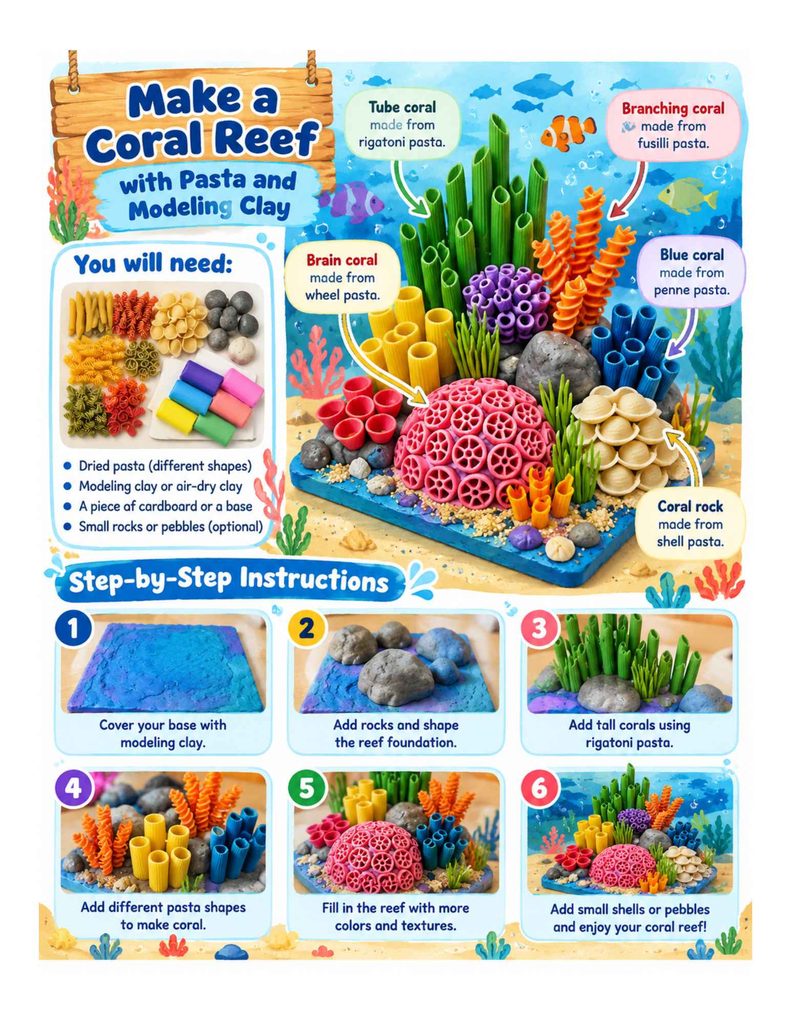
Hands-On Extension: Build a Coral Reef Model
After students learn about the five ocean zones, give them a chance to build a simple model of one of the ocean’s best-known shallow-water habitats: a coral reef.
Using modeling clay, small rocks, and different shapes of dried pasta, students can create their own reef and think about how ocean habitats change with depth. Tube pasta can represent branching or tube-shaped corals, wheel pasta can form rounded coral colonies, and shell pasta can add extra texture to the reef.
As students build, ask questions such as:
- Which ocean zone would this coral reef belong to?
- How much sunlight reaches this part of the ocean?
- What animals might live around the reef?
- How would this habitat be different from the twilight or midnight zone?
Most tropical, reef-building corals live in the sunlight zone, where enough light reaches the water for the algae living inside the corals to photosynthesize. This makes the activity a useful way to connect ocean depth, sunlight, habitat, and living things.
Teacher tip: After completing the reef, challenge students to compare it with a deep-sea habitat. They can list what might change as they move from the bright sunlight zone down into the darker ocean zones.
Frequently Asked Questions About Teaching Ocean Zones
In elementary lessons, the phrases are often used in the same way. Ocean zones is the more scientific term because the water is not divided into solid layers. The boundaries are approximate, and conditions change gradually with depth
Most students in Grades 2–3 can work with the five familiar names: sunlight, twilight, midnight, abyssal, and trenches. If five categories feel overwhelming, begin with three light conditions—sunlit, dim, and dark—before adding all five zones.
No. Approximate depth ranges help students understand scale, but the central learning goal should be recognizing patterns. They should understand that the ocean becomes darker and generally colder as depth increases, while pressure becomes greater.
Sunlight does not reach the midnight zone, so plants and other organisms that depend on sunlight cannot carry out photosynthesis there. Deep-ocean food webs may depend on material sinking from above or on microbes that use chemical energy.
No. Some animals travel between zones to feed, hide, reproduce, or breathe at the surface. Elementary sorting activities simplify a complex habitat system, so it is helpful to say that each card shows a zone where the animal is commonly found.
Some organisms create light through bioluminescence. They may use it to attract prey, communicate, hide, or confuse predators. NOAA’s introduction to deep-sea marine life provides useful background information for teachers.
It can support NGSS expectations such as 2-LS4-1 and 3-LS4-3 when students compare habitats, observe organisms, use models, and explain survival using evidence. Simply memorizing zone names is not enough for a strong standards connection.
Yes. The reading passage, illustrated diagram, and flashcards work well for whole-group modeling. The vocabulary, comprehension, sorting, comparison, writing, and quick-check pages can then be used for guided practice, science centers, homework, assessment, or independent review. Teachers can select either the full-color or printer-friendly black-and-white set.
The deepest parts of the ocean are far beyond students’ everyday experience, but visual models and carefully chosen activities make them understandable. When children label a vertical diagram, compare changing conditions, sort animals, and explain their reasoning, they learn much more than five new names. They discover that habitats are shaped by physical conditions and that living things have features and behaviors that help them survive.
The Ocean Zones Worksheets | 5 Layers of the Ocean Activities for Grades 2–3 pack provides the reading, vocabulary practice, diagrams, animal cards, comparison tasks, creative pages, review tools, and answer key needed to guide this journey. Use the printable pages alongside discussion and evidence-based questions so that students become active ocean explorers rather than passive memorizers.