
Teaching about deserts becomes much more memorable when students can build, color, write, and create at the same time. This Sahara Desert collaborative art project for Grades 2–3 combines desert habitats, camel adaptations, creative writing, and classroom art in one hands-on activity.
The centerpiece of the project is a large class caravan. Each student chooses a different camel, gives it a personality, decorates it, and then adds it to a shared Sahara Desert background.
Because the resource includes 17 different camel characters, the finished display does not look like a row of identical worksheets. Students can choose from walking, resting, running, playful, decorated, and simpler camel designs, so every contribution feels different.
Why Use a Collaborative Sahara Desert Project?
Collaborative art projects work especially well in elementary classrooms because students create something individually while contributing to a much larger finished piece.
In this activity, every camel can look completely different.
One student might create a bright geometric saddle blanket. Another might add yarn tassels. Someone else may create a funny camel character with a name and personality.
When all of the pieces are placed together, they become one large Sahara caravan classroom display.
This makes the activity useful for combining:
- desert habitat learning
- animal adaptations
- geography
- art and pattern design
- fine motor skills
- creative writing
- classroom community
The project directions are designed around creating a large desert background, decorating individual camel characters, assembling the caravan, and adding final desert details
Step 1: Create the Sahara Desert Background

Start with a large sheet of bulletin-board paper, kraft paper, or several sheets joined together.
Students can create rolling desert dunes using:
- yellow
- tan
- orange
- light brown
- darker brown
Sponges and wide brushes work especially well because students can quickly create large areas of color.
For a more tactile project, add a thin layer of glue to selected dune areas and sprinkle on a small amount of clean sand or cornmeal.
The background does not need to be highly detailed. In fact, keeping it fairly simple allows the colorful student-created camels to become the main focus of the display.
Step 2: Design a Unique Camel
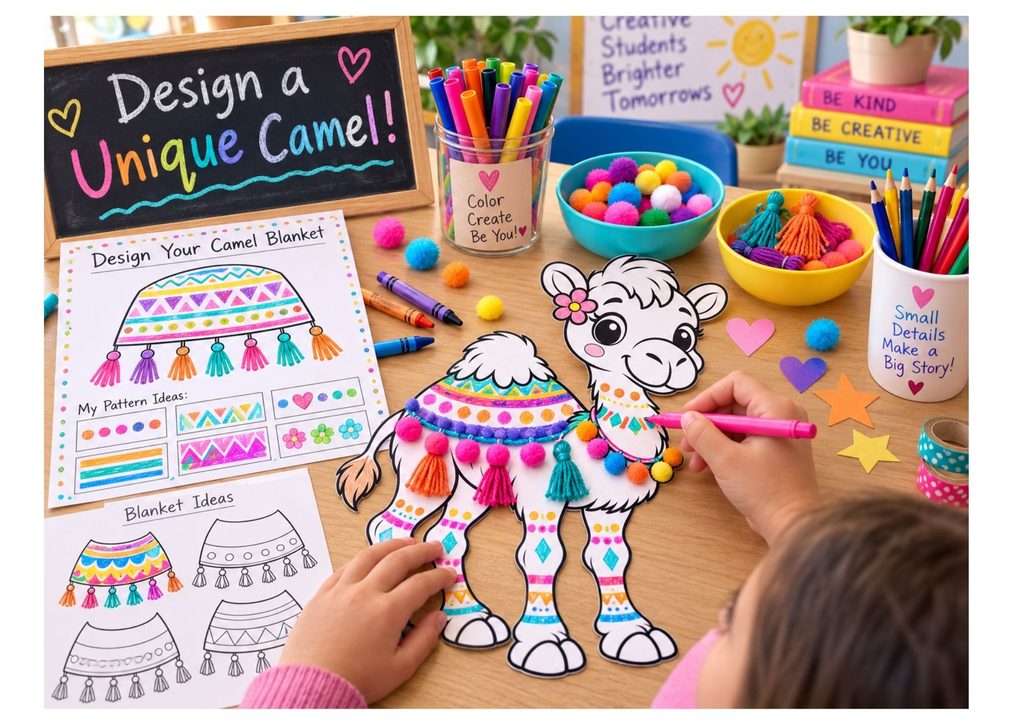
Each student chooses a camel character and colors it using crayons, markers, or colored pencils.
Students can personalize their camels with:
- stripes
- dots
- geometric designs
- bright color combinations
- jewelry
- tassels
- pom-poms
- yarn
- paper decorations
Several of the camel designs include open or blank saddle areas, making them perfect for a small pattern-design activity.
Before students decorate the final camel, they can also complete a Design Your Camel Blanket planning page. This gives them space to experiment with colors and patterns before transferring the design to their camel.
This small step turns the coloring activity into a simple textile and pattern-design lesson.
Step 3: Learn About Camel Adaptations

The art project can easily become a science activity by introducing the adaptations that help camels survive in desert environments.
Students can label:
- hump
- long eyelashes
- nostrils
- long legs
- wide feet
Then they connect each feature to its function.
For example, students learn that the hump stores fat, eyelashes help keep sand away from the eyes, nostrils can close to help block sand, long legs keep the body farther from the hot ground, and wide feet help camels move across soft sand.
This makes the collaborative art project especially useful during a desert habitat or animal adaptations unit.
Step 4: Add Sahara Desert Animals
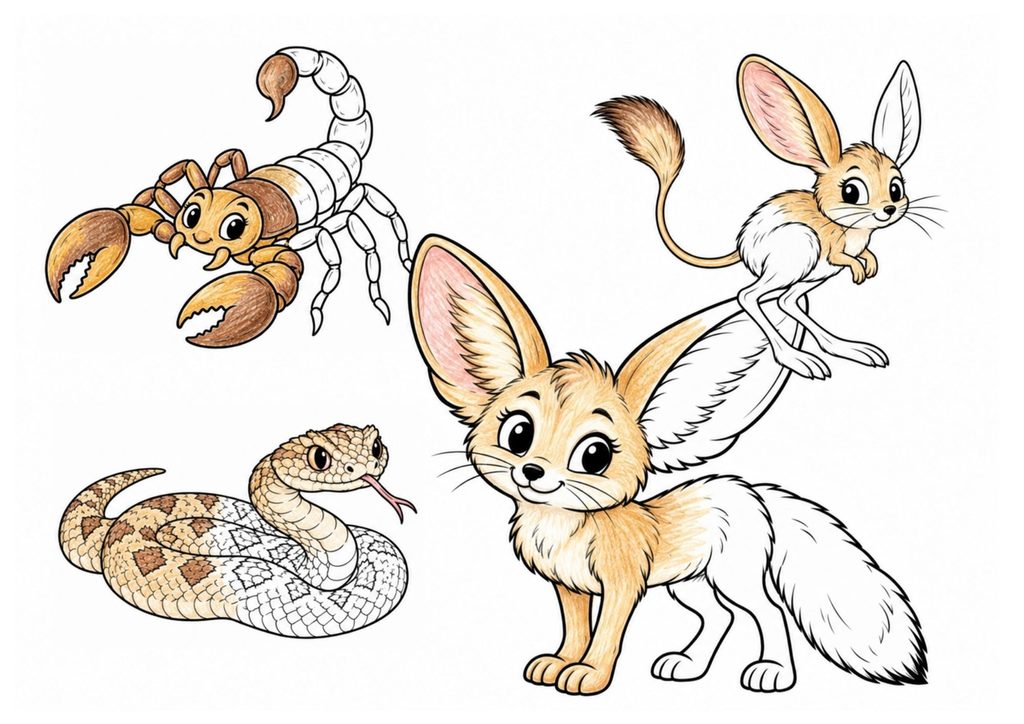
Camels are not the only animals living in desert environments.
Students can color and add smaller desert animals around the caravan, including:
- fennec fox
- scorpion
- sand viper
- jerboa
- monitor lizard
These smaller cut-outs work well near rocks, desert plants, dunes, or an oasis.
They also create an opportunity to discuss how different animals survive heat, dry conditions, and limited water.
Step 5: Build the Desert Scene
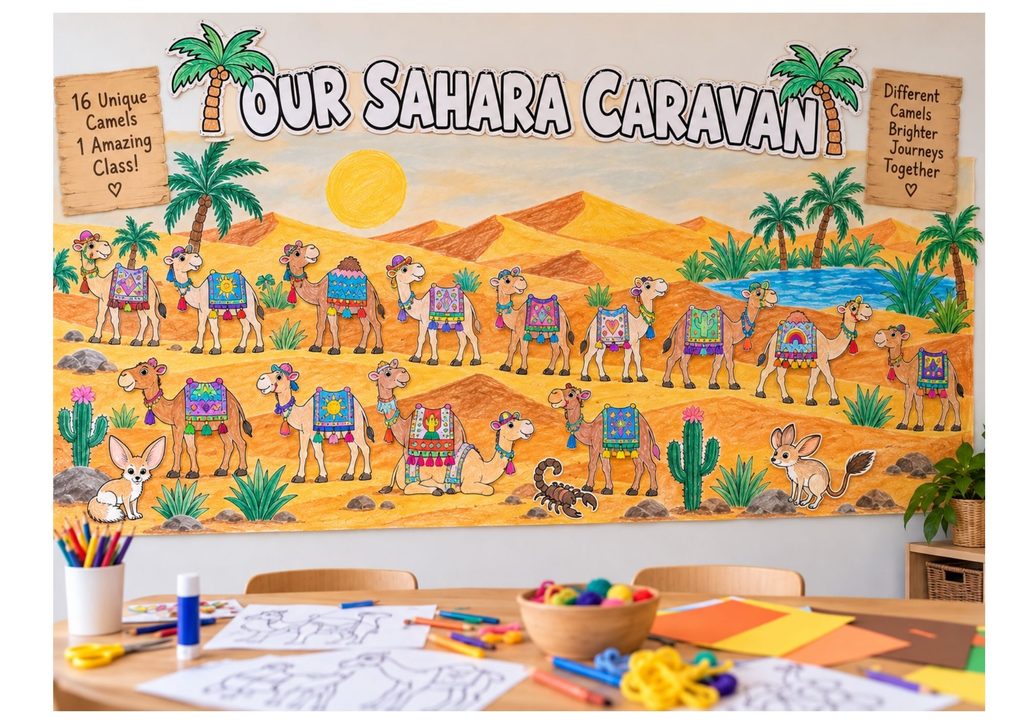
Once the background and camel characters are complete, arrange the pieces before gluing anything down.
Try placing the camels in a long path across the dunes so they appear to be traveling together.
Mix different poses to create movement.
A resting camel can sit near an oasis while running and walking camels continue across the desert. Smaller desert animals can be placed along the lower edge of the display.
Additional scenery can include:
- palm trees
- desert rocks
- dune clusters
- desert plants
- an oasis
- a desert tent
The finished display can be topped with large printable letters spelling:
OUR SAHARA CARAVAN
This gives the project the look of a finished classroom bulletin board rather than simply a collection of student worksheets.
Add a Sahara Desert Facts Reading Activity
Before students begin the artwork, introduce the Sahara with a short informational reading page.
For Grades 2–3, focus on a few important ideas:
The Sahara is the largest hot desert on Earth and stretches across much of northern Africa.
It is not completely covered in sand. The Sahara also contains rocky plains, mountains, plateaus, and dry riverbeds.
Days can become extremely hot, while nights may be much cooler.
Rainfall is rare.
Some areas contain underground water that reaches the surface and creates oases, where plants, animals, and people can find water.
Keeping the reading short allows students to build important background knowledge without overwhelming them with too many facts at once.
Turn Each Camel Into a Character
One of my favorite ways to extend this activity is to have students create a personality for their camel.
The My Caravan Camel activity asks students to think about questions such as:
- What is your camel’s name?
- What is its personality like?
- What does it like to do?
- What is something funny about it?
- What would it say if it could talk?
Students can even create a small name tag to display next to their finished camel.
This makes it especially fun when students walk past the finished bulletin board and look for their own characters.
Sahara Desert Writing Extension
After students create their camel, they can use it as the main character in a short story.
A simple prompt is:
Imagine you are traveling across the Sahara Desert with your camel. Write a story about your adventure.
Students might describe:
- where they are traveling
- what they see
- which desert animals they meet
- what their camel does
- a surprising event
- how the journey ends
Sentence starters can provide extra support for Grade 2 writers, while Grade 3 students can develop a longer independent story.
A Simple Classroom Schedule
The core collaborative art activity can be completed in approximately 90 minutes, with about 20 minutes for the background, 40–45 minutes for individual camel design, 15 minutes for assembling the caravan, and a short period for finishing and reflecting.
The science and writing pages can be completed before or after the art session, making the project easy to spread across several lessons.
For example:
Day 1: Sahara facts + camel adaptations
Day 2: Camel blanket design + coloring
Day 3: Collaborative background + caravan assembly
Day 4: Sahara writing activity + classroom display
More Than a Coloring Activity
What begins as a camel coloring project can become a much richer elementary learning experience.
Students learn about the Sahara, explore desert animal adaptations, design patterns, develop characters, practice writing, and finally combine their individual work into one large collaborative display.
And because every camel is different, students can immediately see an important part of collaborative art:
every individual piece is unique, but together they create something much bigger.
The finished Our Sahara Caravan works well as a classroom wall display, hallway project, bulletin board, desert habitat unit finale, or art-and-science integration activity for Grades 2–3.
Ready to create your own Sahara caravan? Get the complete Our Sahara Caravan resource on Teachers Pay Teachers, including 17 camel coloring pages, desert animals, scenery cut-outs, camel adaptations, writing activities, Sahara facts, bulletin board letters, and teacher directions.
For more ways to explore desert environments, try these Desert Habitat Activities for Grades 2–3, with a closer look at desert climate, survival, and animal adaptations.:https://lolliartscience.com/2026/08/22/desert-habitat-activities-grades-2-3/
Frequently Asked Questions
The project is designed mainly for Grades 2–3. The coloring, cutting, simple science activities, and writing prompts can also be adapted for slightly younger or older elementary students
The main collaborative art activity takes about 90 minutes. The Sahara facts, camel adaptations, blanket design, and writing activities can be completed separately over several lessons.
The complete resource includes 17 camel coloring pages, a camel blanket design page, desert animal cut-outs, desert scenery pieces, Sahara facts, a camel adaptations worksheet, writing activities, bulletin board letters, teacher directions, and a finished-project example.
No. Students can choose from 17 different camel characters with different poses, expressions, and personalities. This helps the finished caravan look varied and more collaborative.
Yes. Several camel pages include blank or open blanket areas. Students can also use the Design Your Camel Blanket planning page to experiment with colors, shapes, and patterns before decorating their final camel.
The resource includes additional desert animals such as a fennec fox, scorpion, jerboa, sand viper, and monitor lizard. Students can color and cut them out to add to the classroom display.
Yes. Students can complete a Label the Camel activity to learn about camel adaptations such as the hump, long eyelashes, nostrils, long legs, and wide feet. A Sahara Desert facts page is also included.
Basic supplies include large paper for the desert background, crayons or colored pencils, markers, scissors, and glue. Optional materials such as paint, sponges, yarn, pom-poms, paper scraps, sequins, sand, or cornmeal can add texture and detail.
No. Painting is optional. The background can also be created with crayons, colored pencils, pastels, or the included desert scenery cut-outs.
Yes. The finished camels, desert animals, scenery pieces, and OUR SAHARA CARAVAN bulletin board letters can be combined into a large classroom or hallway display.
Yes. Students can create a camel character and complete a My Sahara Caravan Adventure writing prompt. This gives them a chance to connect creative writing with the desert habitat project.
The full printable resource is available in my Teachers Pay Teachers store and includes all camel pages, science activities, writing pages, scenery pieces, and display materials.
References & Further Reading
For additional background information on the Sahara Desert, desert habitats, and animal adaptations, these trusted educational and scientific sources may be helpful:
National Geographic Education – Deserts Explained
An accessible introduction to desert environments, climate, landforms, and life in desert regions.
https://education.nationalgeographic.org/resource/deserts-explained/
National Geographic Education – Africa: Physical Geography
Background information on Africa’s major physical regions, including the Sahara Desert, mountains, plateaus, and other landforms.
https://education.nationalgeographic.org/resource/africa-physical-geography/
Smithsonian’s National Zoo – Fennec Fox
Information about fennec fox habitat, behavior, and adaptations, including their large ears and desert lifestyle.
https://nationalzoo.si.edu/animals/fennec-fox
University of Michigan Animal Diversity Web – Dromedary Camel
Detailed information about dromedary camels, their habitat, physical characteristics, and adaptations for living in hot, dry environments.
https://animaldiversity.org/accounts/Camelus_dromedarius/
U.S. Geological Survey – Sahara and Desert Landscapes
Scientific background on desert environments, landforms, climate, and Earth-surface processes.
https://www.usgs.gov/
NASA Earth Observatory – Dune Types in Algeria
Satellite imagery and information about different types of sand dunes in the Sahara Desert.
https://earthobservatory.nasa.gov/images/6910/dune-types-in-the-issaouane-erg-eastern-algeria
NASA Earth Observatory – Ouargla Oasis, Algeria
A satellite-based look at an oasis environment in the Sahara and the relationship between water and human settlement.
https://earthobservatory.nasa.gov/images/36843/ouargla-oasis-algeria
Britannica Kids – Sahara
A student-friendly overview of the Sahara’s location, climate, landforms, plants, animals, and people.
https://kids.britannica.com/kids/article/Sahara/346205
Teacher Note
These sources can be used for teacher background knowledge, student research, or further reading when exploring the Sahara Desert, desert habitats, camel adaptations, and desert animals in elementary science and geography lessons.