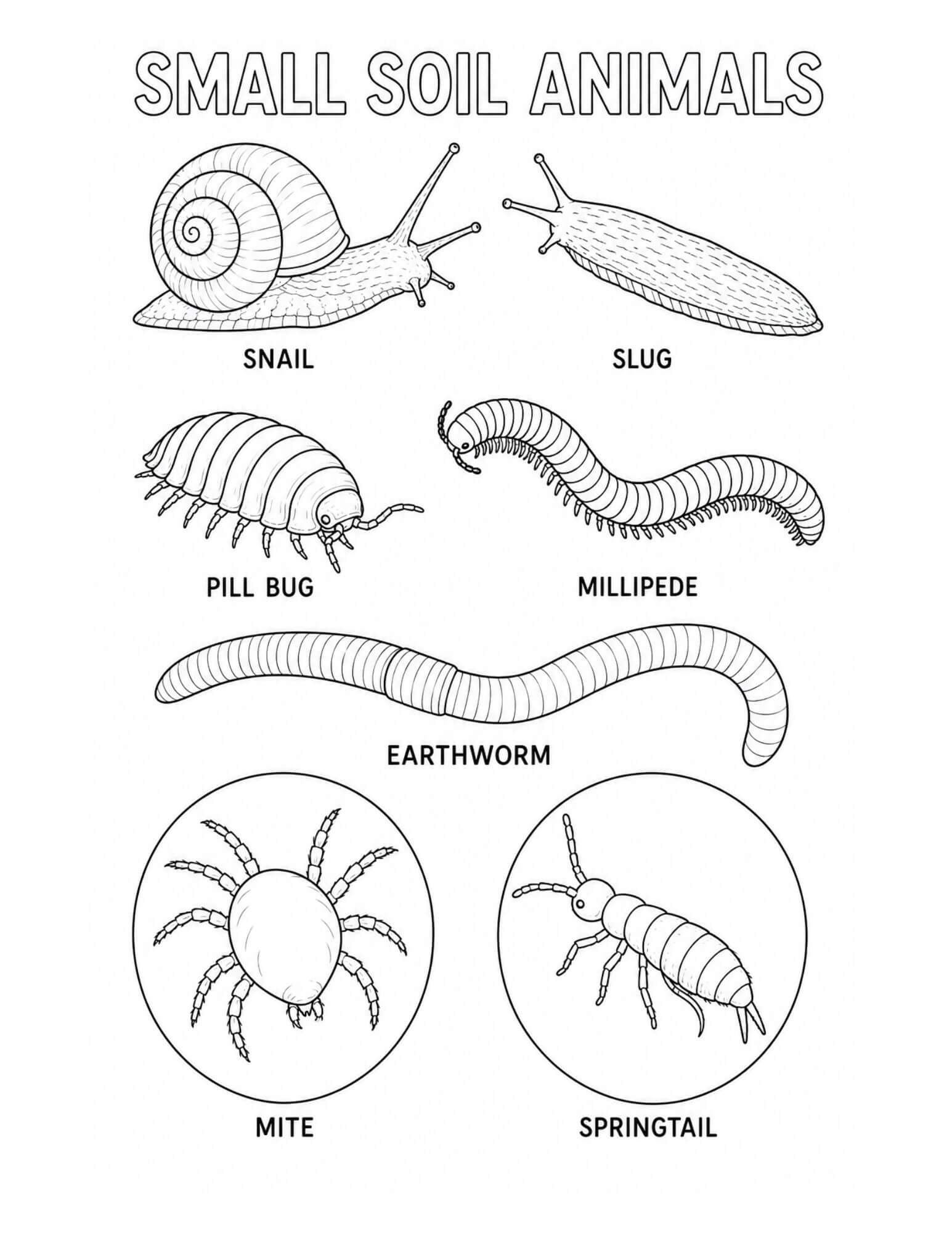
With free sample
These soil animals coloring pages help students in Grades 2–3 discover the busy underground world beneath their feet. Through coloring, observation, labeling, and discussion, children can learn about earthworms, ants, pill bugs, beetle grubs, millipedes, centipedes, moles, and many other soil organisms.
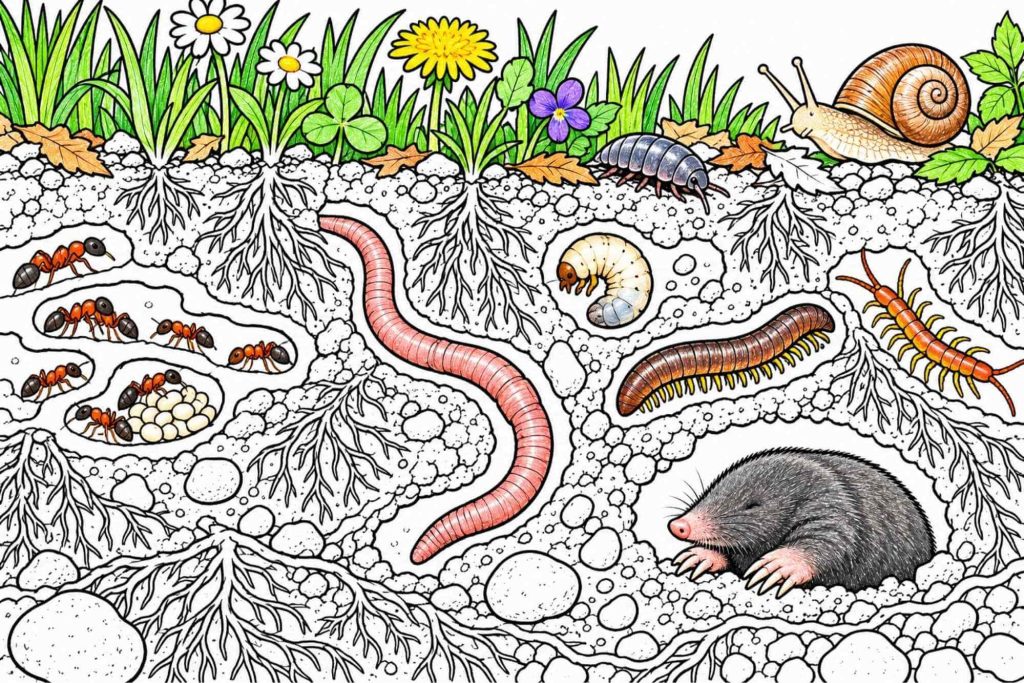
At first glance, soil may look like nothing more than dirt. A closer look, however, reveals a living habitat filled with animals and other organisms that depend on soil for food, moisture, shelter, and space.
These soil animals coloring pages for Grades 2–3 help children explore this hidden world through detailed illustrations, observation, coloring, labeling, comparing, and simple science discussions.
How Can I Teach Children About Soil Animals in Grades 2–3?
Begin with clear pictures of animals in their natural underground habitats. Ask students to observe where each animal lives, how it moves, what body structures it has, and what it might eat. Coloring pages become meaningful science activities when children use visual evidence to describe, compare, classify, and ask questions about soil life.
Soil Is a Living Habitat
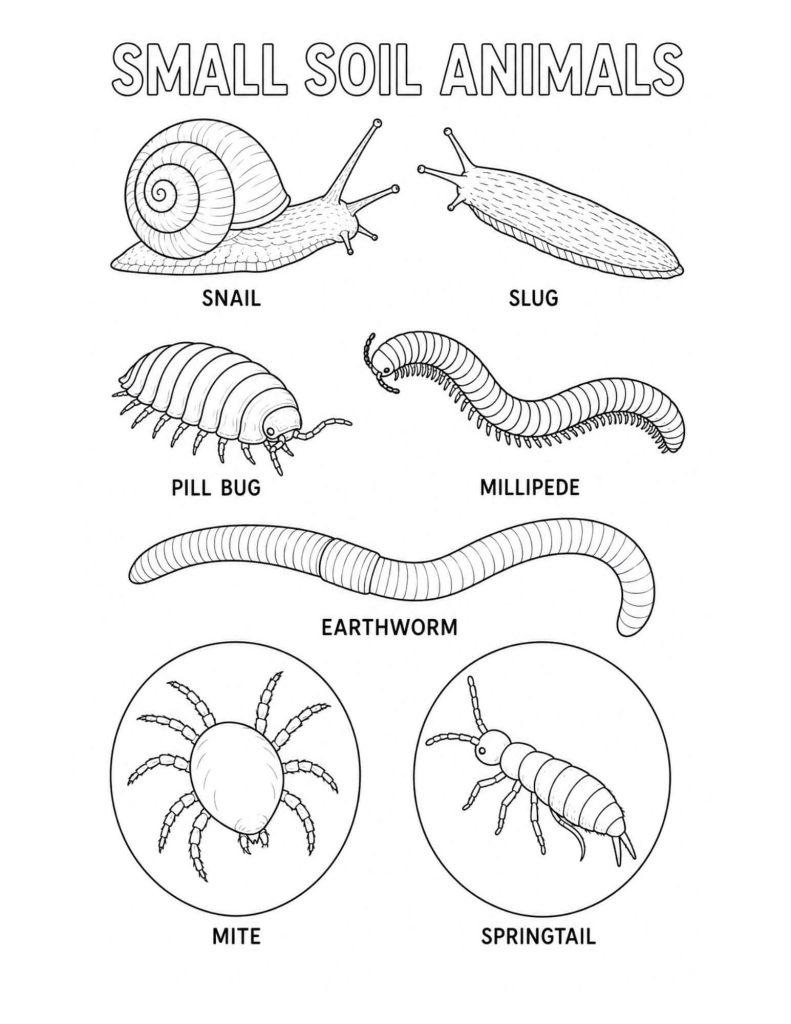
Soil is not simply a material in which plants grow. It is also a habitat that provides living things with food, moisture, shelter, air, and space.
Some soil organisms are too small to see without magnification, while others are easy to observe beneath leaves, rocks, and logs. The USDA Natural Resources Conservation Service Soil Biology Primer describes soil as a living system containing bacteria, fungi, protozoa, nematodes, arthropods, earthworms, and many other organisms.
Students can explore this diversity through coloring pages showing:
- earthworms and their tunnels;
- ants living in underground colonies;
- pill bugs, millipedes, snails, and slugs in moist leaf litter;
- beetle grubs and mole crickets beneath the surface;
- centipedes hunting smaller soil animals;
- moles, field mice, and naked mole-rats living in burrows;
- fungi, bacteria, nematodes, mites, and springtails;
- animals living under rocks, roots, and fallen logs.
This variety helps children understand that soil is an ecosystem rather than an empty space.
Before exploring the animals that live beneath our feet, help students investigate soil layers and components with this hands-on What Is Soil Made Of? An NGSS-Aligned Soil Jar Experiment.
To extend the unit through a creative science-and-art experience, students can explore natural soil colors and pigments with Painting with Soil: A Hands-On Soil Science and Natural Pigment Art Activity for Grades 2–3.
What Can Children Learn From Soil Animal Coloring Pages?
Earthworms and Soil Tunnels
Earthworms move through soil and create tunnels. These tunnels can help air and water move through the ground. Earthworms also move soil particles and interact with decaying organic material. The USDA explains how earthworms create tunnels and influence soil structure.
While students color an earthworm, ask:
- What body parts help an earthworm move?
- Why might an earthworm need moist soil?
- What happens to the soil as the earthworm makes a tunnel?
- Where would you expect to find an earthworm?

Ants and Underground Colonies
An ant colony provides a clear example of an underground animal community. Students can observe tunnels, chambers, eggs, larvae, adult ants, and stored food.
After coloring the ant colony page, children can identify the different chambers and discuss why ants need separate spaces for food, young ants, and movement.
Pill Bugs, Millipedes, and Centipedes
These animals are often found in damp places beneath rocks, logs, and fallen leaves. However, they do not all belong to the same animal group.
A pill bug is a land-dwelling crustacean, while millipedes and centipedes are arthropods but not insects. Millipedes often feed on decaying plant material, while centipedes are predators that hunt other small animals. The University of Minnesota Extension provides additional information about these animals and their roles in moist, decaying habitats.
Ask students to compare:
- the number and position of the legs;
- body shape;
- movement;
- food;
- preferred habitat.

Beetle Grubs and Mole Crickets
A beetle grub is the larval stage of a beetle. Many grubs have a pale, curved body and live among soil and plant roots. Different species may eat roots, decaying plant material, or other organic matter. University of Maryland Extension explains that beetle larvae are commonly found in soil.
Mole crickets are insects with strong front legs adapted for digging. Their unusual body shape makes them an excellent example of how an animal’s structures can help it survive in a particular habitat.
Moles and Naked Mole-Rats
Larger underground animals give students an opportunity to compare mammals with smaller soil invertebrates.
Moles use powerful front feet to dig, while naked mole-rats use their large front teeth to create tunnel systems. Despite their name, naked mole-rats are rodents rather than true moles. They live in underground colonies in eastern Africa. Students can learn more from the Smithsonian’s National Zoo naked mole-rat fact sheet.
Soil Animals, Soil Organisms, and Decomposers
This topic is also a good opportunity to introduce careful scientific classification.
Not every soil organism is an animal. Fungi and bacteria are living organisms, but they belong to different groups. Earthworms, millipedes, pill bugs, beetle grubs, and ants are animals.
Many soil animals eat dead leaves and other organic material, breaking it into smaller pieces. Fungi and bacteria continue the decomposition process and help return nutrients to the ecosystem. National Geographic’s decomposer resource offers a helpful teacher-friendly explanation of decomposers and detritivores.
Students do not need to memorize every scientific category. The main goal is to recognize that many different organisms interact within the soil ecosystem.
Turning Coloring Into a Science Investigation
Coloring is most effective when it is connected to purposeful observation. Before students begin, ask them to examine the entire illustration.
They can look for:
- tunnels and burrows;
- plant roots;
- rocks and soil particles;
- fallen leaves and wood;
- animals living at different depths;
- animals found above and below the soil;
- body structures used for digging or moving.
Encourage students to use observation sentences such as:
- “I notice that…”
- “I think this animal lives here because…”
- “This body part may help the animal…”
- “Both animals have…, but only one has…”
- “My evidence from the picture is…”
Students can then color the illustration, label selected organisms, and write one or two sentences about their observations.
Different Ways to Use the Coloring Activities
Introduce a Soil Science Unit
Display a detailed underground scene and ask students to name everything they can find. Record their ideas before teaching the vocabulary. Return to the same picture at the end of the unit to see what students can now explain.
Create a Soil Science Center
Place several pages in a science center with colored pencils, vocabulary cards, magnifying glasses, and nonfiction books. Students can color, label, compare, and record questions independently.
Complete a Search-and-Find Activity
The “What’s Hiding in the Soil?” page encourages careful visual observation. Students find the hidden organisms and color each matching symbol as they locate it.
Follow the activity with questions such as:
- Which animal was easiest to find?
- Which animal was best hidden?
- What features helped the animal blend into its habitat?
Compare Above- and Below-Ground Habitats
Use the cross-section pages to compare animals found on the soil surface with those that spend most of their time underground.
Students can create a simple two-column chart:
| Above the Soil | Below the Soil |
|---|---|
| Butterfly | Earthworm |
| Bee | Mole |
| Snail | Beetle grub |
| Rabbit | Ant colony |
Some animals may use both areas. This creates an opportunity to discuss why scientific classifications are not always as simple as they first appear.
Finish an Underground Picture
The drawing-completion page invites students to add roots, soil layers, tunnels, and animals beneath a plant. This activity allows children to apply what they have learned rather than simply copy a finished scene.
Ask students to include:
- at least three soil animals;
- plant roots;
- one tunnel or burrow;
- rocks or soil particles;
- labels for two organisms.
Use the Individual Animal Pages for Mini-Research
The earthworm, pill bug, beetle grub, and mole cricket pages can become simple research posters. Students color the animal and add three facts:
- Where does it live?
- What does it eat?
- What body structure helps it survive?
A Simple 30-Minute Soil Animals Lesson
1. Engage – 5 minutes
Show students an underground scene and ask:
“Is soil alive?”
Allow children to share their initial ideas.
2. Observe – 5 minutes
Students examine a soil animals coloring page without coloring it. They circle or point to the organisms they recognize.
3. Explore and Color – 10 minutes
Students color selected animals and their surroundings. Encourage realistic habitat colors while allowing creativity in areas where the exact color is unknown.
4. Discuss – 5 minutes
Ask students to compare two animals. Discuss their body structures, movement, food, and location in the soil habitat.
5. Assess – 5 minutes
Students complete an exit ticket:
- One soil animal I learned about is…
- It lives…
- One structure or behavior that helps it survive is…
Student-Friendly Soil Vocabulary
| Word | Student-Friendly Meaning |
|---|---|
| soil | The loose material covering much of Earth’s land where many plants and animals live |
| organism | A living thing |
| habitat | A place where an organism finds what it needs to live |
| burrow | A hole or underground home made by an animal |
| tunnel | A long underground passage |
| leaf litter | Fallen leaves and other plant pieces covering the ground |
| larva | A young stage of some animals that looks different from the adult |
| colony | A group of animals of the same kind living together |
| decompose | To break down dead material into smaller and simpler parts |
| adaptation | A structure or behavior that helps an organism survive |
NGSS Connections for Grades 2–3
These soil animal activities can support the following Next Generation Science Standards:
- 2-LS4-1: Make observations of plants and animals to compare the diversity of life in different habitats.
- 3-LS4-3: Construct an argument with evidence that some organisms survive well in a particular habitat while others survive less well or cannot survive there.
The activities also support science practices such as making observations, comparing evidence, asking questions, communicating information, and constructing simple explanations.
A coloring worksheet alone does not fully meet a performance expectation. However, it can provide an effective visual model and observation tool when combined with discussion, investigation, and evidence-based writing.
Differentiating the Activities
For emerging readers and English language learners, provide picture-word cards and allow students to answer questions orally.
For on-level learners, ask students to label the animals and write one observation sentence.
For advanced learners, invite students to classify organisms, compare adaptations, or create a simple soil food chain.
Students can also work in pairs, with one child describing an organism while the other locates it in the picture.
Extend Your Soil Science Unit
Before learning about the animals that live in soil, students can investigate the material itself with the What Is Soil Made Of? An NGSS-Aligned Soil Jar Experiment.
You can also combine science and art by exploring the natural colors found in different soil samples with the Painting with Soil Activity for Grades 2–3.
Together, these activities help children explore soil as a material, a natural resource, and a living habitat.
Frequently Asked Questions
What are soil animals?
Soil animals are animals that live in the soil, on its surface, or in the leaf litter above it. Examples include earthworms, ants, pill bugs, millipedes, centipedes, beetle grubs, mites, springtails, moles, and many other organisms.
No. Fungi, bacteria, and plants are living soil organisms, but they are not animals. This distinction provides a useful introduction to classifying living things.
No. A pill bug is a terrestrial crustacean. It is more closely related to crabs and shrimp than to insects.
Earthworms are often described as decomposers in elementary lessons. More precisely, they eat and break apart decaying organic material, helping the decomposition process. Fungi and bacteria carry out much of the final chemical breakdown.
Soil animals have different roles. Some create tunnels, some eat dead plant material, some feed on roots, and others hunt smaller organisms. Together, they form part of a complex soil food web.
Coloring pages support science learning when students observe details, identify organisms, compare structures, label habitats, discuss evidence, and explain what they notice. The scientific thinking surrounding the coloring activity is more important than coloring alone.