How Can I Teach Hibernation to 2nd and 3rd Graders?
Teaching hibernation in Grades 2–3 works best when students begin with a simple winter problem: cold weather and limited food. Students can then explore how hibernating animals conserve energy through slower breathing, a slower heart rate, and changes in body temperature. Reading passages, visual vocabulary, sorting, and cause-and-effect activities help children understand that hibernation is more than a long winter sleep.
Why Do Animals Hibernate?
Winter creates a difficult survival puzzle for many animals. Temperatures fall just as insects disappear, plants stop growing, and berries and seeds become harder to find. At the same time, warm-blooded animals may need more energy to keep their bodies warm.
Imagine trying to keep a house warm during a freezing winter while having very little fuel. Animals face a similar problem: they need energy, but the food that supplies that energy may be scarce. Hibernation helps some animals solve this problem.
Cold Weather Requires Energy
An animal’s body uses energy all day—even while the animal is resting. Energy is needed for breathing, pumping blood, moving, digesting food, and maintaining body temperature.
When the weather gets colder, many mammals must use additional energy to stay warm. Small animals can lose body heat especially quickly because their bodies have a large surface area compared with their size.
A bat, groundhog, or ground squirrel cannot simply turn on a heater. It must use energy from food or stored body fat.
Winter Food Can Be Difficult to Find
Cold weather is only part of the problem. For many hibernating animals, the shortage of food is just as important.
During winter:
- many insects are no longer active;
- snow may cover seeds and plants;
- berries and leaves become scarce;
- frozen ground can make food difficult to reach.
An insect-eating bat may have very little to hunt when insects disappear. A groundhog that eats grasses and other plants may struggle to find food beneath snow-covered ground.
Remaining fully active would use energy faster than these animals could replace it.
Animals Build Energy Stores Before Winter
Many hibernating animals prepare during late summer and fall by eating more than usual. This period of increased eating is called hyperphagia.
The extra food is stored in the animal’s body as fat. That fat works like a packed lunch—or a savings account—that the animal can use when fresh food is unavailable.
Students can think of body fat as a charged battery. Before winter, the animal charges its battery by eating. During hibernation, it uses that stored energy very slowly.
Hibernation Helps Conserve Energy
During hibernation, an animal’s body shifts into an energy-saving state.
Depending on the species:
- its heart beats more slowly;
- its breathing slows down;
- its body temperature may decrease;
- its metabolism slows;
- it uses much less energy than it would while active.
This is why hibernation is not the same as regular sleep. A sleeping animal still uses a considerable amount of energy and can usually wake quickly. A hibernating animal experiences much greater changes throughout its body. Hibernation also does not always mean sleeping continuously from fall until spring. Many hibernators briefly wake at different times before returning to their low-energy state. The main purpose remains the same: hibernation allows an animal to stretch its stored energy through a season when finding enough food would be difficult or impossible.
Classroom Discussion Question
Ask students:
If a small bat remained active all winter but could not find insects to eat, what might happen to its stored energy?
Encourage students to explain the relationship between cold weather, limited food, energy use, and survival.
Quick Quiz
- Why can winter create an energy problem for animals?
- Name two body changes that may happen during hibernation.
- How does stored body fat help a hibernating animal survive?
Answer Key
- Animals may need more energy to stay warm while food becomes harder to find.
- Accept any two: the heart beats more slowly, breathing slows, body temperature may decrease, or metabolism slows.
- Stored body fat provides energy when the animal is not eating or cannot find enough food.
Hibernation Is Not the Same as Regular Sleep
A hibernating animal may look as if it is simply taking a very long nap. It rests in a quiet den, cave, burrow, or hollow log, often curled into a ball. Inside its body, however, something much more complex is happening.
Regular sleep gives the body time to rest, but most body processes continue at nearly normal levels. During hibernation, many of those processes slow down dramatically so the animal can conserve energy.
Think of the difference this way: regular sleep is like turning down the lights in a house. Hibernation is more like placing the whole house in energy-saving mode.
The Heart Beats More Slowly
An animal’s heart pumps blood throughout its body. Every heartbeat requires energy.
During hibernation, the heart may beat much more slowly than it does when the animal is active. Because the animal is not running, hunting, climbing, or searching for food, its muscles need less oxygen and fewer nutrients.
A slower heart rate helps the animal use its stored energy more gradually.
Breathing Slows Down
Hibernating animals also breathe fewer times each minute. Some species may even pause for long periods between breaths.
This slower breathing matches the animal’s reduced activity. Its body is using less oxygen because its cells are working at a much slower rate.
Students can compare this with their own breathing. After running, they breathe quickly because their muscles need more oxygen. When they sit quietly, their breathing slows. A hibernating animal’s breathing can slow much more dramatically than it does during ordinary rest.
Body Temperature May Decrease
Many hibernating animals allow their body temperature to drop. Instead of using large amounts of energy to remain warm, their bodies become cooler and more closely match the temperature of their surroundings.
The amount of change depends on the animal. Some small mammals experience a large decrease in body temperature, while other hibernators remain much warmer.
This is an important reason to use the word may when teaching this concept:
During hibernation, an animal’s body temperature may decrease.
Not every hibernating species experiences the same changes.
The Animal Uses Less Energy
The combined changes in heart rate, breathing, body temperature, and metabolism allow the animal to use much less energy. Imagine a phone with a nearly full battery. If videos, games, and bright lights are running, the battery drains quickly. In energy-saving mode, the phone reduces its activity and the battery lasts much longer. Hibernation works in a similar way. The animal cannot recharge by eating regularly, so its body slows down and carefully uses the energy stored in body fat.
Hibernators May Periodically Wake
Hibernation does not always continue without interruption. Many hibernating animals periodically become warmer and more active for a short time before returning to their low-energy state. These brief waking periods are a normal part of hibernation, although they require a surprising amount of the animal’s stored energy.
The National Park Service’s explanation of hibernation describes hibernation as a specialized form of dormancy rather than ordinary sleep. Animals may appear to be sleeping, but their heart rate, breathing, body temperature, and energy use can change far more than they do during a normal night’s rest.
Regular Sleep and Hibernation Compared

Teacher Discussion Prompt
Ask students:
Why would regular sleep alone not save enough energy for an animal that cannot find food for several weeks? Encourage them to use the words heart rate, breathing, body temperature, and energy in their explanations.
Six Hibernation Activities for Grades 2–3
The best hibernation activities for second and third grade do more than ask students to memorize a list of sleeping animals. Young scientists need opportunities to read, observe, compare, classify, explain, and apply what they have learned.
The following six activities create a simple learning sequence. Students begin with the basic concept of hibernation and gradually move toward explaining how different animals survive challenging seasons.
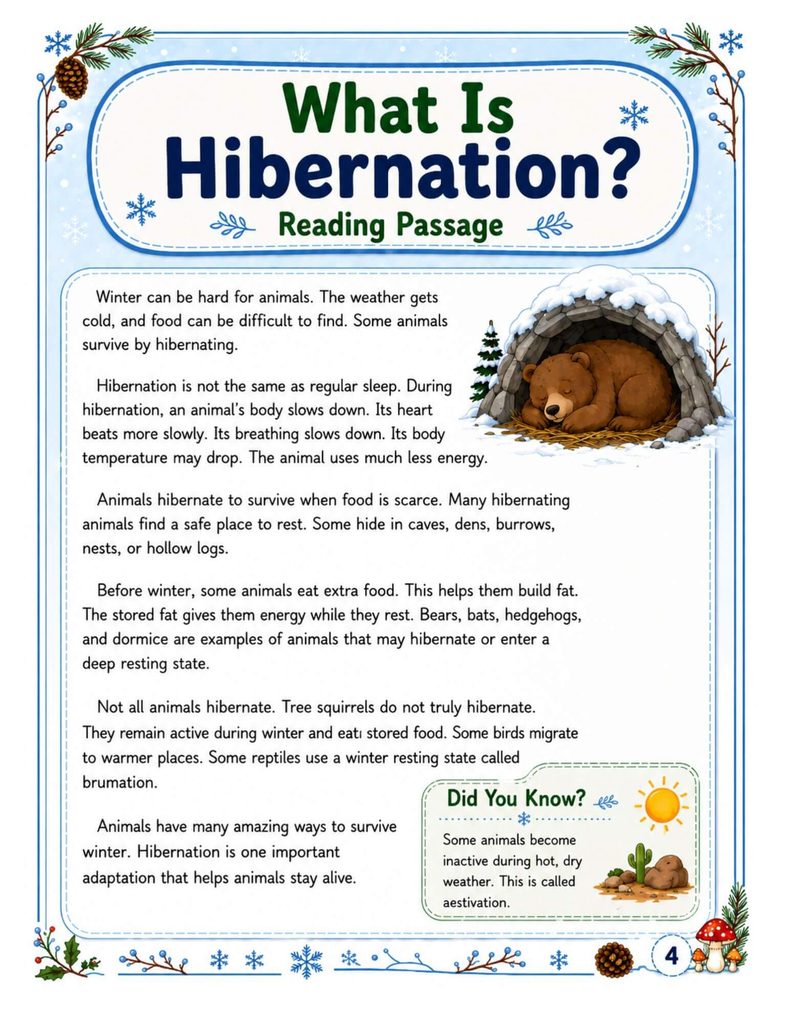
1. Begin With a Hibernation Reading Passage
A short informational passage gives every student the same foundation before the class begins more independent activities.
What It Teaches
Students learn:
- why winter can be challenging for animals;
- why hibernation is different from regular sleep;
- how an animal’s body changes during hibernation;
- how animals prepare by eating extra food;
- where hibernating animals may rest;
- why not every animal uses the same winter survival strategy.
A reading passage also gives students meaningful opportunities to practice identifying the main idea, locating key details, and answering questions with evidence from a text.
How to Use It
Before reading, display the title What Is Hibernation? and ask:
How could an animal survive for several weeks when it is cold and food is difficult to find?
Record a few predictions without confirming the answers. Then read the passage aloud or have students read with a partner.

Pause after each short section to discuss one idea:
- What problem is the animal facing?
- What changes inside its body?
- Where does it get energy?
- Where might it rest?
- What happens when spring returns?
After reading, students can complete a reading check independently, with a partner, or as part of a guided reading group.
Grade 2 Differentiation
Second graders can:
- listen while the teacher reads the passage aloud;
- underline important vocabulary;
- use picture clues to support understanding;
- answer with short phrases or sentence starters;
- discuss answers orally before writing.
Helpful sentence starters include:
Animals hibernate because __________.
During hibernation, the animal’s __________ slows down.
Grade 3 Differentiation
Third graders can:
- read the passage independently;
- identify the main idea and supporting details;
- answer in complete sentences;
- underline the sentence that supports each answer;
- explain a cause-and-effect relationship from the text.
Teacher Tip: Do not introduce hibernation simply as “sleeping all winter.” Establish from the beginning that hibernation is a special energy-saving state involving changes throughout the animal’s body.
2. Build Science Vocabulary With Visuals
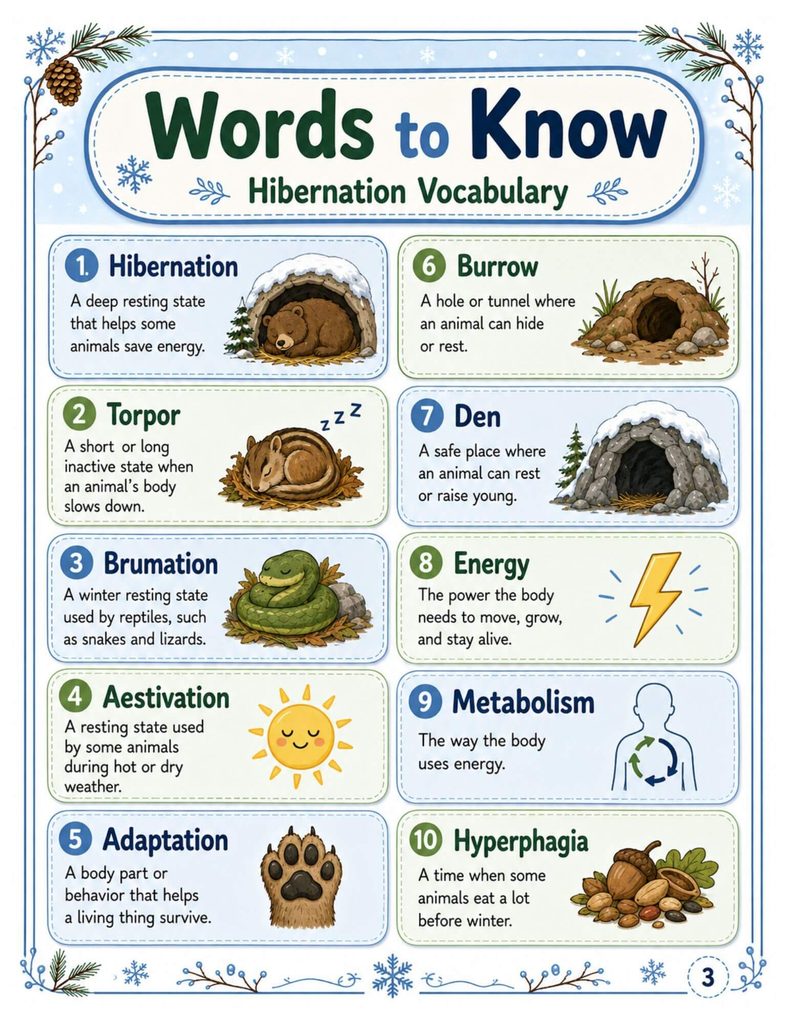
Words such as torpor and metabolism can sound intimidating to young learners. Visual vocabulary cards make these abstract terms easier to understand and remember.
What It Teaches
Students become familiar with important hibernation vocabulary:
- hibernation: a long energy-saving state used by some animals;
- torpor: a shorter period when an animal’s body temporarily slows down;
- burrow: a tunnel or shelter dug into the ground;
- den: a safe place where an animal rests or raises its young;
- energy: the fuel a body needs to work, move, and stay alive;
- metabolism: the body processes that use food and stored fat for energy.
Students also learn that some words describe a body process, while others describe an animal’s shelter.
How to Use It
Introduce only two or three words at a time. Display each word with its picture and definition, read it aloud, and invite students to repeat it.
Next, ask students to use the word in context:
A groundhog rests in a __________.
During hibernation, the animal uses less __________.
An animal’s __________ slows as its body conserves energy.
After the words have been introduced, students can complete a vocabulary match, create illustrated vocabulary cards, or sort the words into categories such as body changes, shelters, and survival strategies.
Grade 2 Differentiation
Second graders can focus on the most concrete terms first:
- hibernation;
- burrow;
- den;
- energy.
Allow students to match words to pictures and complete oral sentences before introducing more challenging vocabulary.
Grade 3 Differentiation
Third graders can work with all six terms and explain how they are connected.
For example:
A groundhog hibernates in a burrow so its body can conserve energy.
Students can also compare related terms such as hibernation and torpor.
Teacher Tip: Use the same vocabulary throughout the unit. Repeatedly seeing and hearing the words in readings, diagrams, discussions, and writing tasks is more effective than memorizing each definition only once.
3. Try a Hibernation or Not? Animal Sort
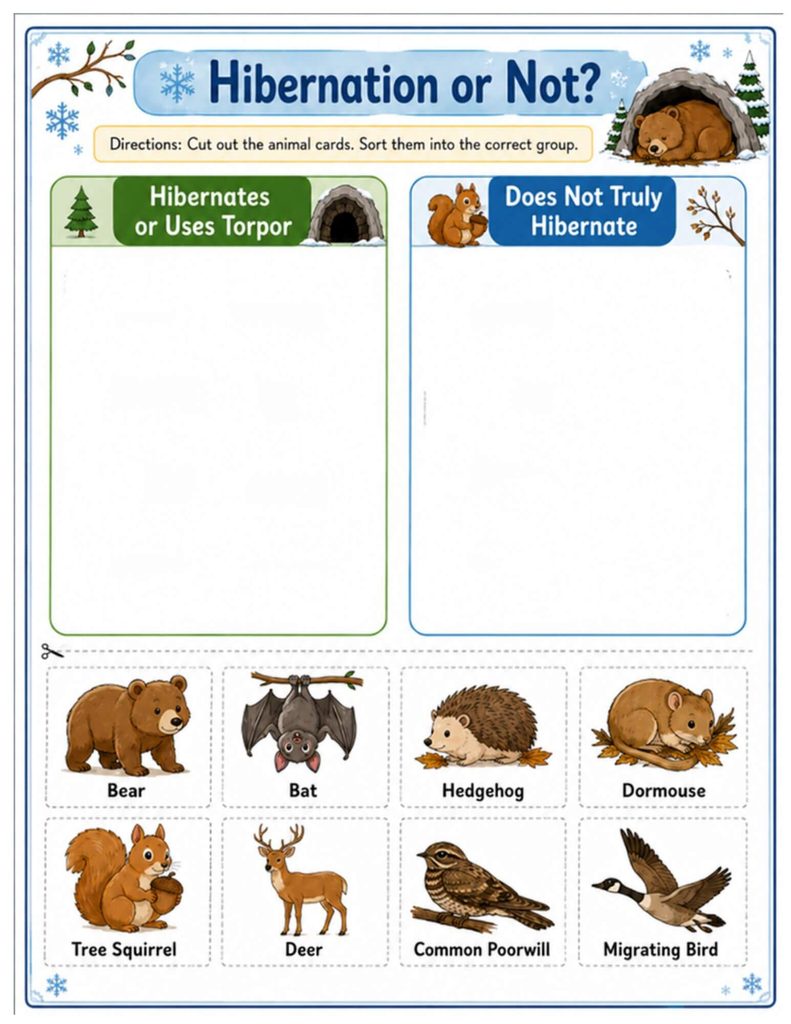
Animal sorting is engaging, but it becomes much more valuable when students must explain the evidence behind their choices.
What It Teaches
Students learn that animals respond to winter in different ways. Some hibernate or use torpor, while others migrate, store food, find shelter, or remain active.
The activity also helps correct common misconceptions. For example, tree squirrels may spend more time in sheltered nests during severe weather, but they do not truly hibernate. They remain active and eat food they stored earlier.
How to Use It
Give students animal cards featuring examples such as:
- bear;
- bat;
- hedgehog;
- dormouse;
- common poorwill;
- tree squirrel;
- deer;
- migrating bird.
Have students sort the cards into two categories:
Hibernates or Uses Torpor
Does Not Truly Hibernate
Before checking the answers, ask partners to select one card and defend its placement.
A simple evidence frame can help:
I placed the __________ in this group because __________.
This changes the task from guessing or memorizing into a small scientific argument.
Grade 2 Differentiation
Second graders can:
- work with a partner;
- sort fewer animal cards;
- use picture and vocabulary supports;
- explain one choice orally;
- complete a sentence frame.
Grade 3 Differentiation
Third graders can:
- sort the complete set independently;
- write an explanation for two or three animals;
- distinguish between hibernation, torpor, migration, and staying active;
- revise a choice after reading new evidence.
Discussion Question:
If an animal does not hibernate, what other behaviors might help it survive winter? Remind students that does not hibernate does not mean does nothing to prepare for winter.
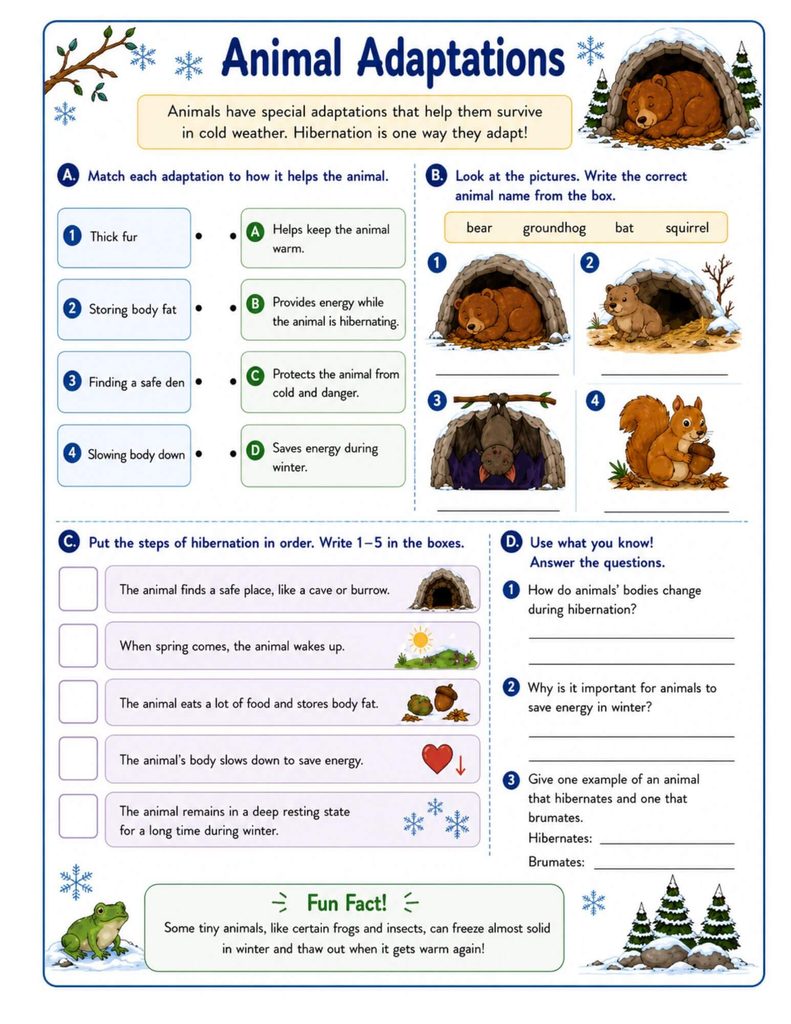
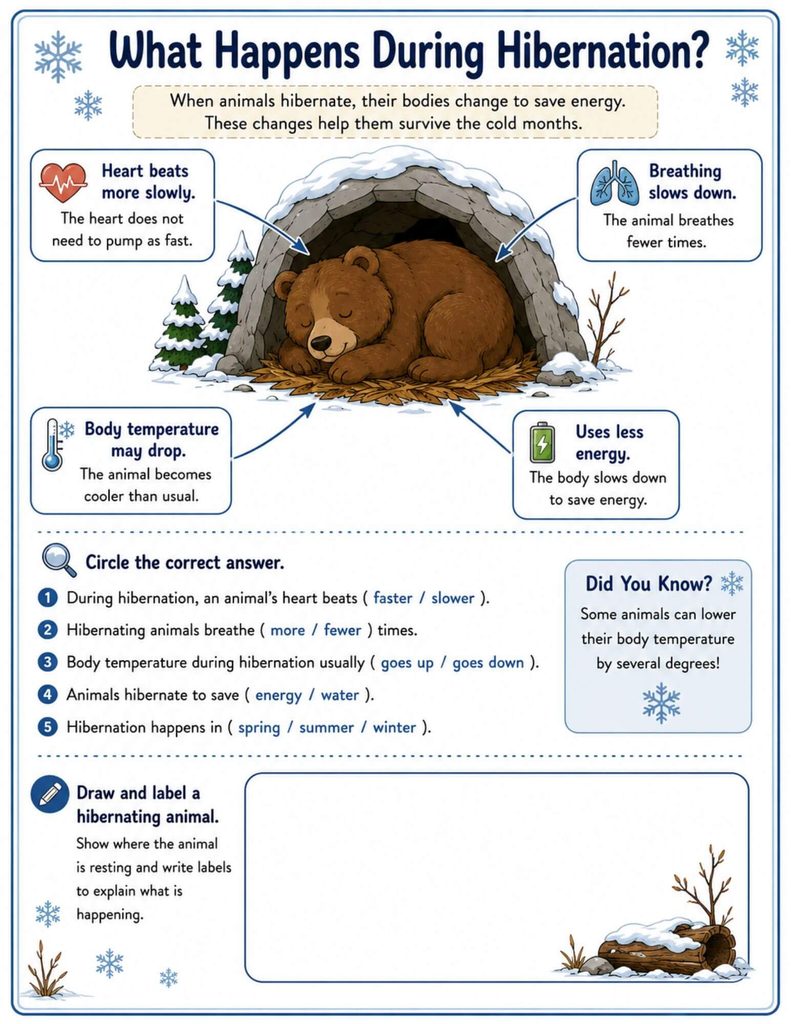
4. Explore Body Changes During Hibernation
Hibernation becomes easier to understand when students can see what happens inside the animal’s body.
What It Teaches
Students examine four major changes:
- the heart beats more slowly;
- breathing slows;
- body temperature may decrease;
- the body uses less energy.
They learn that these changes work together. A slower body needs less fuel, allowing stored fat to last longer when food is scarce.
How to Use It
Begin by asking students to feel their heartbeat while sitting quietly. Then have them imagine how their heartbeat and breathing would change if their body entered an extremely low-energy state.
Use a labeled animal diagram to introduce each body change. Ask students to follow the arrows from the animal to the heart, lungs, thermometer, and energy symbol.
Students can then:
- select the correct words to complete statements;
- label a hibernating animal;
- draw arrows showing body changes;
- explain how one change helps the animal conserve energy.
Be careful not to suggest that every species experiences exactly the same decrease in body temperature. The amount of change varies among hibernating animals.
Grade 2 Differentiation
Second graders can match each body part or symbol with a simple statement:
- heart — beats more slowly;
- lungs — breathing slows;
- thermometer — temperature may decrease;
- energy symbol — uses less energy.
They can also draw and label a hibernating animal using a word bank.
Grade 3 Differentiation
Third graders can explain cause and effect:
Because the animal’s heart and breathing slow down, its body uses less energy.
They can also compare the changes during regular sleep with the more dramatic changes that occur during hibernation.
Discussion Question: How does a slower heartbeat help an animal survive when it cannot find food? Encourage students to connect the slower heartbeat with reduced energy use rather than simply answering, “It helps the animal sleep.”
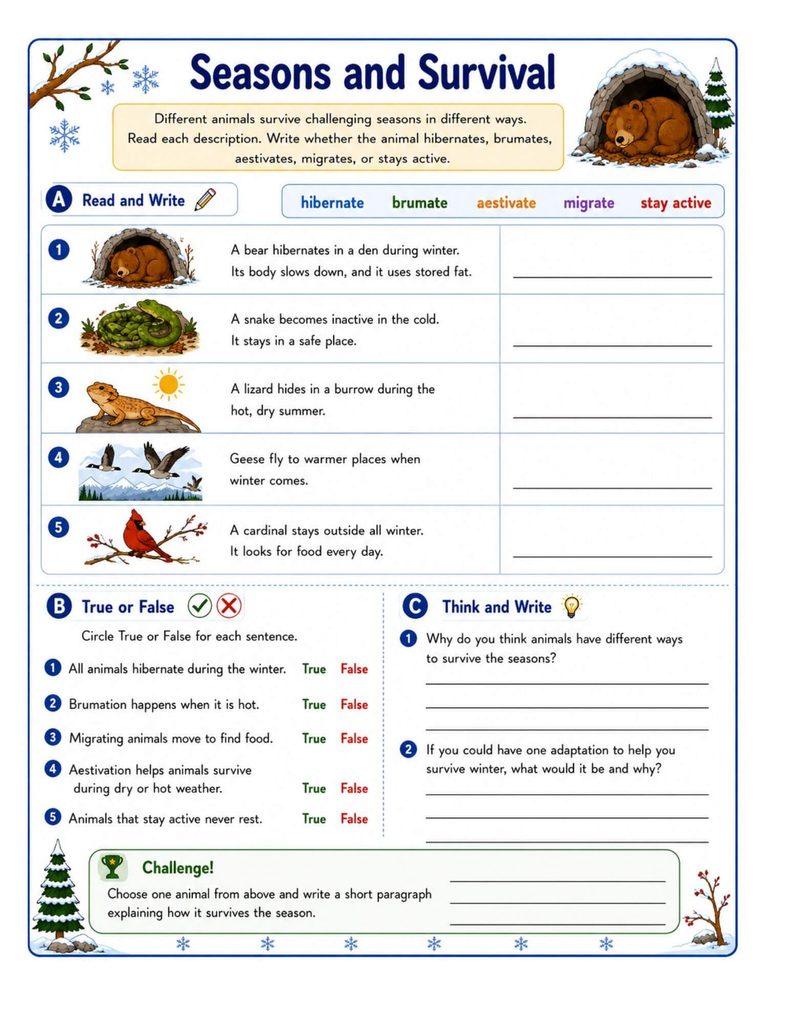
5. Compare Seasonal Survival Strategies
Hibernation is only one way animals survive difficult environmental conditions. Comparing several strategies helps students see that animals respond differently depending on their bodies, habitats, and needs.
What It Teaches
Students compare five seasonal survival strategies:
- hibernate: enter a long energy-saving state;
- brumate: become inactive during cold weather, as some reptiles do;
- aestivate: become inactive during very hot or dry conditions;
- migrate: move to another area to find food or more suitable conditions;
- stay active: continue searching for food and shelter throughout the season.
The activity helps students understand that no single strategy works for every animal.
How to Use It
Present short animal situations one at a time.
For example:
A bat rests in a sheltered cave during winter while its body processes slow down.
A snake becomes inactive in a protected place when temperatures fall.
Geese travel to an area where food is easier to find.
A cardinal remains in its habitat and searches for food throughout winter.
Ask students to identify the strategy and point to the evidence that supports their answer.
Students can then complete a chart, matching activity, or written comparison.
Grade 2 Differentiation
Begin with three familiar strategies:
- hibernate;
- migrate;
- stay active.
Once students understand these, introduce brumation and aestivation as challenge vocabulary.
Grade 3 Differentiation
Third graders can compare all five strategies and explain why a strategy may be suitable for one animal but not another.
They can also write a short paragraph using a cause-and-effect structure:
Because the weather becomes __________, the animal __________. This helps it survive by __________.
Teacher Tip: Avoid presenting one strategy as the “best” way to survive. The most successful strategy is the one that fits the animal’s body, food source, habitat, and environmental conditions.
To extend the lesson beyond seasonal behaviors, students can investigate how body coverings protect animals with this hands-on tundra insulation STEM experiment.
After students explore hibernation as a seasonal survival strategy, extend their thinking with this creative animal adaptations activity, in which they design an animal suited to a particular environment and explain how its features support survival.
Because many familiar winter animals live in woodland environments, these temperate forest habitat resources can help students connect seasonal behavior with an animal’s food, shelter, and habitat needs.
6. Complete an Animal Survival Report
An animal survival report allows students to bring vocabulary, reading, habitats, diet, shelter, and seasonal behavior together in one final task.
What It Teaches
Students apply their learning by researching or selecting one animal and explaining:
- where it lives;
- what it eats;
- where it rests or hides;
- how it survives winter or other difficult weather;
- which vocabulary term describes its strategy.
This activity also develops informational writing and science communication skills.
How to Use It
Provide students with animal fact cards, classroom books, or a small collection of teacher-approved websites. Ask each student to choose one animal.
Students complete the report by recording:
- the animal’s name;
- its habitat;
- its diet;
- its shelter;
- its seasonal survival strategy;
- ononnect its burrow, plant-based diet, stored body fat, and hibernation behavior.
Grade 2 Differentiation
Second graders can use:
- a word bank;
- labeled picture choices;
- sentence starters;
- one provided fact card;
- space for drawing and labeling.
Sentence frames might include:
My animal is a __________.
It lives in __________.
During winter, it __________.
This helps it survive because __________.
Grade 3 Differentiation
Third graders can:
- gather information from two sources;
- write complete informational paragraphs;
- use at least two science vocabulary words;
- explain a cause-and-effect relationship;
- compare their animal with a classmate’s animal.
Discussion Question: Which part of your animal’s survival strategy is most closely connected to its habitat? An animal survival report makes an effective final assessment because students must do more than recognize a vocabulary word. They must use science ideas to explain how a real animal responds to the challenges in its environment.
A Simple Three-Day Hibernation Mini-Unit
These hibernation activities can be organized into three 40–50-minute science lessons. Each day builds on the previous lesson, moving students from basic understanding to comparison, explanation, and independent application.
Day 1: Build Background Knowledge
Learning goal: Students will explain what hibernation is and why some animals use it to survive winter.
Begin with a simple guiding question:
How can an animal survive winter when the weather is cold and food is difficult to find?
Invite students to share their ideas before reading. Record a few predictions on the board, but do not correct them yet.
Read the What Is Hibernation? passage aloud, with partners, or independently. Pause to discuss how cold weather, limited food, and increased energy needs create a survival problem for animals.
Introduce the most important vocabulary with visual support:
- hibernation;
- torpor;
- energy;
- metabolism;
- burrow;
- den.
Finish the lesson with the reading check or a short class discussion. Ask students to return to their original predictions and identify any ideas they would now change.
Quick learning check:
Hibernation helps animals survive because __________.
Second graders can complete the sentence orally or with a word bank. Third graders can write a complete explanation using evidence from the reading passage.
Day 2: Compare Body Changes and Survival Strategies
Learning goal: Students will describe what happens inside a hibernating animal’s body and compare different seasonal survival strategies.
Begin with a quick vocabulary review. Then use the What Happens During Hibernation? diagram to examine four important changes:
- the heart beats more slowly;
- breathing slows;
- body temperature may decrease;
- the body uses less energy.
Ask students to explain how these changes are connected. Help them recognize that a slower body uses stored energy more gradually.
Next, complete the Hibernation or Not? animal sort. Students should not only place each animal in a category but also explain the evidence supporting at least one choice.
Extend the lesson by comparing five seasonal survival strategies:
- hibernate;
- brumate;
- aestivate;
- migrate;
- stay active.
Second graders can begin with hibernation, migration, and staying active. Third graders can compare all five terms and explain why different animals use different strategies.
Quick learning check:
Choose one animal and explain how its seasonal behavior helps it survive.
Day 3: Apply and Assess
Learning goal: Students will apply science vocabulary and survival concepts to a specific animal.
Begin by modeling a short animal survival report. A groundhog is a helpful example because students can connect its plant-based diet, underground burrow, stored body fat, and hibernation behavior.
Students then choose an animal and complete their own report. They should identify:
- where the animal lives;
- what it eats;
- where it rests or hides;
- how it survives winter or difficult weather;
- one vocabulary word connected to its survival strategy.
Second graders can use a provided fact card, word bank, picture choices, and sentence starters. Third graders can gather information from two sources and write a short informational paragraph.
After completing the report, ask students to write one final explanation:
How does your animal’s behavior help it survive the challenges in its environment?
Finish the mini-unit with the animal survival quiz. Use the results to identify which students understand the relationship between seasonal conditions, body changes, energy conservation, and survival.
Teacher Tip: If your science period is shorter than 40 minutes, divide the activities across four or five days. The animal report and quiz can also be completed during separate science or literacy periods.
6. Differentiating the Activities
For Grade 2:
- visual vocabulary;
- matching;
- short written responses;
- sentence starters;
- partner discussions.
For Grade 3:
- cause-and-effect explanations;
- comparing survival strategies;
- citing evidence from reading passages;
- independent animal reports;
- written scientific reasoning.
How These Hibernation Activities Support NGSS
These hibernation activities support NGSS learning goals, especially when students move beyond identifying vocabulary and use evidence to explain how an animal’s characteristics and behaviors help it survive.
Hibernation is not named as a separate elementary NGSS topic. However, it provides an engaging real-world example for exploring relationships among animals, their needs, their behaviors, and the environments in which they live.
Grade 3 Connection: NGSS 3-LS4-3
The strongest connection is to NGSS 3-LS4-3: Biological Evolution—Unity and Diversity.
This performance expectation asks students to construct an argument using evidence that, within a particular habitat, some organisms survive well, some survive less well, and some cannot survive at all.
The hibernation unit supports this standard when students use information about an animal’s needs, habitat, body characteristics, and seasonal behavior as evidence.
For example, students might explain that a groundhog can survive a cold forest winter because it:
- eats extra food and stores body fat before winter;
- rests in a protected underground burrow;
- slows its heart rate and breathing;
- reduces the amount of energy its body uses.
The connection becomes stronger when students compare animals instead of studying one animal in isolation.
Try a prompt such as:
Which animal appears best prepared to survive a cold winter in this habitat? Use evidence about food, shelter, body characteristics, and behavior to support your answer.
Students can gather evidence from the reading passage, animal cards, body-change diagram, seasonal strategy activity, and animal survival report.
This work also supports the three dimensions associated with 3-LS4-3:
- Science and Engineering Practice: Engaging in Argument from Evidence;
- Disciplinary Core Idea: LS4.C—Adaptation;
- Crosscutting Concept: Cause and Effect.
Students identify a cause, such as cold weather or limited food, and explain the effect it has on an animal’s behavior and energy use.
Grade 2 Connection: NGSS 2-LS4-1
The activities can also support NGSS 2-LS4-1: Biological Evolution—Unity and Diversity.
This performance expectation asks students to make observations of plants and animals and compare the diversity of life found in different habitats.
A lesson focused only on defining hibernation would not fully address this standard. The connection becomes more meaningful when second graders observe and compare animals from different environments.
Students might compare:
- a groundhog in a temperate forest;
- a bat resting in a cave;
- a cardinal that remains active during winter;
- a reptile that brumates during cold weather;
- a desert animal that aestivates during extreme heat or dryness.
Ask students to look for patterns:
Do all animals respond to difficult weather in the same way?
How does an animal’s habitat affect where it finds food and shelter?
Which animals remain active, and which enter a low-energy state?
Second graders can record their observations using pictures, sorting cards, oral explanations, or a simple comparison chart. The animal survival report can also support 2-LS4-1 when students share reports and compare animals from more than one habitat.
Strengthening the NGSS Connection
To create a stronger standards connection, include an evidence-based task at the end of the unit:
Choose two animals that use different seasonal survival strategies. Explain how each animal’s behavior helps it meet its needs in its habitat. Use information from the readings, diagrams, or animal cards as evidence.
Second graders may complete this task orally, with pictures, or with sentence frames. Third graders can write a short claim supported by two or more pieces of evidence.
This approach turns a seasonal hibernation lesson into a deeper investigation of how organisms interact with their environments and why different animals use different strategies to survive.
Frequently Asked Questions About Animal Hibernation
Hibernation is a special energy-saving state used by some animals when food is difficult to find or environmental conditions become challenging. During hibernation, the animal’s heart rate, breathing, and metabolism slow down. Its body temperature may also decrease. Think of hibernation as the animal’s built-in energy-saving mode.
No. Hibernation is not the same as regular sleep. A sleeping animal’s heart rate, breathing, and body temperature remain relatively close to normal. During hibernation, these body processes may slow dramatically, allowing the animal to use much less energy. Many hibernators also wake briefly at different times before returning to their low-energy state.
Animals hibernate mainly to conserve energy when food is scarce or environmental conditions make staying active difficult. Cold weather can increase the amount of energy a warm-blooded animal needs, while insects, plants, seeds, and other foods may become harder to find. Hibernation allows the animal to survive by using stored body fat very slowly.
During hibernation, an animal’s metabolism slows, its heart beats more slowly, and it breathes fewer times each minute. Its body temperature may also decrease. These changes reduce the amount of energy the animal needs. The exact changes vary by species, so not every hibernating animal experiences the same decrease in temperature or heart rate.
Many bats, groundhogs, marmots, ground squirrels, dormice, and hedgehogs hibernate. Some animals use shorter periods of torpor instead of spending an entire season in a hibernation cycle. Hibernation behavior can vary by species, habitat, climate, and food availability, so it is better to investigate a particular species than assume every member of a familiar animal group hibernates.
Yes, bears are commonly described as hibernators, but their winter state differs from the more extreme hibernation seen in many small mammals. A bear’s metabolism and heart rate decrease, but its body temperature drops only modestly. Bears can also wake more easily than some smaller hibernators. For elementary students, explain that bears use a form of hibernation that helps them conserve energy while remaining more responsive to their surroundings.
Torpor is usually a shorter low-energy state that may last for several hours or days. Hibernation continues over a much longer period and often includes repeated periods of torpor interrupted by brief awakenings. Both involve reduced activity and lower energy use, but hibernation is an extended seasonal survival strategy.
Brumation is a cold-weather resting state used by reptiles such as snakes, lizards, and turtles. Because reptiles depend on environmental heat to regulate their body temperature, they become much less active when temperatures fall. A brumating reptile may remain in a protected shelter and occasionally move or drink. Brumation is similar to hibernation, but it involves different animals and different body processes.
Begin with a simple question: How can an animal survive winter when it is cold and food is difficult to find? Use a short reading passage, visual vocabulary cards, a labeled body-change diagram, and an animal sorting activity. Let students explain their thinking with pictures, partner discussions, word banks, and sentence starters. Compare hibernation with migration and staying active so students understand that animals use different winter survival strategies.
The strongest Grade 3 connection is NGSS 3-LS4-3 when students use evidence to explain how an animal’s characteristics or behaviors help it survive in a particular habitat. Hibernation activities can also support NGSS 2-LS4-1 when students observe and compare animals from different habitats. A vocabulary activity alone does not fully address these standards; students need opportunities to observe, compare, and explain using evidence.