This simple plant experiment helps children observe what happens when a leaf does not receive sunlight for several days.
Investigation Question
How will a tomato leaf change if it does not receive light for one week?
Materials
- A healthy tomato plant
- Aluminum foil
- Paper clips
- A camera or observation sheet
Procedure

How will a tomato leaf change if it does not receive light for one week?Procedure
Compare the covered leaf with the uncovered leaf. Observe their color, texture, and overall condition.
Discuss what plants need to live and grow, including light, water, air, nutrients, and space.
Choose a healthy leaf and observe it closely. Take a photograph or ask students to draw and describe it.
Invite students to make a prediction:
What do you think will happen if the leaf does not receive light for one week?
Loosely cover both sides of the leaf with aluminum foil. If necessary, use a paper clip to hold the foil in place without damaging the leaf.
Leave a similar leaf uncovered. This will be the control leaf used for comparison.
Continue caring for the plant as usual and keep it in a sunny location.
After five to seven days, carefully remove the foil.
What Might Students Observe?
The covered leaf may become lighter, pale green, or yellow. Sometimes the change will be subtle. Because the foil blocked the light, the leaf could not photosynthesize normally or maintain its usual green color.
Discussion Questions
· How did the covered leaf change?
· How was it different from the uncovered leaf?
· Was your prediction supported by the results?
· How did comparing the two leaves help us understand the effect of light?
· How could we make the investigation more accurate?
Simple Science Explanation
Plants use light energy during photosynthesis. They combine water with carbon dioxide from the air to make sugars. These sugars provide the energy and materials plants need to live and grow.
Teacher tip: Do not wrap the foil too tightly, and avoid covering the plant’s growing tip or the entire plant.
Frequently Asked Questions
Leave the leaf covered for approximately five to seven days. Check the plant each day to make sure the foil is still in place and is not damaging the leaf.
Aluminum foil blocks light from reaching the leaf. This allows students to investigate how a lack of light affects the leaf’s color and condition.
No. Cover only one healthy leaf or one large leaflet. The rest of the plant should remain uncovered so it can continue receiving light and growing normally.
Not necessarily. The leaf may become yellow, pale green, or simply lighter than the uncovered leaf. The amount of change depends on the plant, growing conditions, and how long the leaf remains covered.
The uncovered leaf acts as a control. Comparing the two leaves helps students determine whether the observed change was likely caused by the lack of light.
Covering one leaf for a short time should not seriously harm a healthy plant. Wrap the foil loosely, avoid bending the stem, and do not cover the plant’s growing tip or the entire plant.
Yes. This investigation can also work with other healthy plants that have broad leaves. Choose a plant with several leaves so that covering one leaf will not interfere with its overall growth.
A small or invisible change is still a valid result. Record what students observe rather than what they expected to see. Different plants may respond at different rates.
The experiment shows that leaves need light to photosynthesize normally. Without light, photosynthesis slows or stops in the covered area, and the leaf may begin to lose some of its green color.
Further Reading and References
- Lighting for Indoor Plants – University of Minnesota Extension
Explains how insufficient light affects photosynthesis and can cause leaves to become pale green or yellow. - Plant Growth and Development – Oregon State University Extension
Provides background information about photosynthesis, chlorophyll, light, water, and carbon dioxide. - Photosynthesis – NASA Science
Includes introductory and intermediate explanations of how plants use sunlight during photosynthesis. - Photosynthetic Floatation – Exploratorium
Presents another hands-on investigation demonstrating how light affects photosynthesis in leaves.
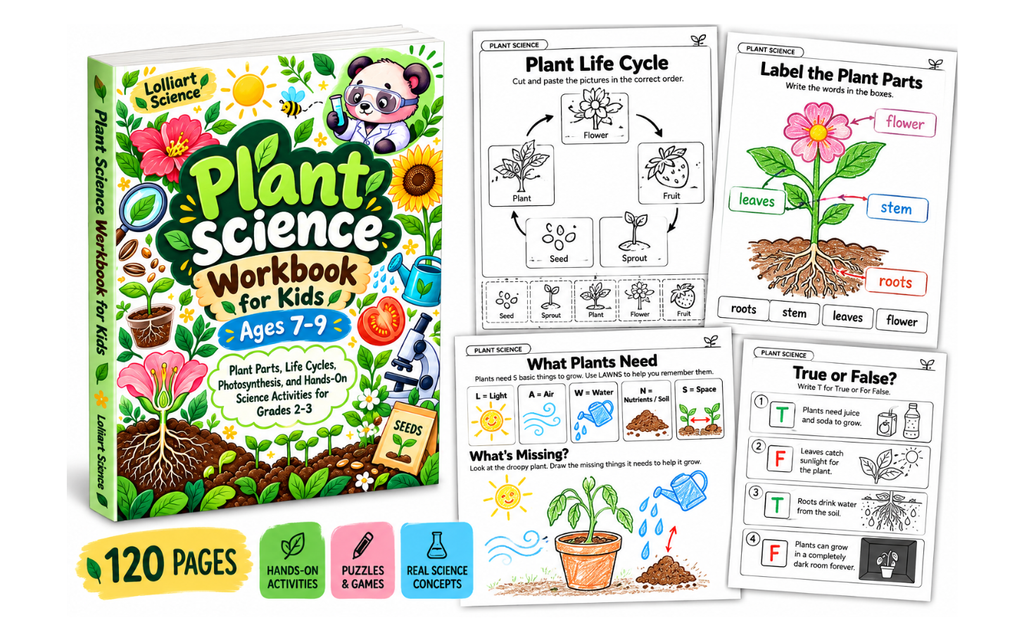
Discover how roots, stems, leaves, and flowers help plants grow! Through illustrated worksheets, creative STEM challenges, and coloring activities, children ages 7–9 can explore plant structures and their functions while developing observation, problem-solving, and science skills.