How does a polar bear walk across deep snow without sinking? Why can a seal stay warm in icy water? And how does a snowy owl protect its feet from freezing temperatures?
Polar animals provide some of the clearest and most fascinating examples of animal structures and behaviors that support survival. For elementary students, these animals make an excellent starting point for exploring the relationship between structure, function, habitat, and survival. (NGSS 4-LS1-1)
Instead of simply asking students to memorize a list of adaptations, teachers can help them look closely at an animal feature and ask:
What does this structure do, and how does it help the animal survive?
That simple question turns a winter animal lesson into meaningful life science.
What Are Polar Animal Adaptations?

Animals living in Arctic and Antarctic environments face some significant challenges.
Temperatures can be extremely cold. Food may be difficult to find. Animals that enter the water must cope with cold temperatures while also moving efficiently enough to swim and catch food.
Different animals have different structures and behaviors that help them meet these challenges.
Students might investigate adaptations such as:
- thick fur and feathers
- layers of body fat, or blubber
- large paws and feet
- specialized hooves
- streamlined body shapes
- flippers
- seasonal camouflage
- sensitive whiskers
- behavioral adaptations such as huddling
The important science idea is not simply that an animal has a particular feature. Students should begin thinking about the function of that feature.
For example, the polar bear activity asks students to connect thick fur and body fat with staying warm and large paws with movement across snow and through water.
That gives students a simple structure-and-function relationship:
large paws → spread body weight over snow → easier movement
Start With Structure and Function
One of the easiest ways to teach animal adaptations in elementary science is to use a repeating question:
How does this feature help the animal?
Students can examine one structure at a time and connect it with its function.

Polar Bear Paws
Polar bears have large paws that spread their weight across snow and ice. Their paws can also help them paddle through water.
Students can compare a wide paw with a much smaller foot and predict which would sink farther into soft snow.

Penguin Feathers
Penguins have dense feathers, and their outer feathers help keep water away from the skin. Staying dry helps reduce heat loss in cold water.
This provides a useful opportunity to introduce the idea of insulation without making the science unnecessarily complicated.
For a closer look at one of the best-known polar animals, explore Penguin Adaptations for Kids with five hands-on activities for teaching how penguins survive extreme habitats.

Seal Blubber
Seals spend much of their time in cold water. A thick layer of body fat called blubber lies beneath the skin and helps slow heat loss.
A labeled diagram of skin, blubber, and muscle can help students see that some important survival structures are located inside an animal’s body.
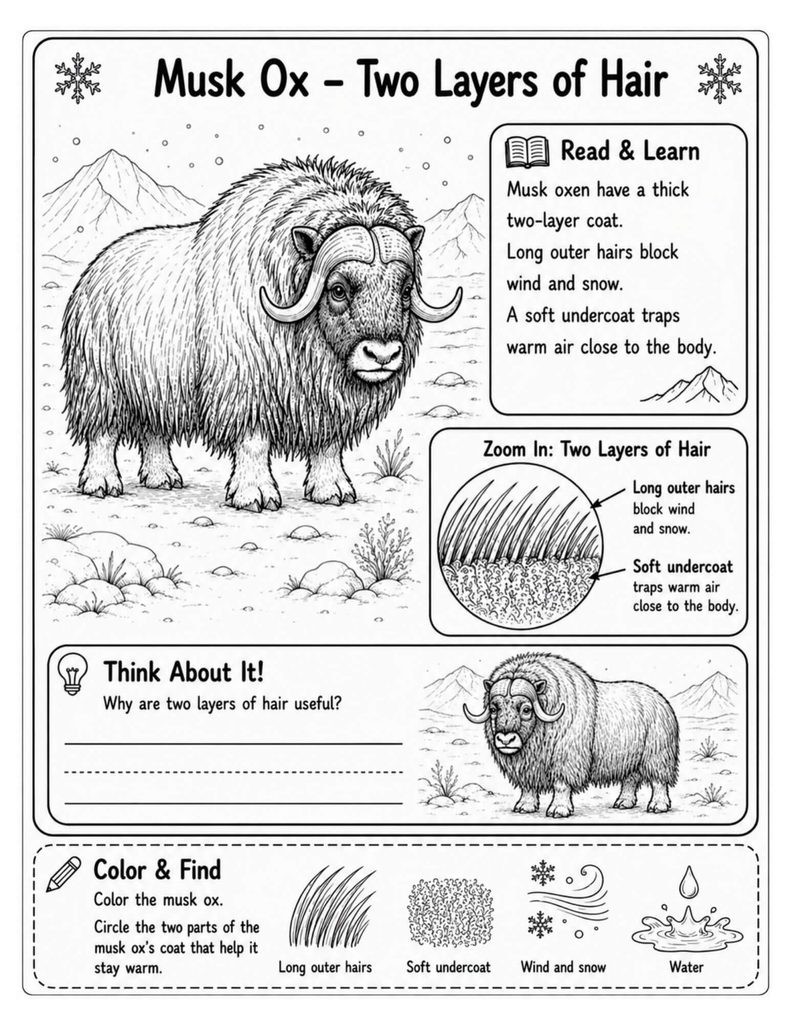
Musk Ox Hair
Musk oxen have two layers of hair with different functions.
Long outer hairs help block wind and snow, while the soft undercoat traps warm air close to the animal’s body.
This is a particularly useful example because students can see that two structures can work together to solve the same survival problem.
Don’t Forget Movement Adaptations

Cold weather is only one challenge in a polar habitat.
Animals also need to move efficiently to find food, escape predators, migrate, or travel through snow and water.
A seal, for example, has a smooth, streamlined body that helps it move through water. Its front flippers help with steering and turning, while its hind flippers provide propulsion.
That gives students another clear cause-and-effect relationship:
streamlined body → less resistance in the water → easier swimming
Caribou provide a land-based example. Their hooves help support them on snow and soft ground, and they can also use their hooves to dig through snow to reach food.
As students compare different animals, they begin to notice that adaptations are connected to the challenges of a particular environment.
Explore Camouflage and Seasonal Change
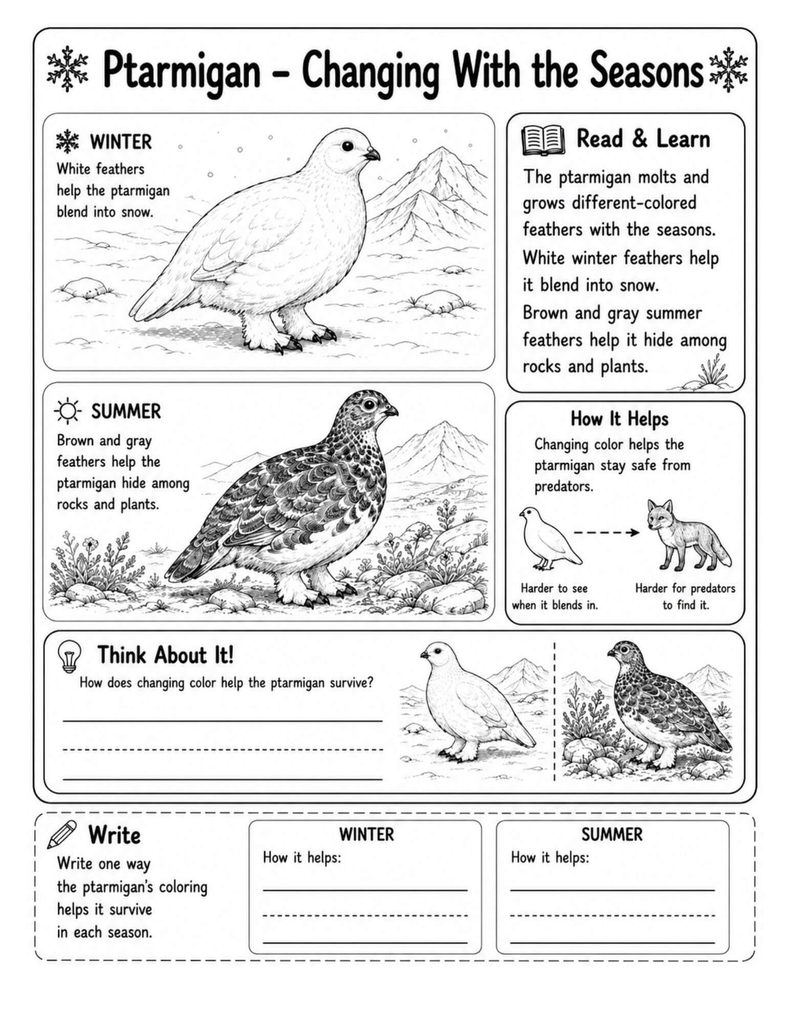
Not every adaptation is about staying warm.
Some polar animals use coloration to make themselves more difficult to see.
The ptarmigan is a useful example because its appearance changes with the seasons. White winter feathers help it blend into snowy surroundings, while brown and gray summer feathers help it blend among rocks and plants.
Arctic foxes provide another example of seasonal camouflage. Their coat color can help them blend into changing surroundings, making them harder to see.
Ask students:
Why might the same color not be useful during every season?
That question can lead to a much deeper discussion than simply asking students to define camouflage.
Physical and Behavioral Adaptations

Polar animals also offer an accessible way to introduce the difference between physical structures and behaviors.
An emperor penguin’s dense feathers and body fat are physical features that help reduce heat loss.
Huddling, however, is a behavior.
Emperor penguins gather closely together during extremely cold weather. Penguins near the center of the group are more protected from the wind, and the animals gradually change positions so different individuals can move toward the warmer center.
Students can classify examples such as:
Physical structures
- thick fur
- blubber
- large paws
- feathers
- flippers
- small ears
Behavior
- huddling together
This distinction helps students see that animals can have both structural and behavioral characteristics that support survival.
Combining Coloring With Science Learning
Coloring pages can be more than a quiet-time activity when students are asked to observe before they color.
A useful sequence is:
- Read a short informational passage.
- Observe the animal and any close-up diagrams.
- Identify an important structure or behavior.
- Color, circle, or label the relevant feature.
- Explain how the feature helps the animal.
For example, students might circle a polar bear’s paws, label a snowy owl’s feathered feet, identify the blubber layer in a seal diagram, or explain how the musk ox’s two layers of hair help it survive.
The activity then becomes a visual science investigation rather than simply a coloring sheet.
The Polar Animal Adaptations resource uses this approach across 20 student pages, combining short Read & Learn sections with activities such as Think About It, Color & Find, Color & Label, Label & Explain, and Draw & Explain. The resource also includes an answer key with suggested responses for open-ended questions
NGSS Connection: 4-LS1-1
These activities have a particularly strong connection to NGSS 4-LS1-1.
The performance expectation asks students to:
“Construct an argument that plants and animals have internal and external structures that function to support survival, growth, behavior, and reproduction.”
Polar animals provide many concrete examples of this structure-and-function relationship.
Students can examine:
Structure → Function → Survival
For example:
Blubber → reduces heat loss → helps an animal remain warm in cold water
Large paws → spread weight across snow → help an animal move across its habitat
Streamlined body → reduces resistance in water → supports efficient swimming
Feathered feet → provide insulation → reduce heat loss
The worksheets help students gather information about these structures. To move even closer to the full performance expectation, teachers can ask students to use two or three examples as evidence in a short written argument.
For example:
Claim: Polar animals have structures that help them survive in cold habitats.
Evidence: A seal has blubber that reduces heat loss. A musk ox has an undercoat that traps warm air.
Reasoning: Both structures help the animals maintain body warmth in very cold environments.
How This Can Support NGSS 3-LS4-3
Polar adaptations also connect naturally with 3-LS4-3, which asks students to construct an evidence-based argument showing that, in a particular habitat, some organisms can survive well, some survive less well, and some cannot survive at all.
The coloring and reading pages provide useful background knowledge about characteristics that help polar animals survive.
However, teaching animal adaptations alone does not completely address the performance expectation.
A simple extension can make the connection much stronger.
Try a “Who Could Survive Here?” Challenge
Show students a polar habitat and give them three animals with different characteristics.
For example:
- polar bear
- Arctic hare
- an animal without thick fur or another form of insulation
Ask:
Which animal could survive well in this habitat?
Which might have difficulty surviving?
What evidence supports your answer?
Students must then use what they know about fur, blubber, feet, camouflage, food, and other characteristics to support their reasoning.
This moves the lesson from identifying adaptations to arguing from evidence, which is much closer to the intent of 3-LS4-3.
A Simple Polar Adaptations Lesson Sequence
You can also turn the pages into a short science mini-unit.
Day 1 – Staying Warm
Explore fur, feathers, blubber, and other forms of insulation.
Day 2 – Moving and Finding Food
Investigate paws, hooves, flippers, streamlined bodies, and specialized structures such as walrus whiskers.
Day 3 – Camouflage and Behavior
Compare seasonal camouflage and behavioral adaptations such as emperor penguin huddling.
Day 4 – Structure and Function Review
Have students choose several polar animals and explain how one structure helps each animal survive.
Day 5 – Evidence Challenge
Ask students which animals would survive best in a polar environment and require them to support their answers with evidence.
This sequence gradually moves students from observing to explaining and finally to using evidence to support an argument.
Make Animal Adaptations Visible
Animal adaptations can feel abstract when students only read definitions.
Polar animals make the concept much more concrete.
A paw can be examined.
A blubber layer can be diagrammed.
A streamlined body can be compared with a less efficient shape.
A winter coat can be compared with a summer coat.
And coloring the animals gives students time to slow down and notice those details.
By combining reading, coloring, observation, labeling, and explanation, students can begin to understand one of the central ideas behind animal structure and function:
An animal’s features are closely connected to how it lives and survives in its environment.
Frequently Asked Questions About Polar Animal Adaptations
Polar animals have many structures and behaviors that help them survive cold environments. Examples include thick fur, dense feathers, blubber, large paws, wide hooves, streamlined bodies, flippers, seasonal camouflage, and huddling behavior. Different adaptations solve different survival challenges, such as staying warm, moving through snow, swimming, or avoiding predators
Blubber is a thick layer of body fat beneath the skin. It helps reduce heat loss and keeps animals such as seals, walruses, narwhals, and beluga whales warmer in cold water.
Polar bears have large paws that spread their weight across snow and ice, helping them move without sinking as deeply. Their paws also help them paddle while swimming.
A physical adaptation is a body structure or feature, such as thick fur, blubber, feathers, or large paws. A behavioral adaptation is something an animal does to help it survive. Emperor penguins huddling together during very cold weather is an example of a behavioral adaptation
Why do some Arctic animals change color with the seasons?
A strong connection is NGSS 4-LS1-1, which focuses on how internal and external structures help plants and animals survive, grow, behave, and reproduce. Polar animal adaptations provide clear examples of structure and function, such as blubber for insulation, flippers for swimming, and specialized feet for movement. The topic can also support 3-LS4-3 when students compare organisms and use evidence to explain why some animals are better suited to survive in a particular habitat.
Yes—when the coloring is combined with observation and explanation. In this resource, students do more than color. They read short informational passages, identify adaptations, label structures, answer questions, and explain how particular features help animals survive. The activities include formats such as Color & Find, Color & Label, Think About It, and Draw & Explain
Instead of asking students only to name an adaptation, ask them:
What challenge does this animal face?
Which structure or behavior helps solve that challenge?
What evidence supports your answer?
For example, students can connect a seal’s streamlined body with easier movement through water or a musk ox’s two-layer coat with protection from wind and heat loss.
Recommended Resources & References
For additional background information on animal adaptations, structure and function, and survival in polar environments, explore these reliable science and education resources:
Next Generation Science Standards – 4-LS1-1: Structure and Function
This standard focuses on how internal and external structures help plants and animals survive, grow, behave, and reproduce.
Explore NGSS 4-LS1-1
Next Generation Science Standards – 3-LS4-3: Survival in a Habitat
This performance expectation asks students to use evidence to explain why some organisms survive well in a particular habitat while others survive less well or cannot survive there.
Explore NGSS 3-LS4-3
Australian Antarctic Program – Adapting to the Cold
Learn how Antarctic animals survive extreme cold through insulation, body fat, feathers, and behavioral adaptations.
Read About Cold-Weather Adaptations
Australian Antarctic Program – Emperor Penguin
Explore emperor penguin adaptations, including dense feathers, body fat, and huddling behavior.
Learn About Emperor Penguins
U.S. Fish & Wildlife Service – Polar Bear
Find information about polar bear characteristics and adaptations for living in Arctic environments.
Learn About Polar Bears