Penguin Adaptations for Kids: How Penguins Survive + 5 Hands-On Activities
How can a bird survive freezing winds, dive hundreds of feet underwater, and swim faster than many other birds?
Penguins have some of the most fascinating animal adaptations on Earth.
Their bodies and behaviors help them find food, stay warm, move through water, and survive in habitats ranging from icy Antarctica to the warm Galápagos Islands.
For elementary students, penguins are a great way to explore an important life science idea:
Animals have structures and behaviors that help them survive in their environments.

What Is an Adaptation?
An adaptation is a body structure, body function, or behavior that helps a living thing survive in its habitat.
Penguins have evolved many adaptations for life in and around the ocean.
Some help them:
- swim efficiently,
- dive underwater,
- avoid predators,
- conserve body heat,
- find food,
- or cool down in warmer environments.
One important teaching point is that not all penguins have exactly the same adaptations. A penguin living on Antarctic ice faces very different challenges from a penguin living near the Equator.
Penguins Are Built for Swimming
Penguins are birds, but they cannot fly through the air.
Instead, their bodies have become highly specialized for moving through water.
Flippers Instead of Flight Wings
Over millions of years, penguin wings evolved into strong, stiff flippers.
These flippers work almost like underwater wings. Penguins move them up and down to propel themselves through the water.
This evolutionary trade-off made penguins excellent swimmers but unable to fly through the air. National Geographic describes how increasingly efficient swimming and diving were linked with the eventual loss of flight.
Streamlined Bodies
A penguin has a smooth, tapered body shape.
This streamlined shape reduces resistance as the bird moves through water, allowing it to swim more efficiently.
Penguins also use their webbed feet and powerful flippers to steer and propel themselves.

Countershading Camouflage
The familiar black-and-white coloring of a penguin is more than decoration.
It is a type of camouflage called countershading.
When a predator looks down from above, the penguin’s dark back can blend with the darker ocean water.
When a predator looks upward from below, the penguin’s white belly can blend with the brighter surface and sky.
This coloring can make swimming penguins harder for predators to see.
How Do Penguins Stay Warm?
For penguins living in Antarctica, keeping warm is one of the greatest survival challenges.
Emperor penguins live and breed in an environment where temperatures and wind chills can become dangerously low.
Several adaptations work together to protect them.
Dense, Overlapping Feathers
Penguins have tightly packed feathers that help create a protective layer around the body.
Their feathers also help keep water away from the skin.
A Layer of Body Fat
Body fat provides additional insulation and stores energy.
This is especially important for emperor penguins, which may spend long periods without eating while caring for an egg.
Research summarized by National Geographic identifies waterproof feathers, thick skin, and body fat as important penguin adaptations associated with life in cold marine environments.
Huddling: A Behavioral Adaptation
One of the best examples of a behavioral adaptation is emperor penguin huddling.
During extreme Antarctic weather, emperor penguins gather closely together.
Penguins on the outside help shield the group from the wind, while birds nearer the center experience warmer conditions.
But the same penguins do not remain in the warm center.
The group slowly moves and reorganizes so different individuals get opportunities to move toward the protected interior.
In other words, a penguin does not survive the Antarctic winter only because of its feathers and body fat.
Working together is part of its survival strategy too.
Emperor Penguins Are Extraordinary Divers
Penguin adaptations are not only about staying warm.
They are also built for finding food underwater.
Emperor penguins can dive to remarkable depths. National Geographic reports dives of about 1,850 feet, or more than 560 meters, and dives lasting more than 20 minutes.
Their bodies have adaptations that help them manage oxygen during long dives, and their underwater vision helps them hunt beneath the surface.
This makes a useful classroom connection:
Structure: strong flippers and streamlined body
Function: efficient swimming
Survival benefit: reaching fish, squid, and krill underwater

The Gentoo Penguin: Built for Speed
The gentoo penguin is another impressive swimmer.
Its streamlined body and powerful paddle-shaped flippers allow it to reach speeds of up to about 22 miles per hour underwater, according to National Geographic.
For students, this is a useful reminder that adaptations can help animals do more than simply tolerate their environment.
They can also help animals move, hunt, escape, and compete for resources.
Not All Penguins Live in the Cold
A common elementary misconception is that every penguin lives surrounded by snow and ice. They do not. Penguin species live in many different environments across the Southern Hemisphere.
Some even live in very warm climates. This gives teachers an excellent opportunity to compare how different species solve different environmental problems.
Humboldt Penguins Have Their Own Cooling System
Humboldt penguins live along the coasts of Peru and Chile, where conditions can become hot.
They have areas of bare pink skin around the eyes and at the base of the bill.
Heat can escape through these featherless areas, helping the penguin cool its body.
Students can think of these patches almost like little heat-release zones.
How Galápagos Penguins Stay Cool
Galápagos penguins live close to the Equator.
For them, the challenge is often not conserving heat—it is getting rid of excess heat.
They can:
- pant to release heat,
- hold their flippers away from their bodies,
- lose heat through featherless areas of the body,
- and adjust the timing of breeding and molting depending on food conditions.
They also have less body fat and fewer feathers than many cold-climate penguins.
This creates an excellent comparison for students:
Emperor penguin: adaptations help conserve heat.
Galápagos penguin: adaptations help release heat.
Both are penguins, but they face very different environmental challenges.

Even Penguin Feathers Can Be Different
Fiordland penguins live in the temperate rainforests of New Zealand rather than on Antarctic ice.
National Geographic Kids notes that these penguins have fewer and less dense feathers than penguins that need to survive freezing Antarctic conditions.
They also tend to be smaller because they do not need to conserve as much body heat.
This is a particularly useful example for teaching that adaptations make sense only when we consider an animal’s specific habitat.
Physical vs. Behavioral Penguin Adaptations
Students can organize penguin adaptations into two simple categories.


A Surprising Penguin Behavior: Cliff Diving
In 2024, National Geographic filmmakers recorded hundreds of young emperor penguins entering the ocean from an ice shelf about 50 feet high.
Most survived the dramatic fall.
Normally, young emperor penguins enter the water from much lower sea ice, so scientists consider this high jump unusual rather than a standard emperor penguin adaptation.
For students, this can lead to an interesting discussion:
Is every behavior we observe an adaptation?
Not necessarily. An adaptation is a trait or behavior that has developed over generations because it improves survival or reproduction. An unusual action by an individual animal is not automatically an adaptation.
Penguins, Evolution, and a Changing Climate
Penguins have survived enormous environmental changes during their evolutionary history.
However, adaptation does not happen instantly.
A large genomic and fossil study reported by National Geographic found that modern penguins have the slowest known evolutionary rate among birds.
Their highly specialized bodies are extremely effective in the environments in which they evolved, but rapid environmental changes can create new challenges faster than populations can genetically adapt. This distinction is important when teaching children about adaptation. An individual penguin cannot simply decide to grow different feathers because its environment becomes warmer.
Evolutionary adaptations develop across many generations.
Penguin Adaptations: The Big Idea
Penguins are a powerful example of how an animal’s structures and behaviors connect to its environment.
A penguin’s:

5 Hands-On Penguin Adaptation Activities for Grades 2–3
Penguin adaptations become much easier for children to understand when they can observe, model, compare, and explain how each adaptation works.
The activities below move beyond simply naming adaptations. Students investigate an important science question:
How does this structure or behavior help a penguin survive in its environment?
These activities work especially well in Grades 2–3 and can be used as individual science centers, whole-class demonstrations, or as part of a short animal adaptations mini-unit.
1. Build a “How Penguins Stay Warm” Concept Map
Start with the question:
How can a penguin stay warm in freezing Antarctic conditions?
Introduce several adaptations that work together:
- blubber,
- dense feathers,
- special blood flow,
- and huddling behavior.
The How Penguins Stay Warm page in the resource introduces these four survival strategies and explains their basic functions.
Write How Penguins Stay Warm in the center of the board. Then add one branch for each adaptation.
For example:
Blubber → adds insulation → reduces heat loss
Dense feathers → trap warm air → help insulate the body
Special blood flow → reduces heat loss through the feet
Huddling → helps penguins conserve warmth
Ask students:
- Which adaptations are body structures?
- Which adaptation is a behavior?
- Do penguins rely on just one adaptation?
- How might these adaptations work together?
This activity helps students understand an important science idea: animals usually survive because of several interacting adaptations, not because of one special feature.
2. Model Penguin Huddling
Huddling is one of the clearest examples of a behavioral adaptation.
Emperor penguins gather closely together during extremely cold and windy conditions. Penguins toward the center are more protected, while those on the outside are more exposed.
The resource asks students to draw penguins huddling and write a sentence explaining how the behavior helps them.
Before completing the worksheet, turn the idea into a quick classroom model.
Have one student stand alone as the “single penguin.”
Then ask five or six students to stand close together in a group.
Pretend that cold Antarctic wind is blowing toward them.
Ask:
Which penguins would be most protected from the wind?
Students will quickly notice that the penguins in the center of the group are more sheltered.
Next, have students rotate positions so that different children move between the center and the outside.
Explain that emperor penguin huddles also reorganize over time.
Finish with the question:
Is huddling a physical adaptation or a behavioral adaptation? How do you know?
Students can then complete the huddling drawing and explanation page.
A simple sentence frame for younger learners is:
Huddling helps penguins __________ because __________.
3. Investigate Waterproof Feathers
Penguin feathers do more than help keep the body warm.
Their outer feathers also help keep water away from the skin.
The penguin feather worksheet shows water droplets sitting on a feather and asks students what the droplets reveal about the feather.
You can extend this idea with a simple classroom model.
Materials
- two small pieces of paper
- one white crayon or small piece of wax
- water
- eyedropper or straw
What to Do
Rub wax firmly over one piece of paper.
Leave the second piece untreated.
Place one drop of water on each surface.
Ask students to observe carefully.
Does the water soak into the untreated paper?
Does the water bead up more on the wax-covered surface?
Explain that the waxed paper is only a model. It is not the same as a real penguin feather, but it helps students visualize how a water-resistant surface can prevent water from soaking through easily.
Ask:
Why would staying dry be especially important for an animal swimming in very cold water?
Students should connect waterproofing with reducing heat loss and keeping the body protected from icy water.

4. Test a Model Blubber Layer
The resource introduces blubber as a thick layer of fat under the skin and includes a diagram showing the basic layers of skin, blubber, and muscle.
Turn this diagram into a simple insulation investigation.
Materials
- bowl of cold water
- ice cubes
- two resealable plastic bags
- shortening or another safe classroom insulation material
- optional disposable gloves
Make a Blubber Model
Place shortening between two plastic layers so students do not need to touch it directly.
Students can briefly compare how the cold water feels:
- through a plain plastic bag,
- through the insulated “blubber” model.
Ask students to describe the difference.
Then explain:
This model is not real blubber. It helps us investigate how an insulating layer can slow the transfer of heat from a warm body to a cold environment.
Connect the investigation back to the penguin.
Ask:
- Which model kept your hand feeling warmer?
- What does the insulating layer do?
- Why would stored body fat be useful in a cold habitat?
Students can then return to the blubber diagram and explain the function of the fat layer.

5. Design a Penguin or Polar Animal for Survival
Finish the lesson by moving from identification to application.
The resource includes an open-ended Design Your Own Polar Animal task in which students create an animal and label at least three adaptations that would help it survive.
Before students begin drawing, give them a simple environmental challenge:
Your animal lives in a place with freezing temperatures, strong winds, snow, ice, and very cold water. What adaptations would help it survive?
Students might choose:
- thick fur,
- dense feathers,
- blubber,
- small ears,
- large paws,
- flippers,
- waterproof feathers,
- camouflage,
- or huddling behavior.
For each feature, require students to explain its function.
For example:
Adaptation: Thick feathers
How it helps: They trap warm air and help reduce heat loss.
Or:
Adaptation: Flippers
How it helps: They help the animal move efficiently through water.
For a stronger science response, ask students to complete this sentence:
My animal has __________ because it helps __________.
This turns the activity from a simple drawing exercise into a small science performance task.
6. Adaptation Gallery Walk
Display students’ completed animal designs around the classroom. Give each student three small sticky notes and ask them to look for:
- one adaptation that helps an animal stay warm;
- one adaptation that helps an animal move;
- one adaptation that helps an animal find food or avoid predators.
Students can place their notes next to examples they find and briefly explain how each adaptation helps the animal survive.
This activity works especially well with open-ended animal design tasks because students must identify both the adaptation and its function.
7. End With an Evidence-Based Question
Instead of ending the lesson with a simple recall question such as:
“Name a penguin adaptation.”
Ask a question that requires students to connect multiple ideas:
“Which two adaptations work together to help an emperor penguin survive cold Antarctic conditions? Explain how each adaptation helps.”
This encourages students to think in terms of adaptation + function + evidence, rather than simply memorizing vocabulary. It also helps them explain how several adaptations can work together to support survival.
Encourage Students to Think Like Scientists
Throughout the activities, keep returning to the same three-part thinking routine:
What does the animal have or do?
What does that adaptation do?
How does it help the animal survive?
For example:
Dense feathers → trap warm air → help reduce heat loss
Flippers → move water backward → help the penguin swim
Huddling → brings penguins close together → helps conserve warmth
This structure → function → survival connection is much more meaningful than asking students to memorize a list of animal adaptations.
By the end of the lesson, students should be able to do more than say that penguins have blubber or feathers. They should be able to explain why those adaptations matter in the penguin’s habitat.
3-Day Penguin and Polar Animal Adaptations Mini-Unit
This simple three-day mini-unit helps students move from identifying adaptations to explaining how structures and behaviors help animals survive.
It works especially well for Grades 2–3, but the activities can easily be simplified for younger learners or extended for Grades 3–4.
Day 1 – What Are Adaptations?
Focus: Understanding physical and behavioral adaptations
Begin by introducing the word adaptation:
An adaptation is a body part, body process, or behavior that helps an animal survive in its habitat.
Show students several examples, such as:
- thick fur,
- blubber,
- waterproof feathers,
- large paws,
- flippers,
- camouflage,
- and huddling.
Ask students to decide whether each example is something an animal has or something an animal does.
Introduce the two categories:
Physical adaptations are body structures or features.
Behavioral adaptations are actions animals perform that help them survive.
Next, use a matching activity in which students connect polar animals with their adaptations. For example:
- Arctic fox → small ears
- penguin → waterproof feathers
- seal → blubber
- polar bear → large paws
As students work, ask them to explain the purpose of each adaptation.
Instead of only asking:
“What adaptation does this animal have?”
add:
“How does this adaptation help the animal survive?”
Day 1 Wrap-Up
Ask students to complete the sentence:
An adaptation helps an animal __________.
For a quick exit check, show one adaptation and ask students to identify whether it is physical or behavioral.
Day 2 – How Do Penguins Survive?
Focus: Connecting penguin adaptations to their functions
Begin with the question:
How can a penguin survive in freezing Antarctic conditions and icy water?
Introduce several penguin adaptations:
- blubber,
- dense and waterproof feathers,
- special blood flow,
- strong flippers,
- streamlined body shape,
- and huddling behavior.
Create a class chart using a simple structure:
Adaptation → Function → Survival Benefit
For example:
Blubber → provides insulation → helps reduce heat loss
Dense feathers → trap warm air → help keep the body warm
Waterproof outer feathers → keep water away from the skin → help the penguin stay dry
Huddling → brings penguins close together → helps conserve warmth
Try a Quick Huddling Demonstration
Choose one student to represent a penguin standing alone.
Then have several students stand close together in a group.
Ask:
- Which penguin is more protected from the “cold wind”?
- Which students are most protected inside the group?
- Why might penguins change positions within a huddle?
Explain that huddling is a behavioral adaptation, while feathers and blubber are physical adaptations.
Optional Hands-On Investigation
Extend the lesson with one of these simple models:
Waterproof Feather Model: Compare water droplets on untreated paper and wax-covered paper.
or
Blubber Insulation Model: Compare how cold water feels through a plain plastic bag and through a bag surrounded by a model insulating layer.
Remind students that classroom models are not real penguin feathers or real blubber. They simply help us investigate how an adaptation may function.
Day 2 Written Response
Ask students:
Choose one penguin adaptation. How does it help the penguin survive?
Sentence frame:
A penguin has/uses __________. This helps it __________.
Day 3 – Apply, Compare, and Design
Focus: Applying knowledge of adaptations to a new situation
Begin by reviewing several adaptations from Days 1 and 2.
Ask students to compare them:
- Which adaptations help animals stay warm?
- Which help animals move?
- Which help animals find food?
- Which help animals avoid predators?
Then move to an open-ended design challenge.
Design Your Own Polar Animal
Give students this challenge:
Design an animal that could survive in a cold, snowy, windy environment.
Students should include and label at least three adaptations.
Possible adaptations might include:
- thick fur,
- blubber,
- waterproof feathers,
- small ears,
- large paws,
- flippers,
- white camouflage,
- or a useful behavioral adaptation.
For each feature, students should explain:
What is the adaptation?
How does it help the animal survive?
Encourage students to think about the animal’s whole habitat rather than simply adding random features.
For example:
Feature: Large paws
How it helps: Large paws spread the animal’s weight over snow.
Feature: Thick fur
How it helps: Thick fur helps reduce heat loss.
Adaptation Gallery Walk
Display the finished animal designs around the classroom.
Give each student three sticky notes and ask them to find:
- one adaptation for staying warm;
- one adaptation for moving;
- one adaptation for finding food or avoiding predators.
Students can place their notes beside examples and explain why they chose them.
This turns the design activity into a review of structure, function, and survival.
End With an Evidence-Based Question
Instead of ending with a simple recall question such as:
“Name a penguin adaptation.”
ask:
“Which two adaptations work together to help an emperor penguin survive cold Antarctic conditions? Explain how each one helps.”
Students might choose blubber and feathers, special blood flow and huddling, or another appropriate combination.
The goal is for students to connect:
adaptation → function → survival
rather than simply memorize vocabulary.
Frequently Asked Questions About Penguin Adaptations
Penguins have several physical and behavioral adaptations that help them survive in their habitats. These include streamlined bodies, strong flippers, dense feathers, body fat, waterproof outer feathers, specialized blood flow, and behaviors such as huddling and diving. Different penguin species have different adaptations depending on where they live.
Emperor penguins use several adaptations together to reduce heat loss. Body fat provides insulation, dense feathers trap warm air, specialized blood flow helps reduce heat loss through the feet, and huddling allows groups of penguins to conserve warmth. The accompanying worksheets introduce these four strategies as key ways penguins stay warm.
Huddling is a behavioral adaptation. Emperor penguins gather closely together during cold, windy conditions, helping the group conserve warmth. Penguins also change positions within the huddle so individuals do not remain on the colder outside all the time.
Penguin feathers help in two important ways. Dense feathers provide insulation by trapping air close to the body, while the outer feathers help keep water away from the skin. This is especially important for animals that spend time swimming in very cold water.
Blubber is a layer of body fat beneath the skin. It acts as insulation, helping slow heat loss in cold conditions, and it can also store energy. A simple blubber model is a useful way for students to investigate how an insulating layer can protect a warm body from a cold environment.
A streamlined body reduces resistance as a penguin moves through water. Strong flippers propel and steer the penguin underwater. Together, these adaptations make penguins highly efficient swimmers.
Countershading is the dark-back, light-belly coloring seen in many penguins. From above, the dark back can blend with darker ocean water, while from below, the lighter belly can blend with the brighter surface. This type of camouflage can make a swimming penguin harder to see.
No. Penguins live in several different environments across the Southern Hemisphere. Emperor penguins are adapted to extremely cold Antarctic conditions, while species living in warmer climates need ways to release excess body heat. Comparing cold- and warm-climate penguins is a useful way to show students that adaptations depend on the habitat.
Students can model penguin huddling, investigate a waterproof surface, test a model blubber layer, create a penguin adaptation concept map, or design their own polar animal. These activities help children move beyond memorizing adaptation names and begin explaining how each feature or behavior helps an animal survive.
One simple classroom model uses two pieces of paper. Cover one with a thin layer of wax and leave the other untreated, then place a drop of water on each. Students can observe how the wax-covered surface causes the water to bead up more easily and discuss how a water-resistant surface can help keep cold water away from an animal’s body.
No. A classroom blubber experiment is a model of insulation. Materials such as shortening between plastic layers can help students investigate how an insulating layer slows heat transfer, but teachers should explain that the model is not actual animal tissue.
Simple matching, labeling, drawing, and observation activities work especially well in Grades 1–2. Students in Grades 2–4 can move into comparison, explanation, evidence-based questions, and design challenges. The resource follows this progression from basic adaptation activities to compare, read, and think tasks.
Keep returning to three questions:
What does the animal have or do?
What does that structure or behavior do?
How does it help the animal survive?
For example:
Dense feathers → trap warm air → help reduce heat loss.
This structure–function–survival connection encourages students to explain why an adaptation matters rather than simply naming it.
Ask students to design a penguin or another polar animal with at least three adaptations. For each adaptation, they should explain how it helps the animal survive in a cold, windy, snowy, or icy environment. This turns a drawing activity into a simple science performance task.
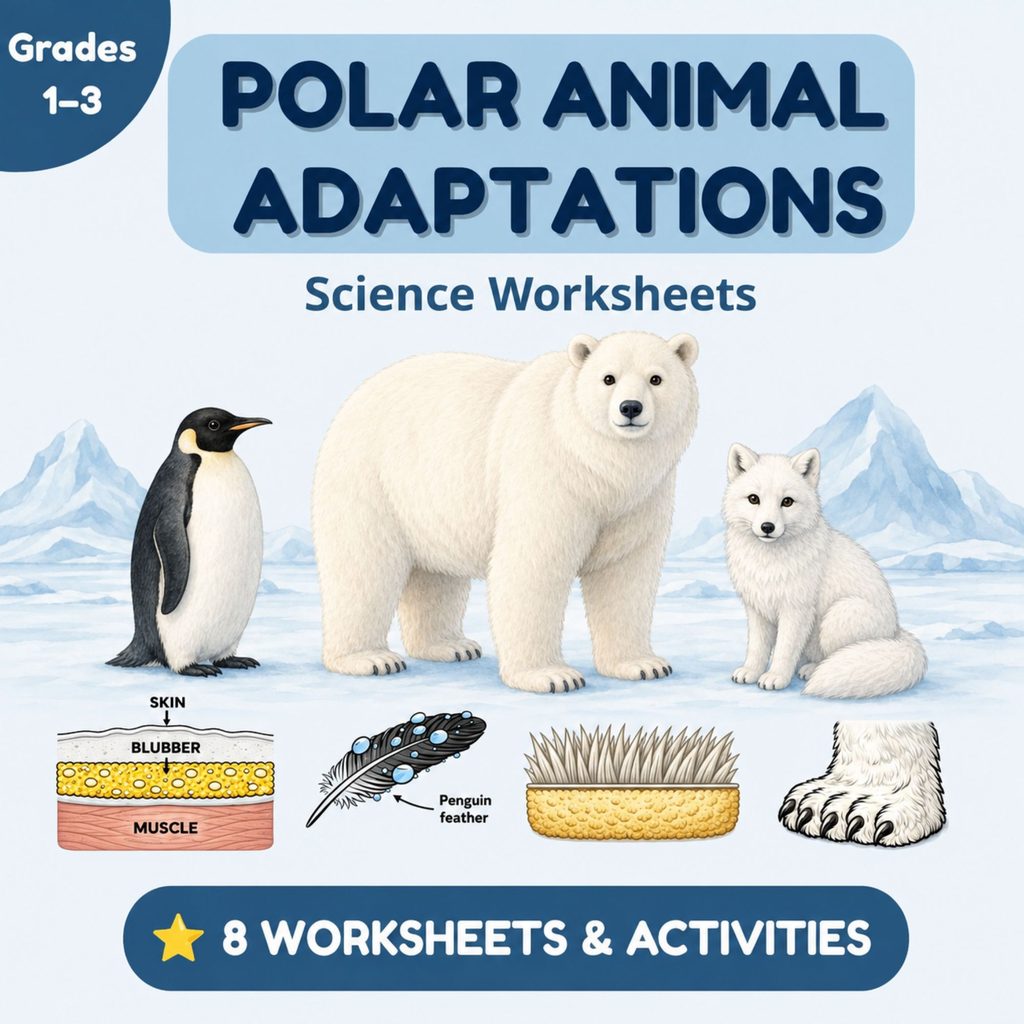
Looking for a simple and engaging way to teach polar animal adaptations? This Grades 1–3 science resource helps students explore how animals survive in cold environments through clear visuals, matching activities, labeling tasks, reading, and creative challenges. Students learn about adaptations such as blubber, thick fur, waterproof feathers, large paws, special blood flow, and huddling while connecting each feature to its survival function. Perfect for science lessons, centers, independent work, review, or winter-themed learning.
Professional References and Further Reading
- National Geographic – Emperor Penguin
Emperor Penguin – National Geographic - Australian Antarctic Program – Emperor Penguin
Emperor Penguin – Australian Antarctic Program - National Geographic – Emperor Penguin Diving and Survival
How Antarctica’s Penguins Became Nature’s Daredevils – National Geographic - Galápagos Conservation Trust – Galápagos Penguin Adaptations
Galápagos Penguin Facts – Galápagos Conservation Trust - Smithsonian Ocean – Surviving the Freeze
Surviving the Freeze – Smithsonian Ocean - Polar Bears International – Polar Bear Adaptations & Characteristics
Polar Bear Adaptations & Characteristics – Polar Bears International
Comments