Teaching Decomposers and Matter Cycling in Grade 5: A Simple Apple Investigation
Why does a fallen apple seem to disappear over time?
At first, many elementary students say that the apple simply rots away, disappears, or turns entirely into soil. These ideas are understandable because students can see the apple getting smaller, softer, and darker, but they cannot see most of the organisms and processes responsible for the change.
This makes a decomposing apple a powerful anchoring phenomenon for teaching decomposers and matter cycling in Grades 4-5. With one familiar object, students can investigate microbes, environmental conditions, fair testing, data collection, graphing, scientific models, and the conservation of matter.
How Can I Teach Decomposers and Matter Cycling in Grade 5?
Begin with a visible example of decomposition, such as an apple changing over time. Ask students to record what they notice and wonder before introducing bacteria, fungi, or matter cycling. Then allow them to investigate one condition that may affect decomposition, collect evidence, graph their observations, and revise a model showing how matter moves among dead organisms, decomposers, the environment, plants, and animals.
The most important goal is not for students to memorize the names or shapes of microbes. Students need to explain that decomposers change dead matter into other forms and that this matter continues to move through an ecosystem.
Start with an Anchoring Phenomenon
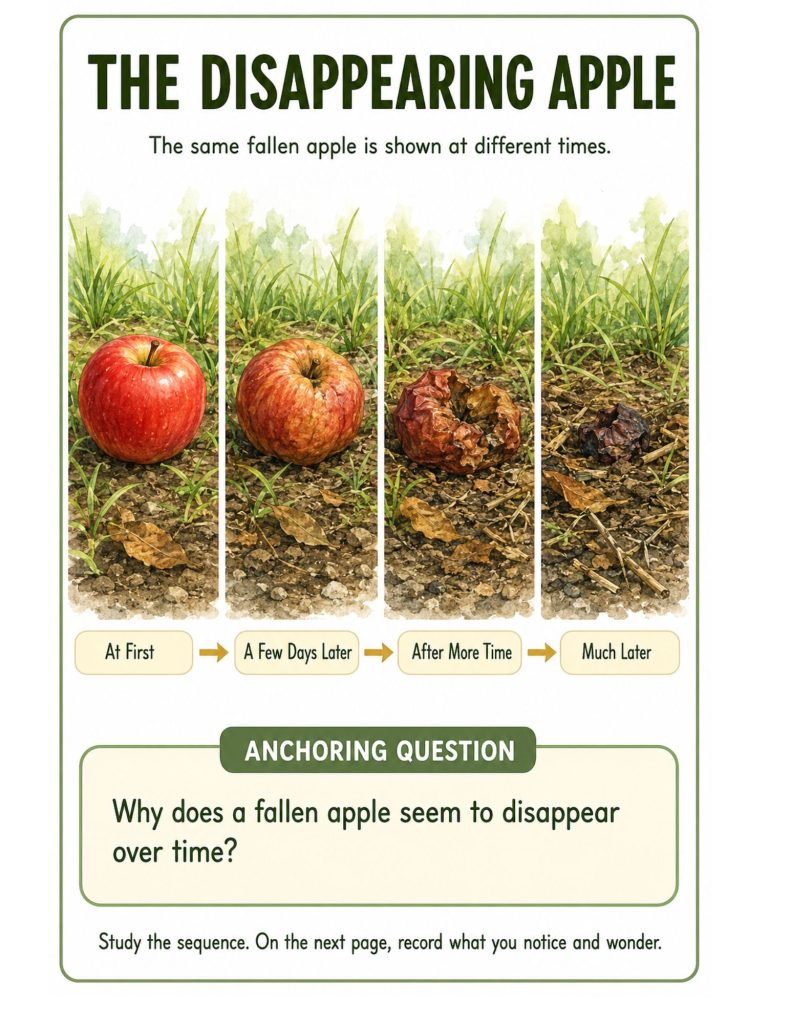
Show students a sequence of the same apple at different stages: fresh, several days old, partly decomposed, and mostly broken down.
Ask:
Why does a fallen apple seem to disappear over time?
Do not provide the scientific explanation immediately. Instead, give students time to observe carefully and record their initial ideas.
Useful prompts include:
- What changes do you notice?
- What do you think caused those changes?
- What might be happening that we cannot see?
- Where do you think the apple matter goes?
A Notice and Wonder chart works especially well here. It separates visible evidence from questions and prevents the opening discussion from becoming a search for one correct answer.
Record an Initial Explanation and Model
Before students read about decomposers, ask them to write an initial explanation and draw a model of what happens to a fallen apple.
Their first models may contain misconceptions. Some students may show the apple matter vanishing. Others may draw an arrow directly from the apple to the soil. These responses are valuable because they provide evidence of students’ starting ideas.
Encourage students to include:
- pictures;
- arrows showing movement;
- labels explaining what changes; and
- a note about anything they are not yet sure about.
Save these models. Students will return to them after the investigation and revise them using new evidence.
Record an Initial Explanation and Model
Before students read about decomposers, ask them to write an initial explanation and draw a model of what happens to a fallen apple.
Their first models may contain misconceptions. Some students may show the apple matter vanishing. Others may draw an arrow directly from the apple to the soil. These responses are valuable because they provide evidence of students’ starting ideas.
Encourage students to include:
- pictures;
- arrows showing movement;
- labels explaining what changes; and
- a note about anything they are not yet sure about.
Save these models. Students will return to them after the investigation and revise them using new evidence.
Investigate What Decomposer Microbes Need
Before beginning an investigation, ask students what conditions may affect how quickly an apple decomposes.
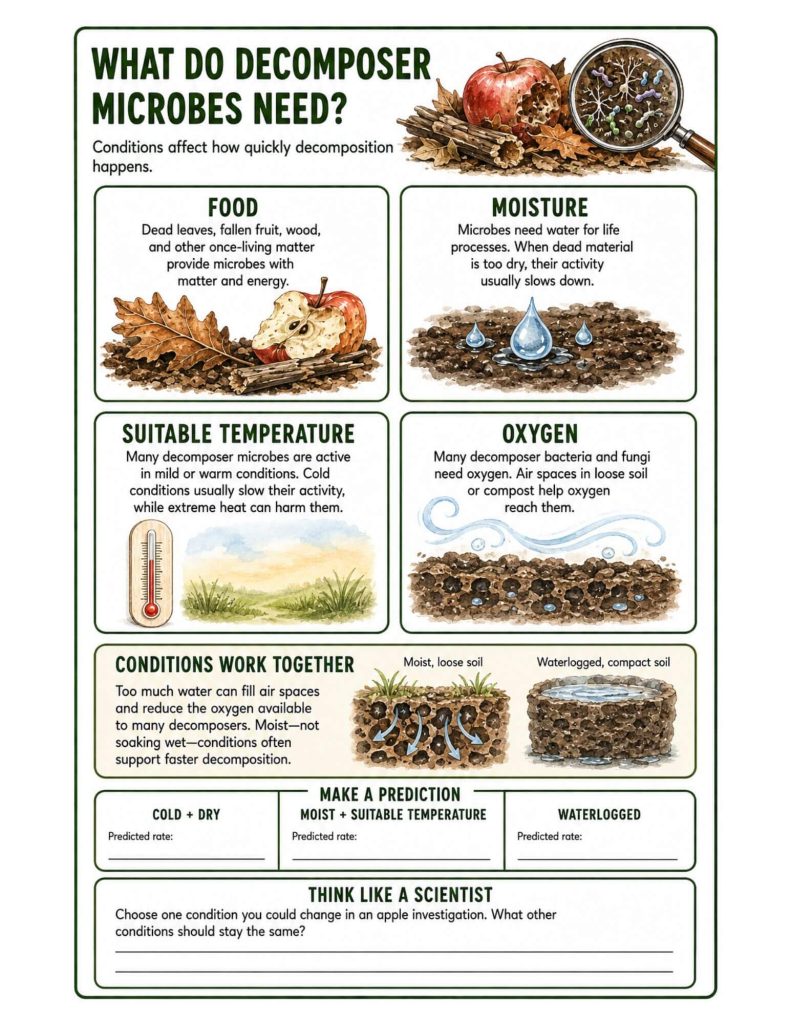
Decomposer activity is influenced by:
- available food;
- moisture;
- a suitable temperature; and
- available oxygen.
The goal is not to tell students that one condition always produces the fastest result. Too little moisture may slow microbial activity, while too much water can fill air spaces and reduce available oxygen. Cold conditions usually slow decomposition, but excessive heat can also harm organisms.
The U.S. Environmental Protection Agency’s composting guidance explains that moisture, oxygen flow, temperature, material size, and the balance of organic materials all affect microbial decomposition. This real-world connection provides a natural transition from the apple investigation to compost system design.
Set Up a Sealed Apple Investigation
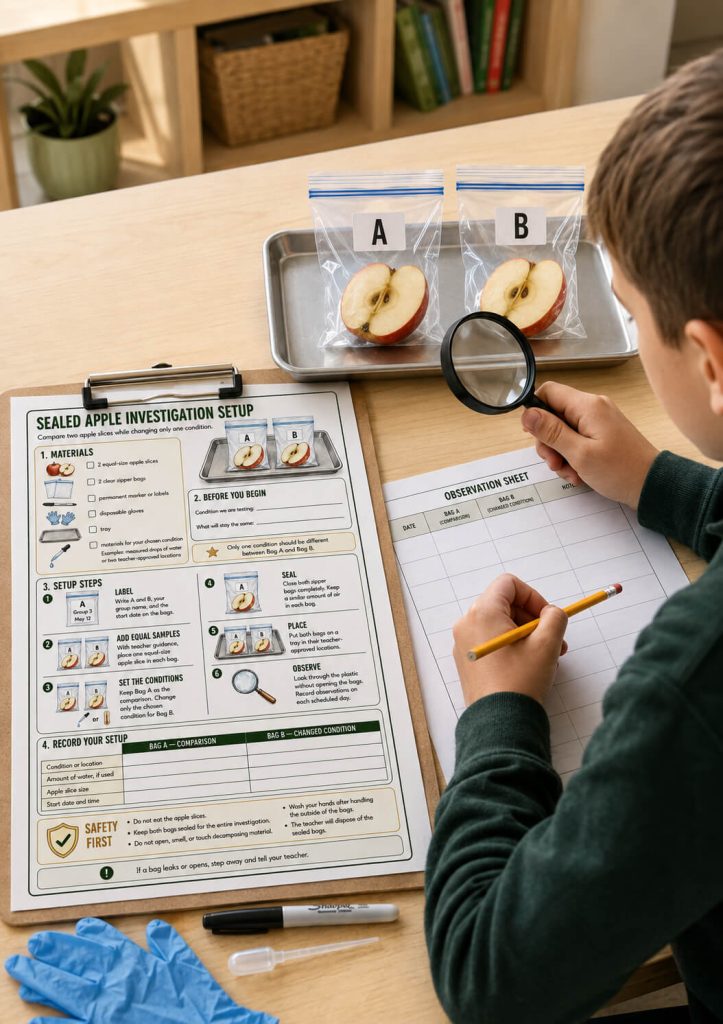
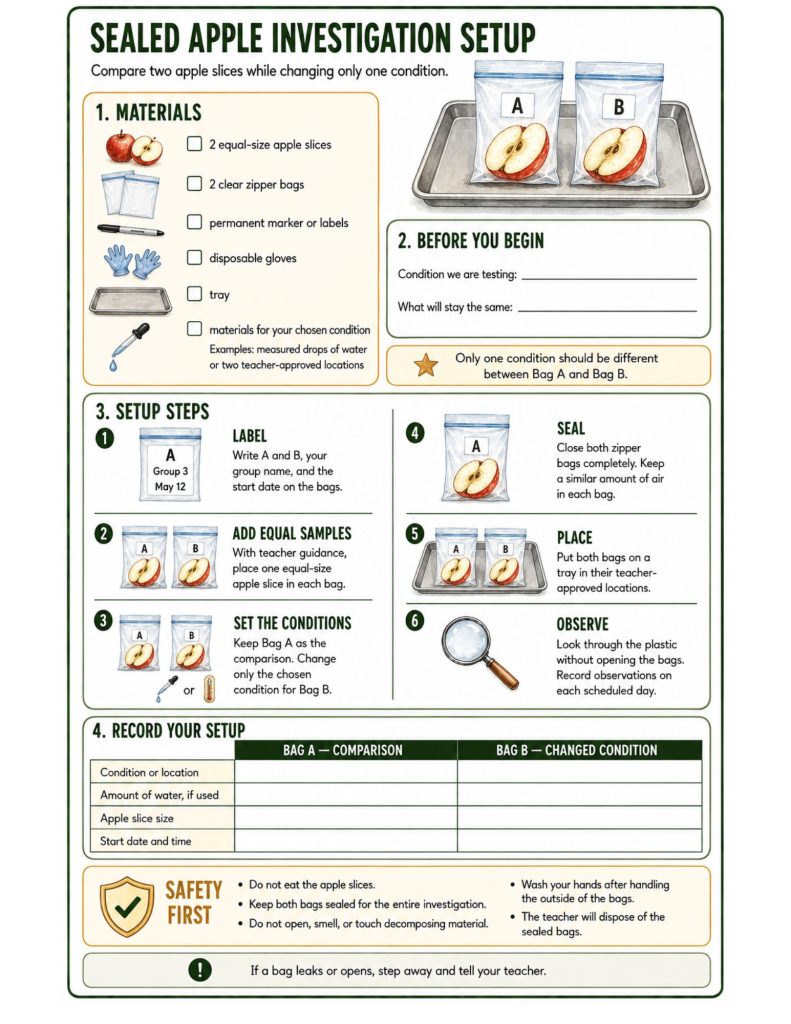
Students can compare two sealed bags containing similar apple slices. Bag A serves as the comparison condition, while Bag B contains one deliberately changed condition.
Possible class investigations include comparing:
- dry and slightly moistened conditions;
- cooler and room-temperature locations; or
- different amounts of available air, if this can be set up safely and consistently.
Materials
- two clear, sealable plastic bags per group;
- two similar apple slices from the same apple;
- labels and permanent markers;
- a measuring tool appropriate for the selected condition;
- trays to hold the sealed bags;
- gloves for teacher setup and disposal; and
- student observation pages.
Plan a Fair Test
Ask students to identify three parts of the investigation:
- Change: the one condition that will be different.
- Measure: the visible changes or decomposition rating students will record.
- Keep the same: apple source and size, bag type, starting time, observation schedule, rating scale, and all other conditions.
Students should write a prediction in an if-then-because format. For example:
If Bag B receives a measured amount of water while Bag A does not, then Bag B may show more visible decomposition because decomposer microbes need moisture.
A prediction is not a promise. If the results do not match the prediction, the evidence is still useful.
Important Safety Rule
Keep both bags sealed throughout the investigation. Students should observe through the plastic and should never smell, touch, or taste decomposing material. The teacher should handle final disposal according to school procedures.
Use an Observation Journal
Decomposition does not happen instantly, so students need a consistent system for recording changes across several observations.
At each observation, students can record:
- the date and number of days elapsed;
- color changes;
- shape or texture changes visible through the bag;
- spots or fuzzy growth;
- collected liquid;
- a labeled drawing; and
- a decomposition rating.
A simple 0-4 scale helps turn qualitative observations into graphable data:
- 0 – No visible change
- 1 – Slight change
- 2 – Some decomposition
- 3 – Much decomposition
- 4 – Advanced decomposition
The scale should include visible criteria so students do not choose ratings based only on a general impression. It is also important to discuss the limitation of the method: the rating measures visible change, not the exact number of microbes or the precise amount of matter converted into each new form.

Graph and Analyze the Evidence
After several observations, students organize their data in a table and create a line graph.
The horizontal axis should show the actual number of days elapsed, and the vertical axis should show the 0-4 decomposition rating. Students can use different symbols for Bag A and Bag B and connect points from the same bag.
Ask students to analyze each data series separately before comparing the two bags:
- Did Bag A’s ratings increase, remain about the same, or change unevenly?
- Did Bag B’s ratings increase, remain about the same, or change unevenly?
- How did the distance between the two graph lines change over time?
- When was the difference between the two bags greatest?
- What conclusion is supported by the data?
Avoid telling students that the changed bag should decompose faster. A tie, an uneven pattern, or a result that contradicts the prediction can all lead to meaningful scientific discussion.
Ask the Essential Question: Where Did the Apple Matter Go?
This is the conceptual heart of the lesson.
Students may be tempted to say that the apple disappeared or that all of it became soil. A more accurate Grade 5 explanation is:
Decomposer microbes broke down the apple. Some apple matter became part of microbial cells, and some became carbon dioxide, water, and other smaller substances. The matter did not disappear. It changed form and moved within the system.
Students do not need a molecular explanation. In fact, the NGSS assessment boundary for 5-LS2-1 does not require one. They do, however, need to understand that matter is conserved and continues to move.
Build a Plants-Animals-Decomposers Model
The NGSS performance expectation 5-LS2-1 asks students to develop a model describing the movement of matter among plants, animals, decomposers, and the environment.
A strong model may include these pathways:
- the environment to plants: plants take in carbon dioxide and water;
- plants to animals: animals eat plants;
- plants to dead matter: plants die or shed material;
- animals to dead matter and waste: animals die or produce waste;
- dead matter and waste to decomposers: decomposers break the material down; and
- decomposers to the environment: matter returns as carbon dioxide, water, and other substances.
Students can trace one example pathway:
dead apple matter -> decomposers -> environment -> plants -> animals -> waste or dead matter -> decomposers
The arrows matter. They show direction and help students see that matter does not move through an ecosystem in one straight line.
Revise the Initial Model
Return the initial models students created at the beginning of the unit. Ask them to use a different color to add, remove, or redirect parts of the model.
Students should explain at least three revisions, such as:
- adding bacteria and fungi;
- showing gases and water moving into the environment;
- adding plants and animals;
- correcting an arrow that implied matter disappeared; or
- adding a complete cycle instead of a one-way sequence.
This revision process makes learning visible. It also provides stronger evidence of understanding than a vocabulary quiz alone.
Move from Evidence to CER Writing
After students graph and analyze their observations, they can write a Claim-Evidence-Reasoning response.
Claim
Answer the investigation question and match the actual result.
Evidence
Include at least two specific observations or numbers. Strong evidence might compare the two bags at the same observation and compare their total rating changes.
Reasoning
Explain how the evidence connects to decomposer needs. For example, students may explain that adequate moisture can support microbial activity, which may lead to more visible decomposition.
Accept claims that the tested condition increased, slowed, or did not clearly affect decomposition when the data support them.

Extend the Learning with a Compost Design Challenge
Once students understand what decomposers need, ask them to design a small compost system for plant scraps.
Their designs should provide:
- food for decomposers;
- controlled moisture;
- available oxygen;
- a suitable temperature;
- a way to reduce leaks and pests; and
- a plan for monitoring and improving the system.
Students should also show the matter pathway:
plant scraps -> decomposers -> air, water, and soil -> garden plants
The challenge connects classroom evidence to a real application. The EPA describes composting as the managed, oxygen-requiring biological decomposition of organic materials by microorganisms. Its classroom value is that students must apply their understanding of microbial needs rather than simply repeat a definition.
Assess Understanding with a Final Performance Task
A final performance task can ask students to combine the unit’s three major ideas:
- Use a model to show how apple matter moves through an ecosystem.
- Use investigation evidence to explain how one environmental condition affected visible decomposition.
- Explain why the apple matter changed form rather than disappearing.
A successful response should include dead apple matter, decomposers, the environment, plants, and animals; directional arrows and process labels; two specific pieces of evidence; and an explanation that matter is not destroyed.
NGSS Alignment
This lesson sequence directly supports NGSS 5-LS2-1: Ecosystems: Interactions, Energy, and Dynamics.
Performance Expectation
Develop a model to describe the movement of matter among plants, animals, decomposers, and the environment.
Science and Engineering Practices
- Developing and Using Models
- Planning and Carrying Out Investigations
- Analyzing and Interpreting Data
- Constructing Explanations and Designing Solutions
Disciplinary Core Ideas
- LS2.A: Interdependent Relationships in Ecosystems
- LS2.B: Cycles of Matter and Energy Transfer in Ecosystems
Crosscutting Concepts
- Systems and System Models
- Energy and Matter
- Cause and Effect
The full NGSS Grade 5 matter and ecosystems topic arrangement provides additional context for how decomposition connects with plant growth, food webs, and the cycling of matter.
Classroom Tips for a Successful Investigation
- Use apple slices from the same apple whenever possible.
- Take photographs at each observation as backup evidence.
- Choose observation dates before beginning the investigation.
- Keep the bags on trays and away from student food areas.
- Do not open sealed samples after visible growth appears.
- Model how to write observations without claiming an unobserved cause.
- Allow students to report unexpected or inconclusive results.
- Use the same decomposition rating scale during every observation.
- Discuss limitations instead of presenting the investigation as proof.
A Complete Decomposers and Matter Cycling Unit
The Microbes at Work: Decomposers and Matter Cycling resource guides students through the entire learning sequence, from the disappearing apple phenomenon to a final ecosystem model.
The printable unit includes:
- informational reading about microbes, bacteria, and fungi;
- reading comprehension and classification activities;
- investigation planning and sealed-sample setup pages;
- a three-part observation journal;
- a decomposition rating scale;
- data tables, graphing, and evidence analysis;
- initial and revised matter-cycling models;
- CER writing support;
- a compost system design challenge;
- a final performance task and exit ticket;
- teacher guidance, safety information, NGSS alignment; and
- a complete answer key with sample and data-dependent responses.
Frequently Asked Questions
The complete unit is designed for Grades 4-5, with its strongest NGSS connection at Grade 5 through 5-LS2-1. Teachers can adjust the writing expectations and graph analysis for fourth-grade students.
Plan for approximately one to two weeks, depending on classroom temperature, the condition being tested, and the observation schedule. Students do not need to observe the bags every day. Three carefully spaced observations can provide enough evidence for comparison and graphing.
No. Both bags should remain sealed. Students observe through the clear plastic, and the teacher handles final disposal according to school safety procedures.
That result is still useful. Students should report what happened, analyze possible limitations, and write a claim that matches their evidence. A result that contradicts a prediction is not a failed investigation.
In an elementary model, it is helpful to describe worms, pill bugs, and similar animals as decomposer helpers or detritivores. They break dead material into smaller pieces. Bacteria and fungi carry out much of the chemical decomposition.
No. Some matter may remain in or move into the soil, some becomes part of decomposer cells, and some moves into gases, water, and other substances. The important Grade 5 idea is that matter changes form and moves; it does not disappear.
Students develop an initial model, collect evidence from decomposition, and revise the model to show matter moving among dead organisms, decomposers, the environment, plants, and animals. The investigation supports the model, while the model directly addresses the performance expectation.
Suggested Internal Links
- What Is Soil Made Of? An NGSS-Aligned Soil Jar Experiment – link this when discussing soil and the environment.
- Painting with Soil: A Science and Art Activity – link this near the compost or soil extension.
- Add a relevant food chain or food web article when explaining how matter moves from plants to animals.
Comments