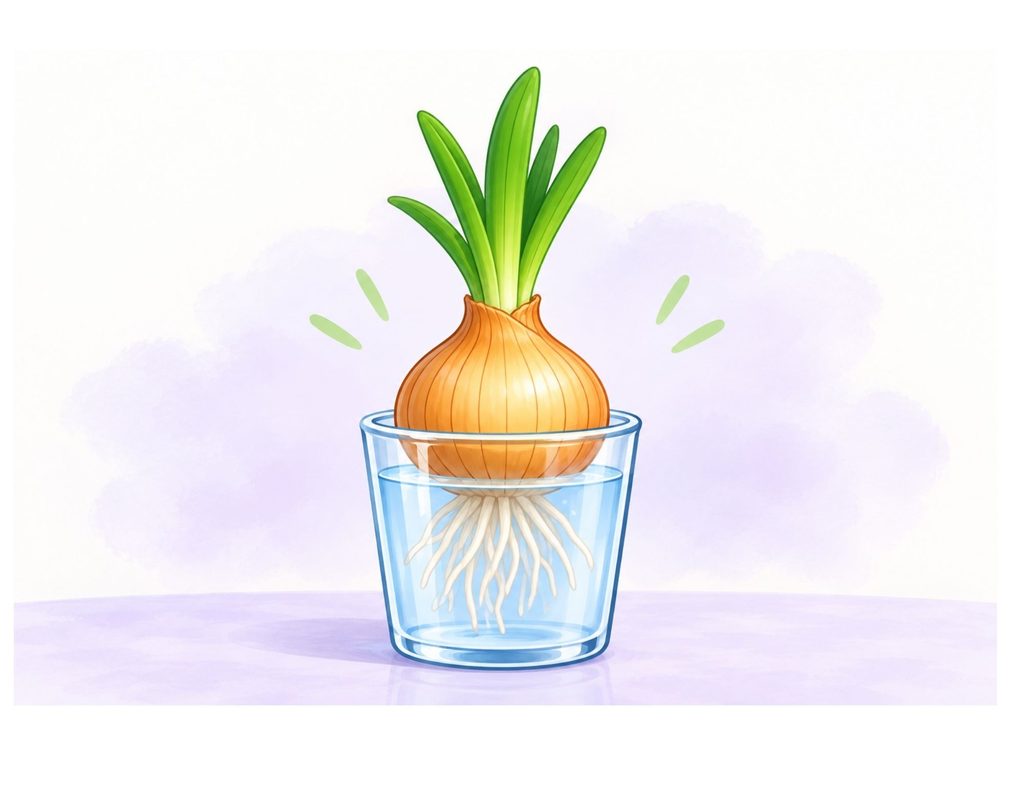
You do not need a complicated lab setup to help young students think like scientists. Sometimes, one onion, a clear cup, and a little water are enough.
An onion growth investigation gives Kindergarten, first grade, and second grade students an opportunity to watch plant growth happen right in front of them. Over several days, children can observe new roots and green shoots, measure changes, make drawings, record data, and look for patterns.
It is a simple way to turn a familiar vegetable into a hands-on elementary science investigation.
And because much of the growth happens where students can actually see it, onions are especially useful for introducing observation and measurement skills.
Why Is an Onion a Good Plant for Classroom Observation?
Most children recognize an onion from the kitchen, but they may be surprised to discover that the onion itself is part of a living plant.
An onion bulb is more interesting botanically than it first appears. The flat structure at the bottom of a bulb, called the basal plate, is actually a highly modified stem. New roots develop from this area, while new leaves and shoots grow upward. The fleshy layers of the bulb store resources that help support new growth.
This makes an onion a useful classroom specimen because students can observe two directions of growth at the same time:
roots growing downward and green shoots growing upward.
Instead of only reading that plants change and grow, children collect evidence of that change themselves.
A Simple Onion Growth Investigation
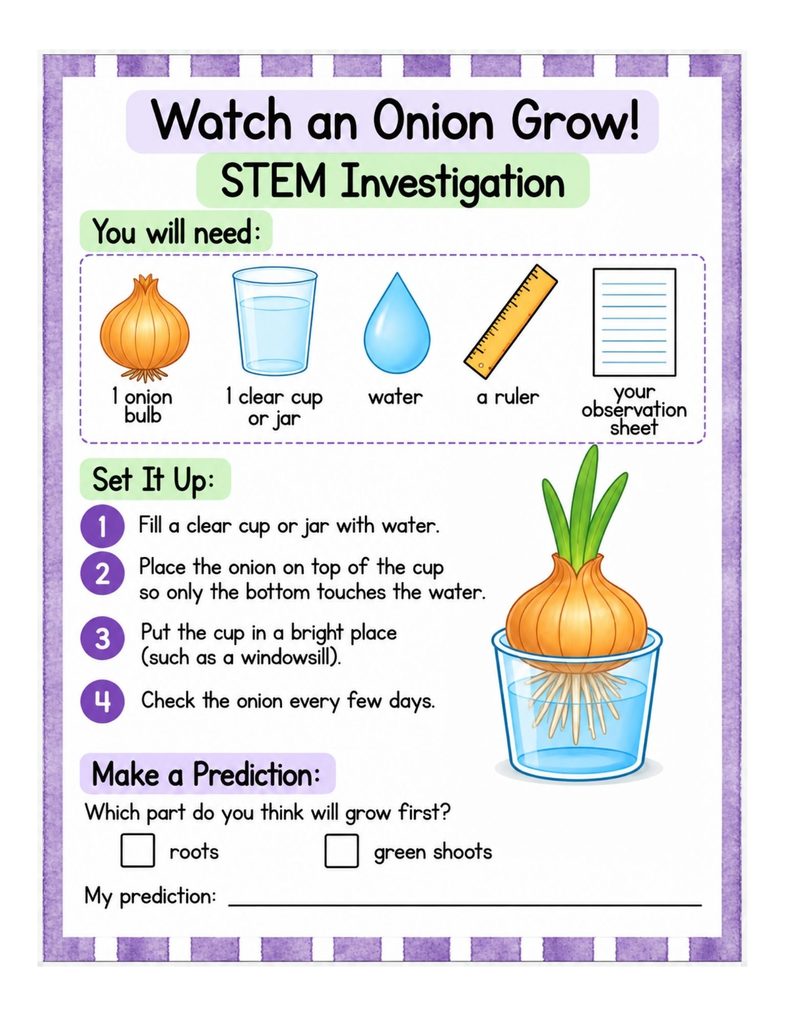
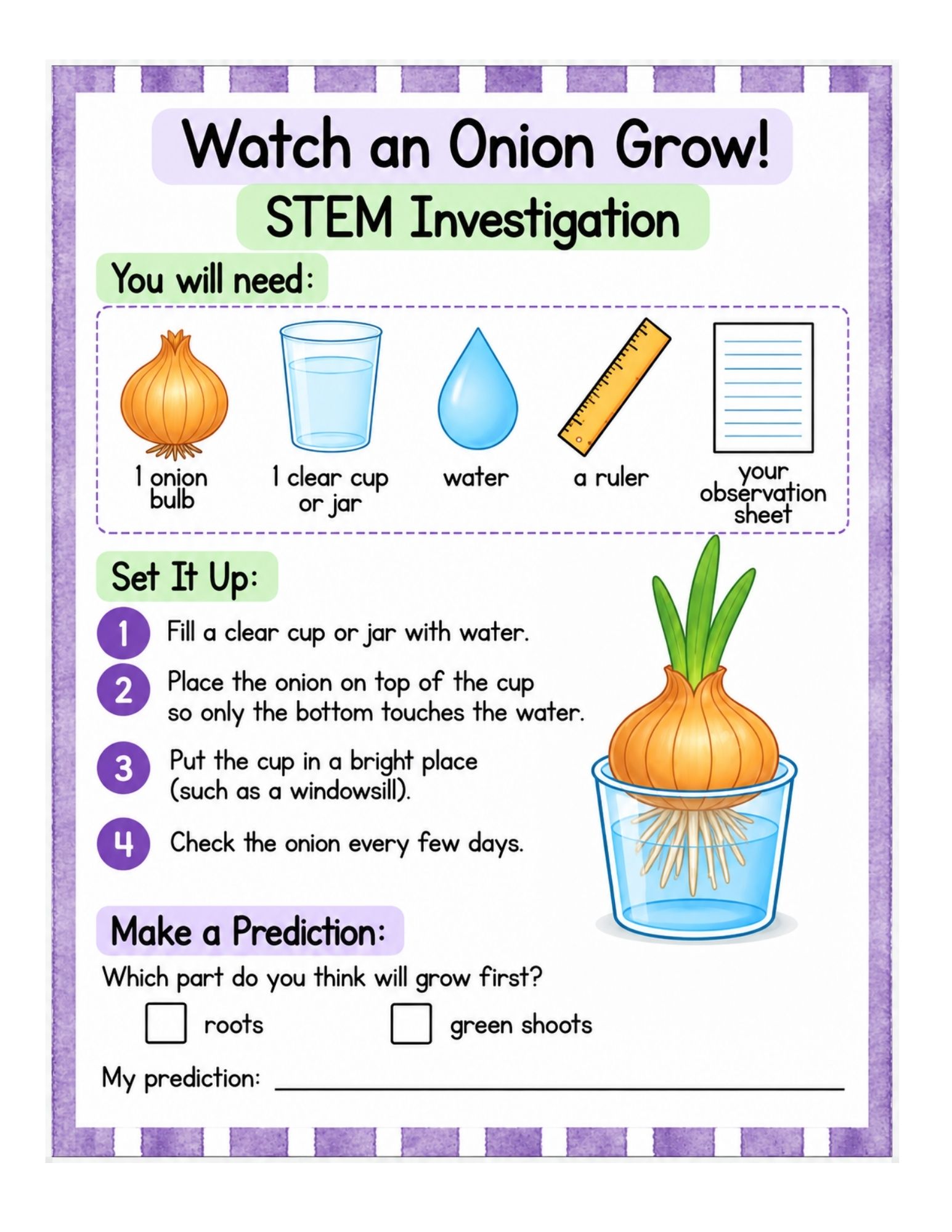
For this investigation, place a firm onion bulb over a clear cup or jar so that the root end at the bottom of the onion is in contact with the water while most of the bulb remains above it.
You will need:
- one firm onion bulb
- a clear cup or jar
- water
- a ruler
- an observation sheet
Place the onion in a bright location, such as near a classroom window, and check it regularly.
A classroom bulb-growing lesson from the New Jersey Agricultural Society similarly recommends suspending an onion over water so that students can observe new growth, with shoots often becoming visible within several days.
Results will not be identical for every onion. Some bulbs may already be beginning to sprout, and roots and shoots may develop at different rates. That variation is actually useful: students should record what they observe, rather than being told what is supposed to happen first.
Start With a Prediction
Before adding any measurements, ask students:
Which part do you think will grow first—roots or green shoots?
Young students do not need to know the correct answer beforehand. The purpose of a prediction is to give them a question they can return to after collecting evidence.
Students can check a prediction box and then complete a sentence such as:
My prediction is ______ because ______.
For Kindergarten students, the explanation can be completed orally with the teacher. First and second graders can write their own simple reasoning.
This small step changes the activity from simply “growing an onion” into an investigation.
Observe, Measure, and Record
Check the onion every few days rather than only looking at the final result.
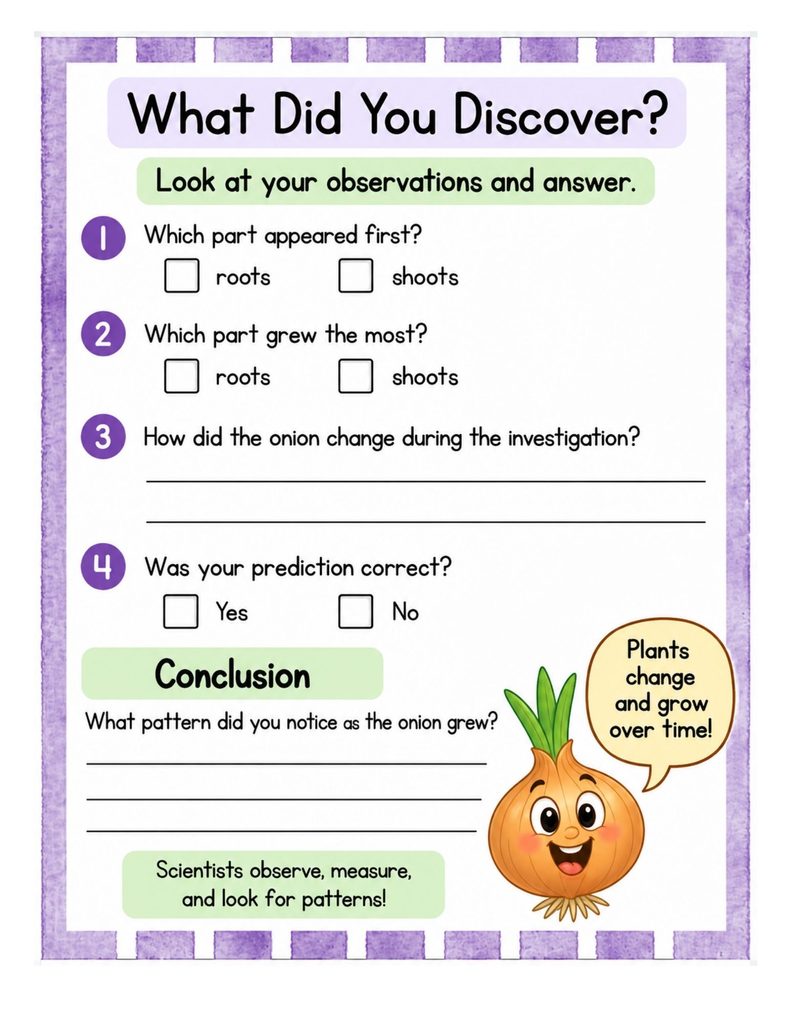
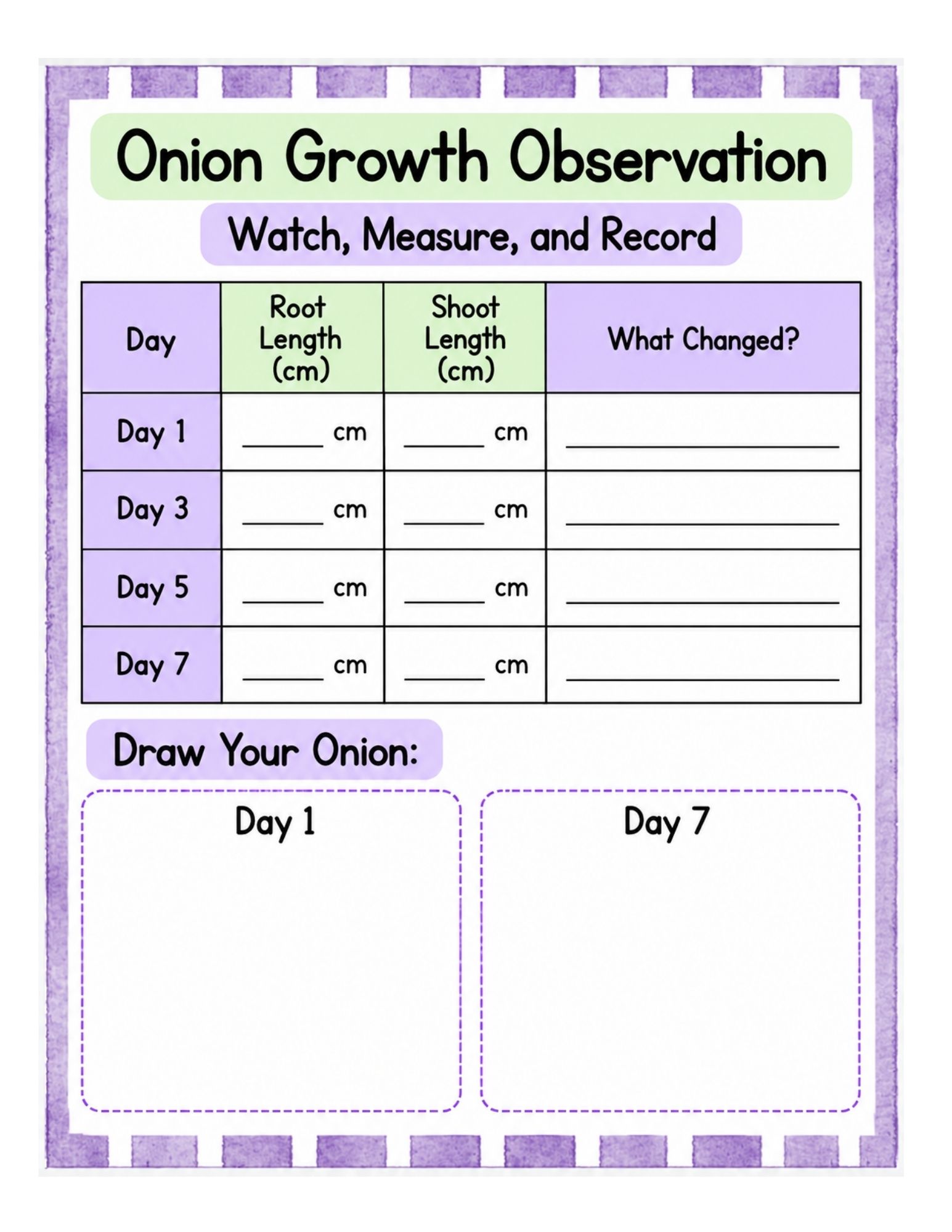
The free observation page included with this lesson provides spaces for Day 1, Day 3, Day 5, and Day 7. Students measure both root length and shoot length in centimeters and record what changed.
This gives children practice with several scientific skills at once:
observation, measurement, recording data, comparing observations, and recognizing patterns.
The Next Generation Science Standards emphasize observation and patterns in early elementary science. For example, K-LS1-1 asks students to use observations to describe patterns related to what living things need to survive.
For older students, the investigation can also become a starting point for exploring how light and water affect plant growth. 2-LS2-1 asks students to plan and conduct an investigation to determine whether plants need sunlight and water to grow, with one variable tested at a time.
The basic onion observation by itself is not a complete 2-LS2-1 investigation, but it provides a useful foundation for a later controlled comparison.
Let Students Draw What They See
Measurement is only one form of scientific recording.
Have students draw the onion at the beginning and again near the end of the investigation. Encourage them to look closely at details such as:
the number and length of roots, the appearance of the green shoots, and changes in the bulb.
The goal is not to create a perfect picture. A science drawing is a visual record of an observation.
Comparing a Day 1 drawing with a Day 7 drawing also makes changes especially easy for young learners to recognize.
Look for Patterns
After the final observation, bring students back to their original prediction.
Ask:
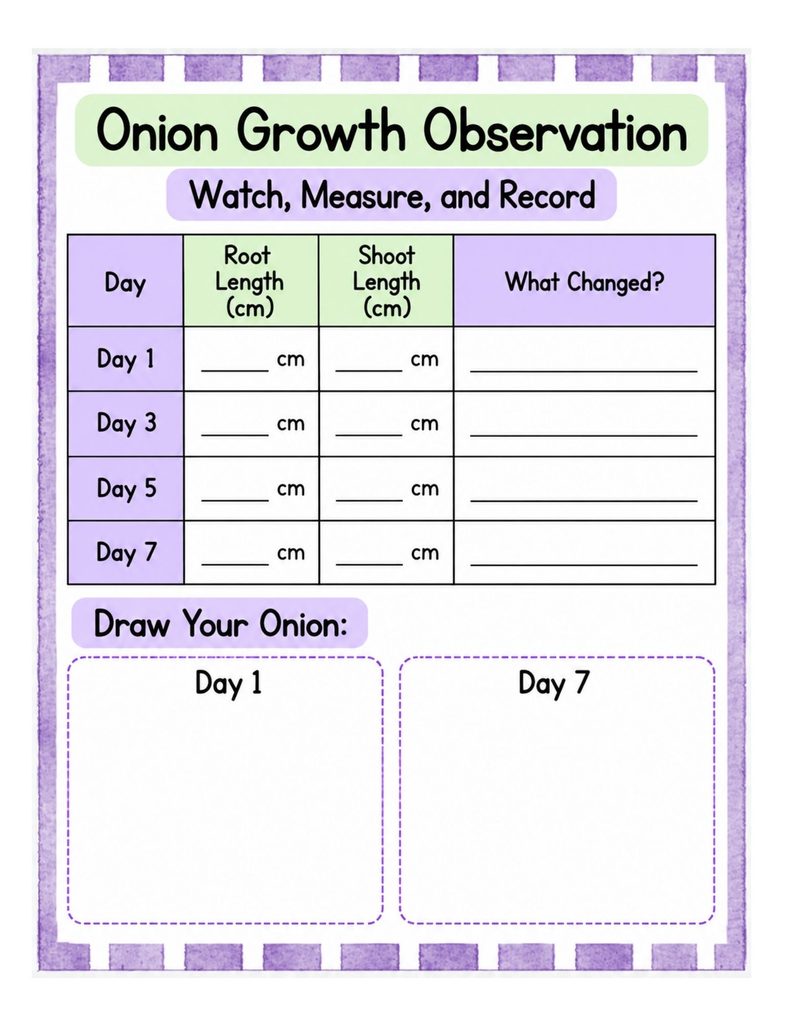
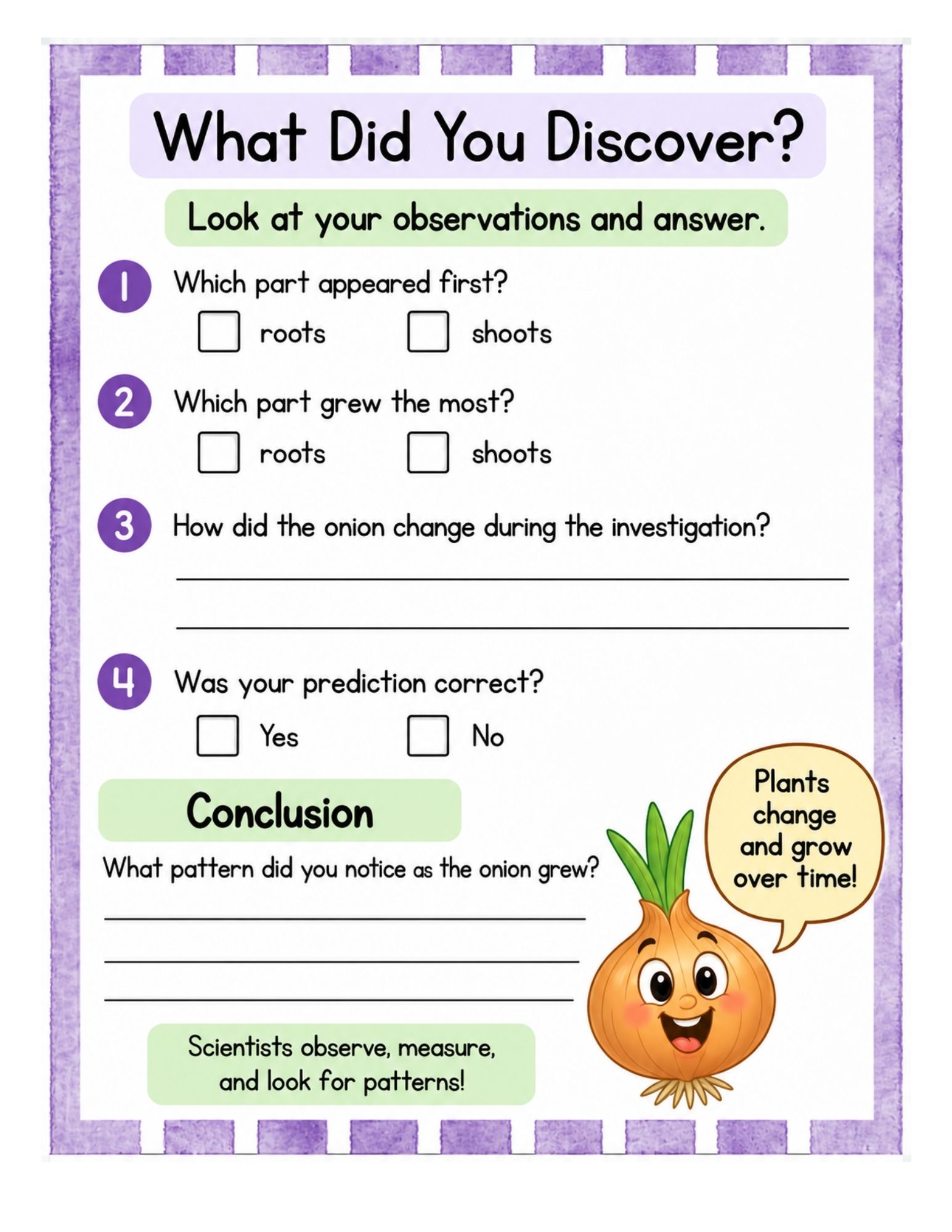
Which part appeared first?
Which part grew the most?
How did the onion change?
Was your prediction supported by your observations?
Then ask students to describe a pattern they noticed.
A response might be as simple as:
The roots became longer each time we measured them.
or
The green shoots grew taller over several days.
The exact result matters less than whether students can use their recorded observations as evidence.
That is an important early step toward scientific reasoning.
Extend the Investigation
Once students understand the basic activity, the onion can lead naturally into a larger plant unit.
Children can examine and label the roots, bulb, leaves, flower stalk, flowers, and seeds, compare growing an onion from a seed with growing one from an onion set, or sequence the stages of the onion life cycle.
It is also worth helping students understand that the bulb is not the entire life cycle.
Onions can be grown from seeds, transplants, or small bulbs called sets. Bulb onions are generally biennial plants, completing their reproductive life cycle over two growing seasons.
That makes the onion particularly useful for connecting several elementary plant concepts: plant parts, growth, plant needs, seasonal change, flowers, seeds, and life cycles.
Free Onion Growth Investigation Printable
Want to try the investigation with your students?
Download the free 3-page Onion Growth Investigation.
The printable includes:
- Watch an Onion Grow! STEM Investigation — materials, setup directions, and prediction
- Onion Growth Observation — root and shoot measurements for Days 1, 3, 5, and 7 plus before-and-after drawings
- What Did You Discover? — observation questions and a student conclusion
Continue Learning About Onions
If you would like to turn the investigation into a larger plant science unit, the Onion Life Cycle & Plant Parts Worksheets | STEM Activities | K–1 Science resource includes plant parts, vocabulary, the onion life cycle, seeds and sets, informational reading, math and literacy activities, and the complete onion growth investigation.
See the complete Onion Life Cycle & Plant Parts unit on Teachers Pay Teachers
For a shorter resource focused specifically on sequencing how an onion grows, the Onion Life Cycle Worksheets set includes the life cycle diagram, labeling, cut-and-paste sequencing, matching, drawing, coloring, a mini quiz, and an answer key for Kindergarten through Grade 2.
See the Onion Life Cycle sequencing worksheets on Teachers Pay Teachers
Frequently Asked Questions About Growing an Onion in the Classroom
Many onion bulbs begin showing new root or shoot growth within a few days, but the exact timing can vary. For a classroom investigation, observing the onion over about 7 days gives students enough time to notice, measure, and record visible changes.
A firm, healthy bulb onion works well. Choose an onion that is not soft or moldy. An onion that is already beginning to sprout may grow more quickly, while a dormant onion may take longer.
No. Only the bottom of the onion, where the roots grow, should touch the water. Keeping most of the bulb above the water helps reduce the chance of rotting.
Place the onion in a bright location, such as near a classroom window. The basic activity is designed as a growth observation. If students are investigating whether light affects plant growth, they should compare onions under controlled conditions and change only one variable at a time.
Students can measure the length of the roots and green shoots in centimeters. They can also record other observations, such as the number of roots, changes in color, or new shoot growth.
That is completely normal and can make the investigation more interesting. Different onion bulbs may grow at different rates. Students should record what actually happens rather than expect one specific result.
This activity is best described as an onion growth or sprouting investigation. Students observe new roots and shoots growing from a bulb. A complete onion life cycle also includes seed germination, leaf and bulb growth, flowering, seed production, and the start of a new generation.
It works especially well in Kindergarten through Grade 2. Kindergarten students can focus on observing and drawing changes, while first- and second-grade students can add measurement, data recording, predictions, and written conclusions.
Students practice making predictions, observing carefully, measuring, recording data, comparing changes over time, identifying patterns, drawing scientific observations, and writing conclusions based on evidence.
Yes, as part of a broader plant science unit. It supports early elementary work with observations, patterns, plant growth, and scientific investigations. However, the basic one-onion observation should not be presented by itself as proof that plants need water or sunlight. A controlled comparison is needed for that type of investigation.
Yes. If the onion remains healthy and has developed roots, it can be transferred to soil. This can extend the lesson and give students more time to observe continued leaf and root growth.
The activity leads naturally into lessons about plant parts, bulbs, roots, shoots, plant needs, onion life cycles, sequencing, and plant growth over time. It also works well as an introduction to a larger plant unit.
References & Further Reading
For additional information about plant growth, onion biology, and elementary science standards, these resources may be helpful:
- Next Generation Science Standards – K-LS1-1: From Molecules to Organisms: Structures and Processes
Kindergarten students use observations to describe patterns in what plants and animals need to survive. The standard includes the ideas that plants need water and light and emphasizes observation and patterns.
View K-LS1-1 on the NGSS website - Next Generation Science Standards – 2-LS2-1: Ecosystems: Interactions, Energy, and Dynamics
Grade 2 students plan and conduct investigations to determine whether plants need sunlight and water to grow. The assessment boundary specifies testing one variable at a time.
View 2-LS2-1 on the NGSS website - University of Maryland Extension – Growing Onions in a Home Garden
A useful overview of onion growth, planting, light and water requirements, and the onion life cycle. It also explains that bulb onions are biennial plants, although they are commonly grown as annual crops.
Read Growing Onions in a Home Garden - University of Florida IFAS – Bulbs and Bulb Anatomy
This resource explains the structure of true bulbs, including the basal plate, fleshy scales, roots, and growing point. It is especially useful for understanding why an onion bulb is more than simply a “root.”
Explore bulb structure from UF/IFAS - Iowa State University Extension – Growing Vegetables from Kitchen Scraps
Includes practical guidance for regrowing green onions in water and observing new shoot growth, making it a useful additional source for classroom sprouting activities.
Read the Iowa State Extension guide
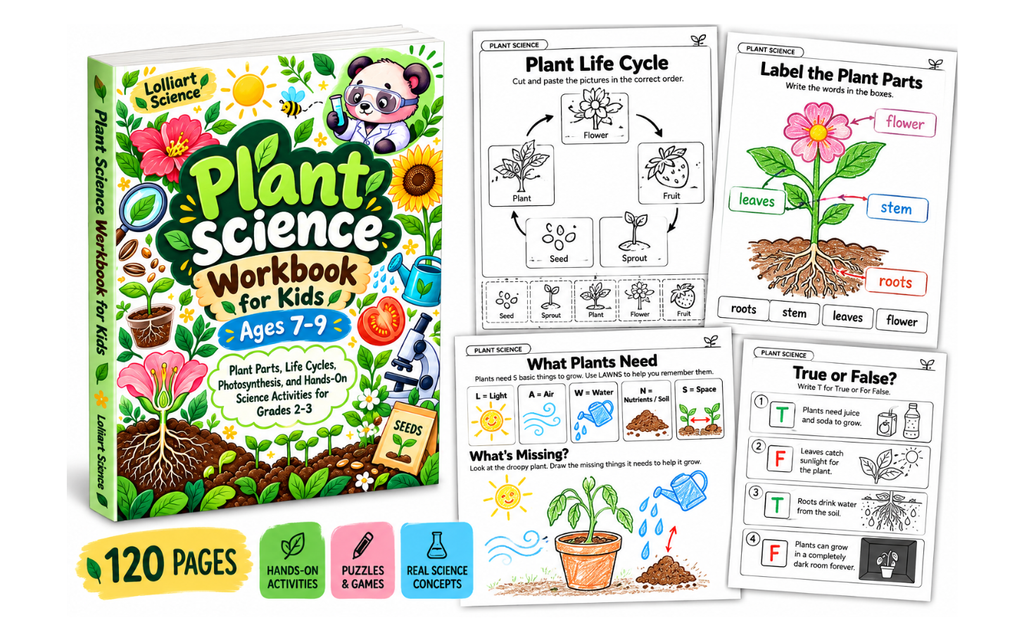
Make plant science exciting with this 120-page workbook designed for kids ages 7–9 (Grades 2–3)! Explore plant parts, life cycles, photosynthesis, and how plants grow through engaging reading passages, hands-on activities, coloring pages, puzzles, and science challenges. Build science knowledge while encouraging curiosity, observation, and critical thinking.