A Hands-On Ocean Habitat Sorting Activity for Grades 2–3 with Free Sample
Why does a stingray have a flat body? Why is a shark shaped differently from a sea star? And how can a sea anemone stay in one place while ocean water moves around it?
Questions like these help children discover an important life science idea: animals have structures and behaviors that help them survive in particular environments. In this hands-on marine animal adaptations activity, students study twelve ocean animals, look for visible clues, and predict whether each animal is best suited to a coral reef, the open ocean, or a sandy bottom.
The lesson combines observation, coloring, cutting, sorting, discussion, and evidence-based reasoning. It works especially well in grades 2–3 and can be simplified for younger learners or extended for grade 4.
Lesson at a Glance
| Grade level | Grades 2–3; adaptable for Grades 1 or 4 |
| Time | 45–60 minutes |
| Prep time | 10–15 minutes |
| Topic | Habitats, animal adaptations, structure and function |
| Habitats | Coral reef, open ocean, sandy bottom |
| Grouping | Individual, partners, or groups of three |
| Main skill | Using observable evidence to explain a habitat prediction |

Learning Objectives
By the end of the lesson, students will be able to:
- explain that adaptations help organisms survive in their environments;
- identify visible external structures of marine animals;
- describe how a structure may help an animal move, hide, feed, stay safe, or remain in place;
- use physical characteristics as evidence when predicting an animal’s most suitable habitat; and
- revise a prediction after listening to new evidence.
Science Vocabulary
Introduce only the terms your students need. A simple student-friendly word bank may include:
- habitat: the place where an organism lives and finds what it needs;
- adaptation: a body feature or behavior that helps an organism survive;
- external structure: a body part that can be seen from the outside;
- evidence: an observation or fact that supports an idea;
- camouflage: colors, patterns, or shapes that help an organism blend in;
- streamlined: having a smooth shape that moves easily through water.
Materials
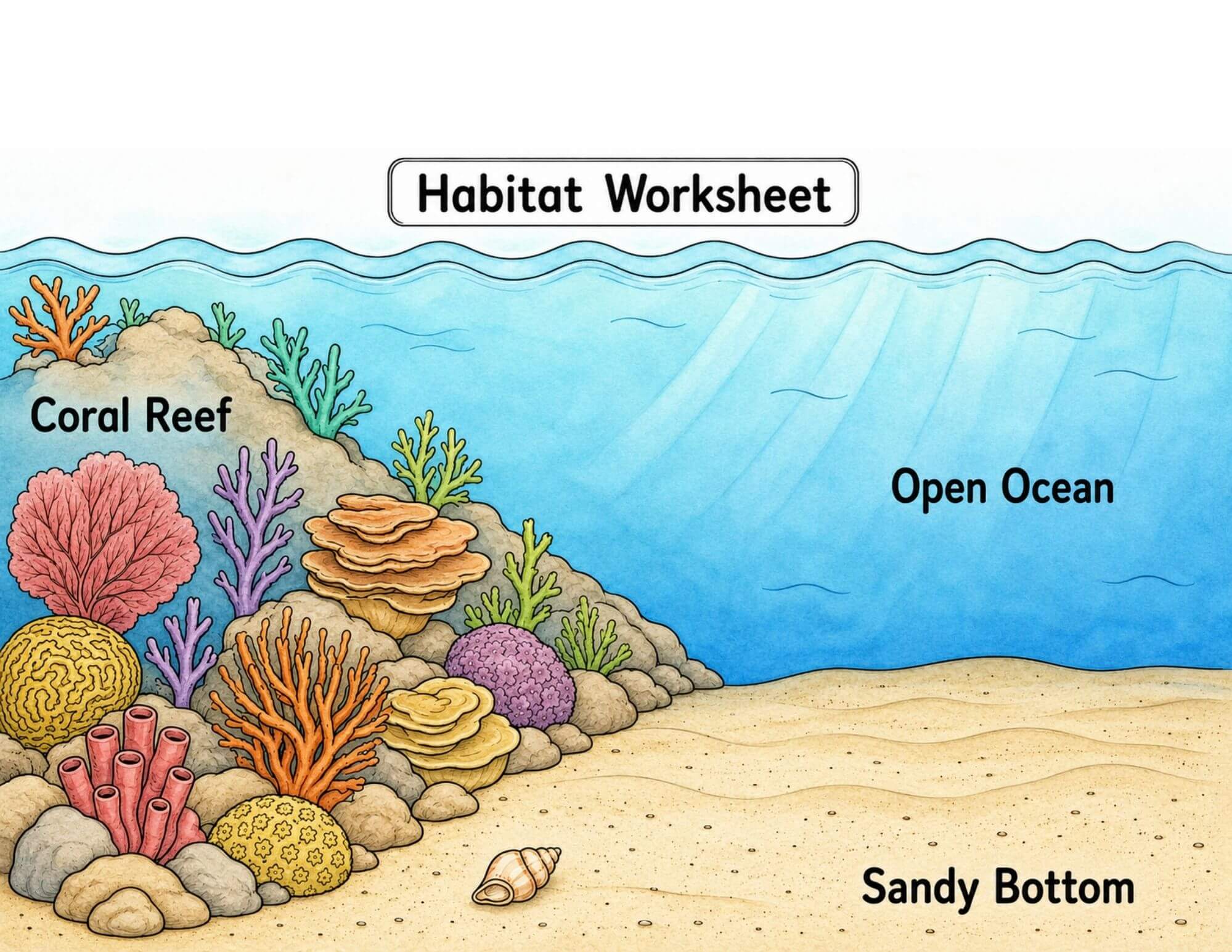
- Marine Habitat Worksheet
- One set of Marine Animal Cards per student, pair, or group
- Scissors
- Colored pencils or crayons
- Glue sticks or removable tape
- Optional: printed or projected photographs of the three habitats
- Optional: science notebooks or recording paper
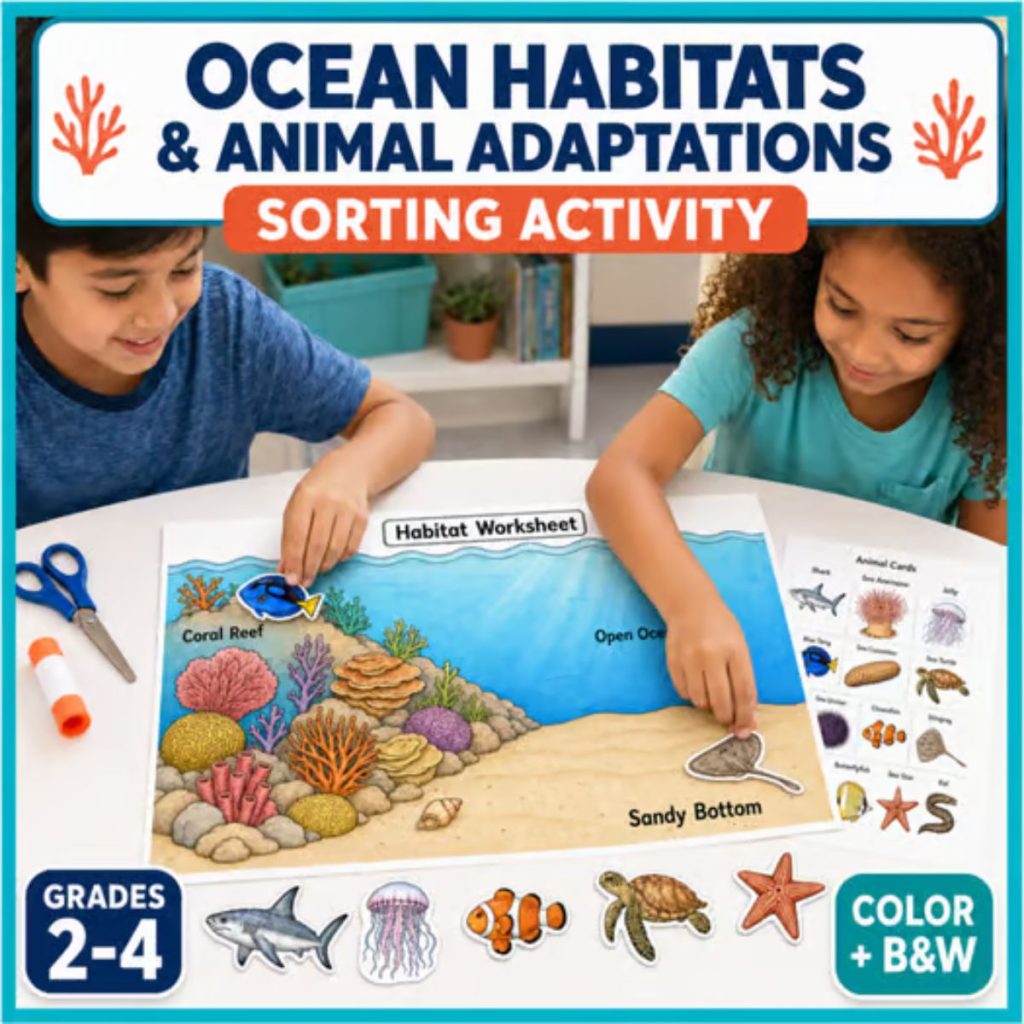
The printable activity shown in this lesson contains twelve labeled animal cards, three habitat photo references, black-and-white and color worksheet options, a completed example, and a flexible teacher answer guide.
[Add your product or download link here]
Teacher Background: What Makes Each Habitat Different?
Before students sort the animals, help them notice the conditions in each habitat. The goal is not to memorize a list of animals. It is to connect a habitat feature with a structure or behavior that could be useful there.
Coral Reef
A coral reef is a complex, structure-rich habitat with holes, ledges, branches, and narrow spaces. Small or laterally flattened fish can turn through tight areas and hide among the reef structures. Some animals grip or attach to hard surfaces so currents do not carry them away. Color, pattern, spines, and protective partnerships can also support survival on a busy reef.
Useful clues may include:
- a narrow or flattened body for moving between reef structures;
- a long snout for reaching food in small spaces;
- gripping structures or an attached body form;
- spines, shells, or hiding behaviors for protection; and
- colors or patterns that work as camouflage, recognition, or warning signals.

Open Ocean
The open ocean has few solid surfaces and very little shelter. Many animals must keep swimming, while others float or drift with the water. Strong swimmers often have smooth, streamlined bodies and powerful tails or flippers. Countershading—a darker upper surface and lighter underside—can make an animal less visible from above or below.
Useful clues may include:
- a streamlined body;
- a strong tail or large flippers;
- a shape suited to continuous swimming;
- countershading; and
- a light, floating body with limited swimming ability.

Sandy Bottom
The sandy seafloor is open and comparatively flat. It offers fewer hard structures than a reef, but the sand itself provides opportunities for camouflage and burrowing. Many bottom-dwelling animals have flattened bodies, neutral colors, eyes positioned toward the top of the body, tube feet, spines, or shapes that help them crawl, dig, or rest on the seafloor.
Useful clues may include:
- a flat body that stays close to the seafloor;
- colors that blend with sand;
- structures used for digging or burrowing;
- eyes on the upper side of the body; and
- tube feet, spines, or a slow-moving bottom-dwelling body form.

Before the Lesson
Print one Habitat Worksheet and one set of Animal Cards for each student or group. If cutting time is limited, prepare the cards in advance. Display one photograph of each habitat where everyone can see it.
For groups of three, divide the preparation naturally: one student can color the coral reef, one the open ocean, and one the sandy bottom. Each student can then color four animal cards.
Decide whether students will glue the cards immediately. Removable tape or simply placing the cards first makes it easier for children to revise their thinking during the class discussion.
Step-by-Step Teaching Guide
1. Engage: What Helps Humans Live on Land? — 5 minutes
Begin with a familiar example. Ask:
What body parts help people move, breathe, eat, and stay safe on land?
Students may mention legs, feet, hands, eyes, skin, or lungs. Explain that living things have structures and behaviors that help them meet their needs. These useful features are called adaptations.
Keep the explanation age-appropriate: an individual animal does not choose or grow a new adaptation because it needs one. Adaptations are inherited characteristics found in a kind of organism over many generations.
2. Observe the Three Habitats — 5–8 minutes
Show the coral reef, open ocean, and sandy-bottom photographs. Invite students to compare them.
Ask:
- Where could an animal hide?
- Where could an animal attach itself?
- Which habitat has the most open space for swimming?
- Where might camouflage be especially useful?
- What problem would an animal need to solve in each habitat?
Record student ideas in three columns. Accept several possible strategies. For example, an open-ocean animal might be a powerful swimmer, but it might also be a drifter such as a jelly.
3. Model a Claim With Evidence — 5 minutes
Choose one card and think aloud without giving away every answer. A stingray is a useful example:
I predict that the stingray is well suited to the sandy bottom. I notice that its body is broad and flat, and its eyes are on top. This shape may help it rest on or partly hide in the sand.
Give students a sentence frame:
I predict the ___ is best suited to the ___. I notice ___. This may help it ___, so my evidence supports my prediction.
For younger learners, shorten it to:
I chose ___ because it has ___.
4. Study and Sort the Animal Cards — 15–20 minutes
Students color and cut out the animal cards, then place each animal in the habitat they think is the best fit. The set includes:
- shark;
- sea anemone;
- jelly;
- blue tang;
- sea cucumber;
- sea turtle;
- sea urchin;
- clownfish;
- stingray;
- butterflyfish;
- sea star; and
- eel.
Ask students to place the cards before gluing. Encourage partners to challenge each other respectfully:
- What structure do you notice?
- How would that structure help in this habitat?
- Could this animal also use another habitat?
- Which evidence is strongest?
The final question is important. Many broad animal groups, including sharks, eels, sea turtles, and sea stars, include species that use more than one habitat. Students may place a card on a border or explain an alternative choice.
5. Gallery Walk and Peer Discussion — 5–8 minutes
Display the completed habitat sheets. Ask students to look for:
- one placement that appears in almost every model;
- one animal that classmates placed in different habitats; and
- one explanation that changed their thinking.
This turns different answers into evidence for discussion instead of treating every difference as a mistake.
6. Discuss, Revise, and Glue — 10 minutes
Use an extra worksheet or the completed model to discuss the cards one at a time. Ask students for a claim and supporting evidence before revealing a common or likely placement.
Useful examples include:
| Animal | Observable clue | Possible survival function | Strong habitat connection |
| Shark | Streamlined body and powerful tail | Efficient long-distance swimming | Open ocean |
| Jelly | Floating bell-shaped body and tentacles | Drifts and captures food in the water column | Open ocean |
| Blue tang | Thin, laterally compressed body | Turns through narrow reef spaces | Coral reef |
| Sea anemone | Attaching base and stinging tentacles | Holds position and captures food | Coral reef |
| Stingray | Flat body, eyes on top, sand-like color | Rests or hides against the seafloor | Sandy bottom |
| Sea urchin | Spines and tube feet | Protection, gripping, and slow movement over surfaces | Reef or sandy bottom |
| Sea star | Tube feet and low bottom-dwelling body | Grips and crawls over the seafloor | Reef or sandy bottom |
| Eel | Long, narrow body | Hides in crevices or moves into burrows | Reef or sandy bottom, depending on species |
Invite students to move cards when the evidence changes their minds. In science, revising an explanation after receiving better evidence is a strength.
A Flexible Answer Key Is More Scientific
This activity should not be graded as though every animal has only one possible home. Habitat use can vary by species, life stage, season, food availability, and behavior. A sea turtle may feed near a reef, travel through open water, and rest near the bottom. Some sharks live in the open ocean, while others regularly use reefs or coastal seafloors.
Use the included answer guide to identify a common or best-fit habitat, then accept an alternative when a student can support it with a reasonable observation. The most important outcome is the quality of the student’s structure–function explanation.
Assessment Ideas
During the Activity
Listen for whether students can:
- name an observable structure;
- connect that structure to a function;
- connect the function to a habitat condition; and
- use evidence rather than “I just think so.”
Exit Ticket
Ask students to complete:
The ___ is well suited to the ___ because its ___ helps it ___.
Simple Three-Point Check
| Score | Student response |
| 3 | Makes a habitat claim, identifies a relevant structure, and clearly explains how it supports survival |
| 2 | Makes a reasonable claim and names a structure, but the explanation is incomplete |
| 1 | Gives a habitat choice without relevant evidence |
Differentiation
Support for Younger Students and English Learners
- Pre-cut the cards.
- Begin with six animals instead of all twelve.
- Provide a picture word bank for body shape, tail, flippers, spines, shell, tentacles, and color.
- Let students rehearse their explanations with a partner.
- Use the shorter sentence frame: “The ___ lives in the ___ because ___.”
- Allow students to point and explain orally instead of writing.
Challenge for Advanced Learners
- Require two pieces of evidence for each prediction.
- Ask students to identify a second possible habitat and explain why it may be a less common fit.
- Have students compare two animals that live in the same habitat but use different survival strategies.
- Let students choose a specific species of shark, eel, jelly, or sea turtle and check whether the general class prediction still applies.
Extension: Design a Marine Animal
Assign each student one of the three habitats. Students design an imaginary marine animal with at least three adaptations that would help it survive there.
Their design should include:
- a labeled drawing;
- three external structures or visible characteristics;
- a short explanation of the function of each adaptation; and
- one sentence explaining why the animal would be less successful in another habitat.
For example, a sandy-bottom animal might have a flat body, tan spots for camouflage, and fin-like structures used to push sand over its back.

DIY Idea: Make a Clownfish and Explore Reef Adaptations
Extend your marine animal adaptations lesson with a simple paper plate clownfish craft. As students create their clownfish, they can identify features such as strong fins, bright color patterns, and the protective mucus coating that allows clownfish to live safely among sea anemone tentacles.
Use the activity to connect animal structures with habitat. Ask students why these features would be useful in a coral reef environment and whether the same adaptations would work as well in the open ocean, deep sea, or polar waters.
This makes a natural follow-up to a “Which Ocean Habitat Is the Best Fit?” activity because students move from simply matching an animal to its habitat to explaining why that habitat meets the animal’s needs.
Teacher tip: Clownfish and sea anemones are also a useful example of a close ecological relationship. The clownfish gains protection among the anemone’s tentacles, while the two organisms can benefit each other in several ways.
NGSS Connections
This activity most directly supports 3-LS4-3, in which students use evidence to argue that some organisms survive better than others in a particular habitat. It can also support 2-LS4-1 when students use observations to compare life in different habitats. With a stronger written or oral argument about external structures and their functions, it provides a useful bridge to 4-LS1-1.
- Disciplinary Core Ideas: LS4.C Adaptation; LS1.A Structure and Function; LS4.D Biodiversity and Humans
- Science and Engineering Practices: Engaging in Argument from Evidence; Constructing Explanations
- Crosscutting Concepts: Cause and Effect; Structure and Function; Patterns
Official standard pages: 3-LS4-3 and 4-LS1-1.
Final Teaching Tip
The most valuable sentence in this lesson is not “That card is in the correct box.” It is “What evidence supports your choice?” When children can connect a visible body structure to a survival function and then to a habitat condition, the sorting page becomes a genuine science reasoning task.
Ready to try the lesson? [Add your product or download link here].
Source and Further Reading
This lesson was inspired by and expands on the California Academy of Sciences: Habitat Adaptation Matchup.
When using material from another organization, link to the original source and follow its terms of use; do not republish its original downloads as your own.
Frequently Asked Questions
Begin with photographs of different ocean habitats and ask students to observe the animals’ visible body structures. Then have them connect each structure—such as a flat body, powerful tail, spines, tentacles, or camouflage—to a possible survival function and habitat.
Examples include a shark’s streamlined body for efficient swimming, a stingray’s flat shape for resting or hiding on the seafloor, a sea urchin’s spines for protection, and a butterflyfish’s narrow body for moving between coral reef structures.
External structures can help marine animals swim, find food, hide, defend themselves, attach to surfaces, or move through a particular environment. Students can study these structures as evidence when predicting where an animal is best suited to live.
The activity focuses on three contrasting habitats: the coral reef, the open ocean, and the sandy bottom. Comparing these environments helps students understand why different adaptations are useful under different conditions.
No. Many marine animals use more than one habitat, and habitat use may vary by species, age, season, or behavior. Students should be encouraged to suggest alternative placements when they can support their choice with observable evidence.
The lesson is designed primarily for Grades 2–3. It can be simplified for Grade 1 by using fewer animal cards and oral explanations or extended for Grade 4 by requiring more detailed structure-and-function arguments.
The activity most directly supports NGSS 3-LS4-3 by asking students to use evidence to explain why certain organisms may survive better in particular habitats. It can also support 2-LS4-1 and provide a bridge to 4-LS1-1 through the study of external structures and their functions.
Ask students to name an observable structure, explain its function, and connect it to a habitat condition. A simple response frame is: “The _ is well suited to the because its helps it _.”