How to Teach Arctic Tundra Plants and Adaptations in Grades 2–3
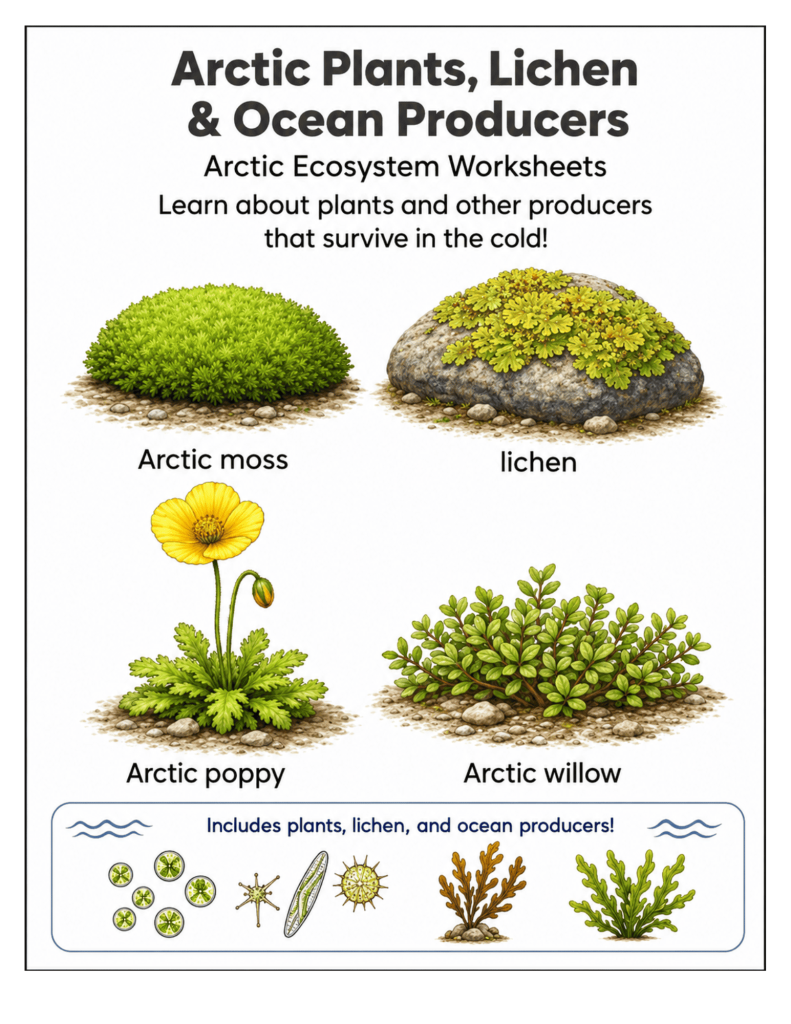
Begin by introducing four important Arctic plants and producers: Arctic moss, lichen, Arctic poppy, and Arctic willow. The picture chart helps Grade 2–3 students connect each name with a clear visual example. Children can also observe how many Arctic plants grow low to the ground, helping them survive cold temperatures and strong winds.
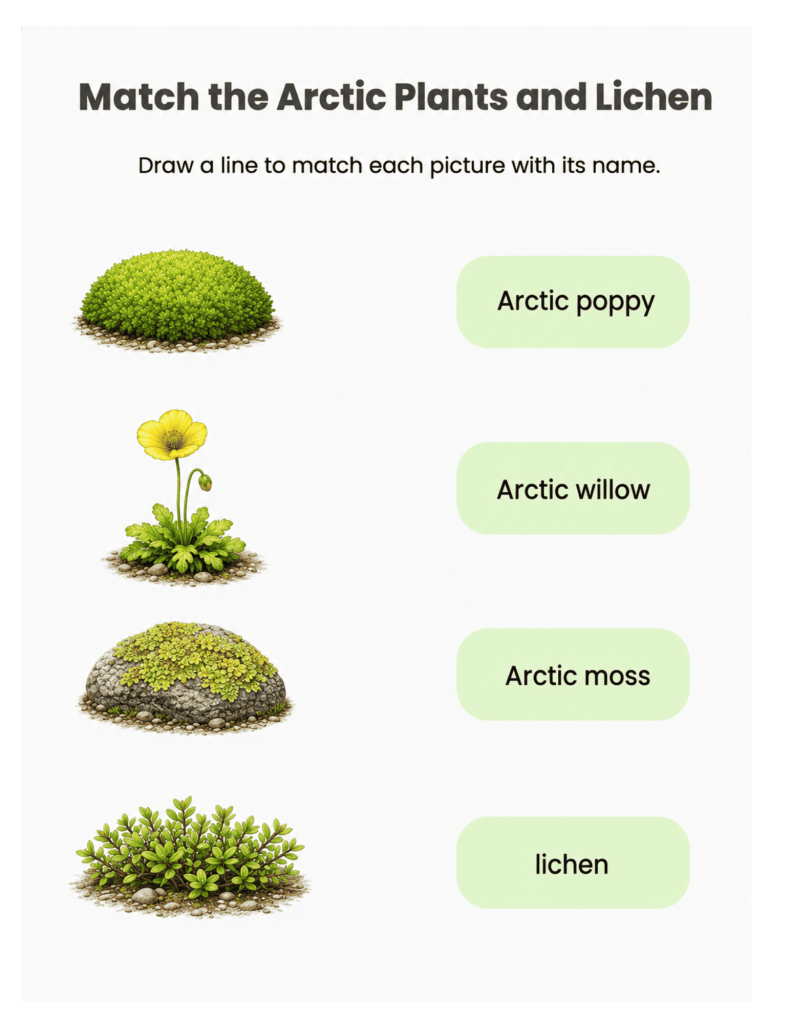
After the introduction, students complete a simple matching activity by drawing a line between each picture and its correct name. This hands-on review reinforces science vocabulary, visual recognition, and understanding of producers in the Arctic ecosystem. It is also a quick, low-prep way to check comprehension before introducing Arctic food chains and animal habitats.
To extend the lesson with a creative, low-prep activity, students can [learn about Arctic tundra plants through coloring] while observing the shapes, features, and adaptations that help these plants survive in a cold environment.
Frequently Asked Questions About Arctic Plants and Lichen
The Arctic tundra supports hardy plants such as Arctic moss, Arctic poppy, Arctic willow, grasses, and sedges. Lichens are also common, although they are not true plants. These organisms are specially suited to cold, windy conditions and a short growing season.
Many Arctic plants grow close to the ground, where they are protected from strong winds. They may also have small or hairy leaves, shallow roots, dark-colored flowers, and the ability to grow and reproduce quickly during the short Arctic summer.
Lichen is not a plant. It is a partnership between a fungus and an alga or cyanobacterium. The photosynthetic partner produces food using sunlight, while the fungus provides protection and helps retain water.
Arctic plants capture energy from sunlight and make their own food through photosynthesis. The algae or cyanobacteria within lichens also photosynthesize. Together, these producers form the base of many Arctic food chains and provide food for animals such as caribou, lemmings, and Arctic hares.
Students practice identifying Arctic moss, lichen, Arctic poppy, and Arctic willow from pictures. The activity also reinforces science vocabulary, observation skills, plant adaptations, and the role of producers in an Arctic ecosystem.
The worksheets are designed primarily for students in Grades 2–3. They may also be used with advanced first graders, as a review activity in Grade 4, or with multilingual learners who benefit from clear pictures and simple science vocabulary.
Begin with the picture chart to introduce each organism. Students can then complete the matching activity independently, with a partner, or in a science center. Follow the activity with a discussion about adaptations, producers, Arctic food chains, or tundra habitats.
Professional References and Further Reading
- U.S. National Park Service – Tundra
Clear overview of the Arctic tundra biome, including low-growing vegetation, mosses, lichens, small shrubs, and the short growing season.
Explore Tundra – National Park Service - U.S. National Park Service – Plants of Bering Land Bridge National Preserve
Useful background on how tundra plants cope with permafrost, including shallow root systems and the narrow layer of soil available for plant growth.
Explore Arctic Plant Adaptations – National Park Service - U.S. National Park Service – Arctic Willow
A particularly relevant source for your Arctic willow section. It explains the willow’s low-growing form, shallow roots, and adaptation to tundra conditions.
Learn About Arctic Willow – National Park Service - U.S. National Park Service – Mosses and Liverworts
Excellent support for your Arctic moss content. It explains how mosses absorb water, remain small and low-growing, and survive harsh Arctic winters.
Learn About Arctic Mosses – National Park Service - U.S. National Park Service – Lichens of the Arctic
A strong scientific reference for explaining that lichens are not plants but composite organisms involving a fungus and an alga and/or cyanobacterium. It also discusses their importance in Arctic ecosystems and as food for caribou.
Explore Lichens of the Arctic – National Park Service - University of Alaska Fairbanks – Toolik Field Station
A useful university-level source for teachers who want to explore Arctic plant research in more depth, including tundra plant growth, seasonal timing, and adaptation to the Arctic growing season.
Explore Arctic Plant Research – UAF Toolik Field Station