Bring rainforest science, biodiversity, and teamwork together with one giant classroom project.
Collaborative posters are a simple way to turn an individual coloring activity into a shared learning experience. Each student works on one small section, but every piece becomes part of a much larger picture.
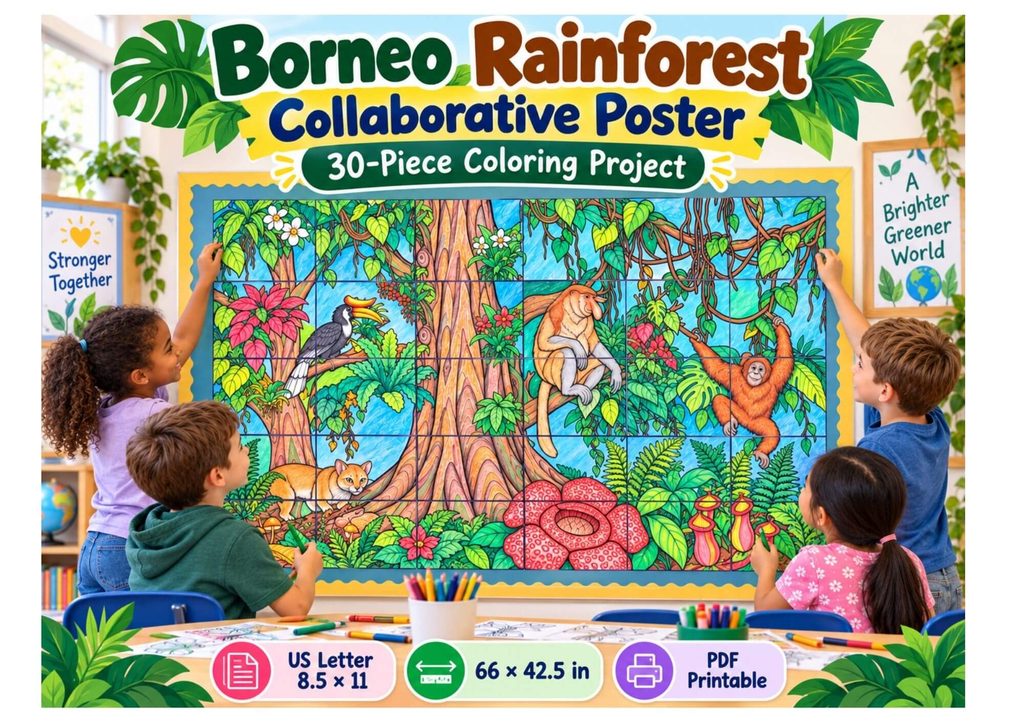
With this Borneo Rainforest Collaborative Poster, students can explore rainforest animals, plants, habitats, and biodiversity while creating a colorful classroom display together.

Why Use Collaborative Projects in the Classroom?
Collaborative activities give every student an individual responsibility while working toward a common goal.
Each child receives one poster section to color. At first, students may only see a hornbill, a vine, part of a tree, or a patch of rainforest floor. When all 30 pieces are assembled, those individual sections become one large rainforest ecosystem.
This makes the final reveal part of the learning experience.
Students can practice:
- teamwork and shared responsibility
- observation and attention to detail
- communication
- creativity
- connecting individual organisms to a larger habitat
Explore a Unique Animal Habitat: The Borneo Rainforest
Borneo is home to an extraordinary variety of tropical rainforest life. Its forests contain towering trees, climbing vines, ferns, fungi, unusual flowering plants, and animals adapted to life from the forest floor all the way to the canopy.
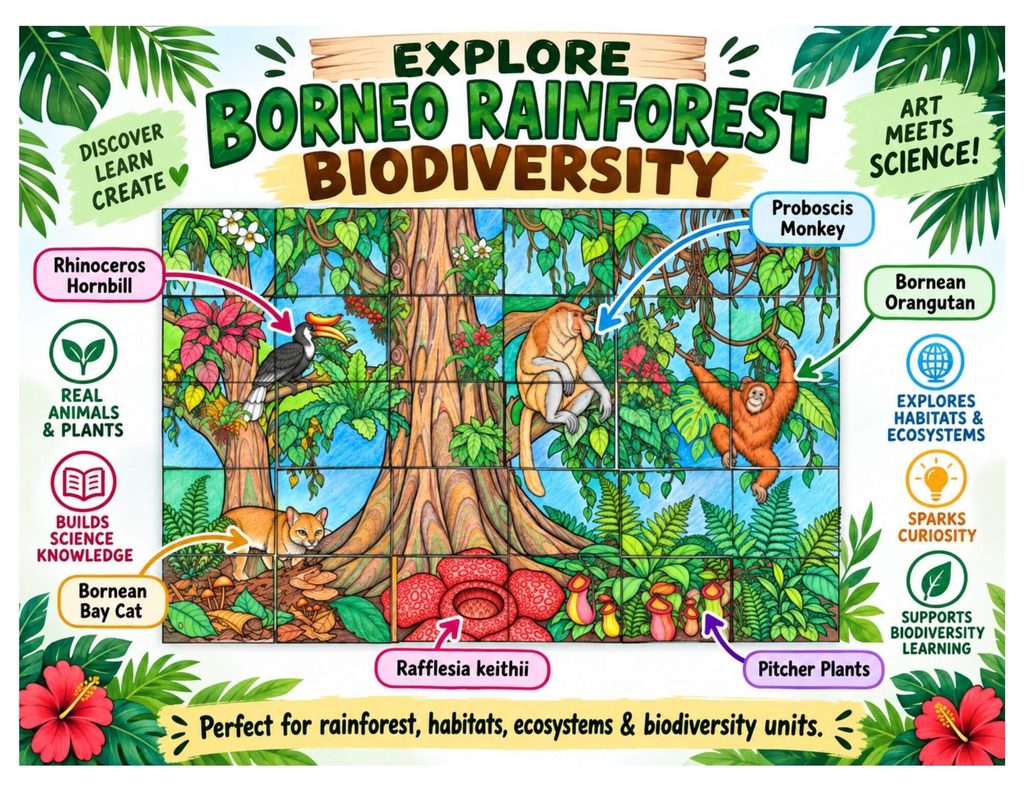
The poster introduces students to several recognizable examples of Borneo biodiversity, including the:
Bornean Orangutan – a tree-dwelling great ape that spends much of its life in the rainforest canopy.
Proboscis Monkey – a monkey native to Borneo that is often associated with forests near rivers, mangroves, and wetlands.
Rhinoceros Hornbill – a large rainforest bird with a distinctive colorful bill and casque.
Bornean Bay Cat – a rare wild cat found only on Borneo.
Students can also discover rainforest plants such as pitcher plants and Rafflesia keithii, helping them see that a habitat is much more than its animals.
From Canopy to Forest Floor
One useful way to extend the activity is to ask students to look closely at where organisms appear in the rainforest scene.
Which animals are high in the trees?
Which organisms are close to the forest floor?
Where do vines grow?
Where can students find fungi, fallen leaves, and other decomposing material?
These simple observation questions help children begin thinking about habitats as connected ecosystems rather than collections of separate animals.
One rainforest, many habitats.
A tropical rainforest is not just one habitat. From sunlit emergent trees to the dark forest floor, each layer provides different amounts of light, food, shelter, and space. Animals may move between several layers, while some plants are especially adapted to particular conditions. Exploring these layers helps students understand why biodiversity in Borneo is so extraordinary—and why protecting an entire rainforest ecosystem matters.
Look closely at the collaborative poster: Can students find examples from different rainforest layers? Ask them to locate an orangutan in the trees, pitcher plants among the vegetation, Rafflesia near the forest floor, and fungi growing among fallen leaves.


How to Use the Collaborative Poster
The activity is designed to be simple to prepare.
1. Print the 30 black-and-white poster sections.
2. Color – give each student one section to complete with crayons, markers, or colored pencils.
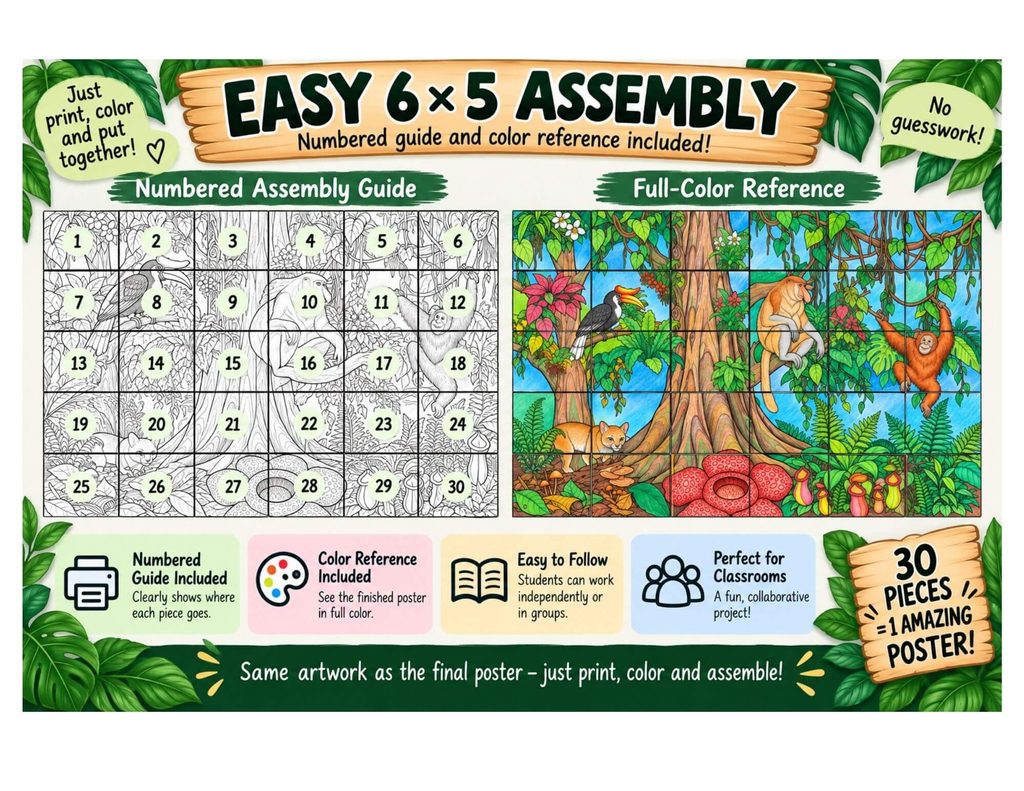
3. Assemble the pages using the numbered guide.
4. Display the finished 66 × 42.5 inch (approximately 5.5 × 3.5 foot) rainforest poster on a classroom wall, bulletin board, or hallway.
[IMAGE – Color • Assemble • Display graphic]
The completed poster works especially well during units about:
- rainforests
- animal habitats
- ecosystems
- biodiversity
- adaptations
- Southeast Asia
- environmental science

If you’re looking for a more complete rainforest lesson, you can pair this collaborative poster with my Borneo Rainforest Mini-Unit for Grades 2–3, which includes hands-on activities, reading, and science learning about rainforest habitats and biodiversity. :https://lolliartscience.com/2026/08/06/borneo-rainforest-mini-unit-grades-2-3/
One Small Piece Becomes Part of a Bigger Ecosystem
One of my favorite things about collaborative posters is that students cannot create the finished result alone.
Each student contributes a small piece. When those pieces are placed together, the class can finally see the complete habitat.
That idea also connects naturally to ecology: individual organisms are part of a much larger, interconnected ecosystem.
Borneo Rainforest Collaborative Poster
The printable resource includes 30 unique coloring pages, a numbered assembly guide, a full-color reference poster, and teacher printing instructions.
Perfect for Grades 2–5 science, rainforest, habitat, ecosystem, and biodiversity units.
👉 Explore the Borneo Rainforest Collaborative Poster on Teachers Pay Teachers
DIY Idea
Hands-On Extension: Make a Walking Stick Insect
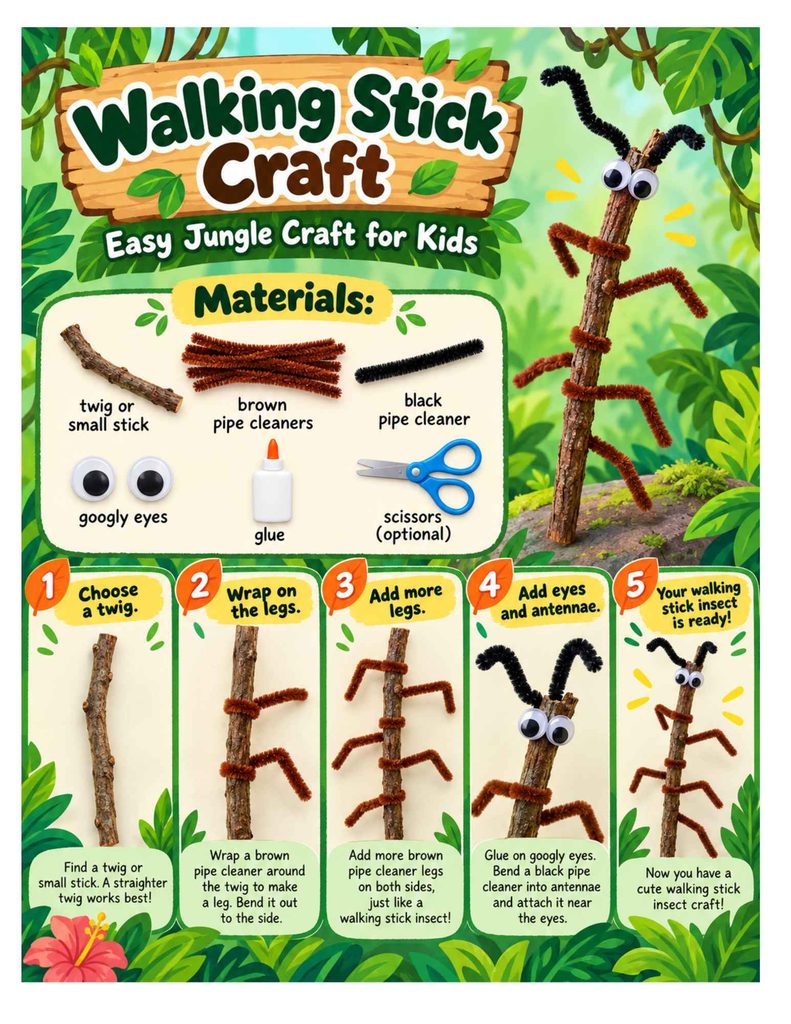
After exploring the animals and plants of the Borneo rainforest, students can create their own walking stick insect craft using a small twig, pipe cleaners, and googly eyes. The activity is a simple way to connect art with science while discussing how stick insects use their long, narrow body shape and camouflage to blend in with branches and leaves.
This makes a fun companion activity for a Borneo rainforest collaborative poster, especially when students are learning how rainforest animals are adapted to their habitat.
Standards & Skills Connections
NGSS Connections
- 2-LS4-1 – Biological Evolution: Unity and Diversity
Students make observations of plants and animals and compare the diversity of life in different habitats. This Borneo rainforest poster can serve as one habitat example when paired with another habitat for comparison. - 3-LS4-3 – Biological Evolution: Unity and Diversity
Students use evidence to explain why some organisms survive well in a particular habitat while others do not. The featured rainforest species can be used as a starting point for discussing how organisms are suited to the warm, wet, densely vegetated rainforest environment. - 5-LS2-1 – Ecosystems: Interactions, Energy, and Dynamics
Students develop models showing the movement of matter among plants, animals, decomposers, and the environment. Because the poster includes plants, animals, fungi, leaf litter, and other decomposer-related elements, it can support discussion of ecosystem interactions and matter cycling when paired with an appropriate modeling activity.
A LS2.A: Interdependent Relationships in Ecosystems kapcsolat különösen jó, mert az NGSS ebben a részben éppen a food webs, decomposers, organism needs és ecosystem interactions fogalmait hangsúlyozza.
Cross-Curricular Skills
Science
- Rainforest habitats
- Biodiversity
- Plants and animals of Borneo
- Ecosystem relationships
- Decomposers and the forest floor
- Observation and classification
Visual Arts
- Coloring and creative expression
- Collaborative art
- Color planning
- Completing one section of a larger composition
Math
- Working with a 6 × 5 grid
- Spatial reasoning
- Sequencing and page placement
- Comparing dimensions and scale
- Understanding how 30 individual pages combine to form one large image
ELA / Communication
- Describing rainforest organisms
- Using science vocabulary
- Comparing observations
- Explaining how an individual poster piece connects to the whole ecosystem
- Collaborative discussion and teamwork
Social-Emotional / Classroom Skills
- Cooperation
- Shared responsibility
- Following a visual assembly guide
- Contributing to a whole-class project
Designed to support these concepts when used with classroom discussion or extension activities.
Sources & Further Reading
Want to learn more about Borneo’s rainforest layers, plants, and wildlife? These trusted sources provide additional background information:
- National Geographic Education – Rain Forest
An introduction to tropical rainforests, including the emergent layer, canopy, understory, and forest floor. - Smithsonian’s National Zoo – Orangutan
Learn about orangutan habitat, behavior, diet, and adaptations for life in the trees. - World Wildlife Fund – Borneo and Sumatra
Explore the biodiversity of Borneo and the importance of protecting its tropical forests. - IUCN Cat Specialist Group – Bornean Bay Cat
Information about the rare Bornean bay cat and the forest habitats it depends on. - Royal Botanic Gardens, Kew – Rafflesia keithii
Botanical information about this remarkable flowering plant native to Sabah, Borneo. - Royal Botanic Gardens, Kew – Nepenthes bicalcarata
Learn about a distinctive pitcher plant native to Borneo. - Royal Botanic Gardens, Kew – Dipterocarpus caudifer
An example of the dipterocarp trees characteristic of Borneo’s tropical forests.
Note: Rainforest layers are useful for teaching how conditions change from the treetops to the forest floor. In nature, however, many animals move between more than one layer.