Looking for a fun, hands-on way to explore the tropical rainforest with your students?
This 3D rainforest project for kids brings the Borneo rainforest to life through 10 easy crafts, colorful plants, fascinating animals, and a collaborative classroom display.
Children can make hanging jungle vines, rainforest frogs, paper mushrooms, pitcher plants, orchids, and more while learning about rainforest layers, habitats, and adaptations.
Best of all, you can download the free 17-page rainforest craft pack below, including step-by-step visual instructions and printable templates.
Perfect for Grades 2–3, science centers, rainforest units, and collaborative classroom projects!
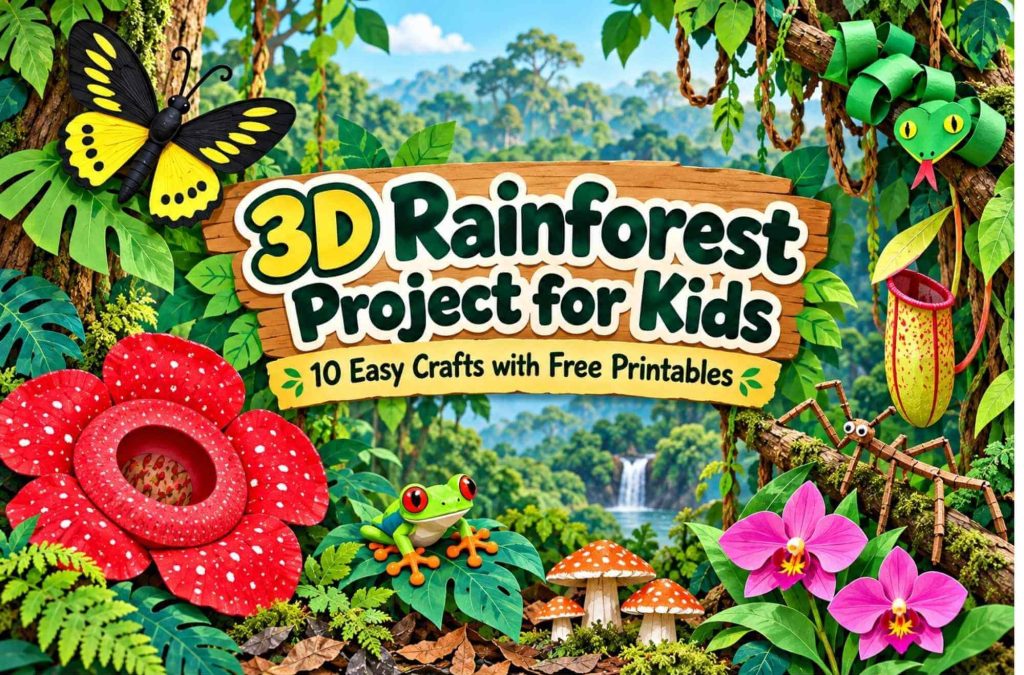
Free 3D Rainforest Craft Pack
17-page printable PDF · 10 rainforest crafts · Printable templates
Build a colorful Borneo rainforest with easy step-by-step craft instructions. Perfect for elementary science lessons, rainforest units, and collaborative classroom displays.
Explore the Layers of the Rainforest
Before starting the crafts, introduce students to the different layers of a tropical rainforest.
Rainforests have a layered structure because trees and other plants grow at different heights, creating habitats with different amounts of sunlight, moisture, and shelter.
For this project, students will build three main display sections.
1. Canopy – The Upper Rainforest
The canopy is formed by the crowns of tall trees. Its branches and leaves provide food and shelter for many rainforest animals.
Students can create:
- A colorful Borneo birdwing butterfly
- Hanging jungle vines
- A paper jungle snake
- Large tropical leaves
- Bright tropical flowers
2. Understory – The Shady Middle Layer
The understory receives less sunlight because the canopy blocks much of the light above.
This layer includes smaller trees, shrubs, vines, and many shade-tolerant plants.
Students can add:
- A walking stick insect
- A colorful rainforest frog
- A tropical pitcher plant
- Pink rainforest orchids
- Branches and overlapping leaves
3. Forest Floor – The Bottom Layer
The rainforest floor is often shaded and covered with fallen leaves, decaying wood, and other organic material.
Fungi and decomposers play important roles in breaking down dead material and recycling nutrients.
Students can create:
- A large rafflesia flower
- Colorful paper mushrooms
- A veiled stinkhorn mushroom
- Tiny forest mushrooms
- Ferns, moss, roots, and rocks
Classroom question: Why might plants growing near the rainforest floor have different adaptations from plants growing high in the canopy?
10 Easy Rainforest Crafts for Kids
The following craft activities can be combined into one large 3D rainforest display or completed as individual science-and-art projects.
1. Walking Stick Insect Craft
Turn an ordinary twig into a rainforest insect using brown pipe cleaners and googly eyes.
Children attach pipe cleaners to a small stick to make legs, then add eyes and antennae.Science connection: Camouflage helps many stick insects blend into branches and vegetation, making them harder for predators to spot.
2. Paper Plate Rafflesia Flower
Create a giant red rainforest flower using painted paper plates.
Students cut five petal shapes, paint them red, add white spots, and attach a raised center.
Science connection: Rafflesia flowers are famous for their enormous size and strong odor, which can attract flies that act as pollinators.
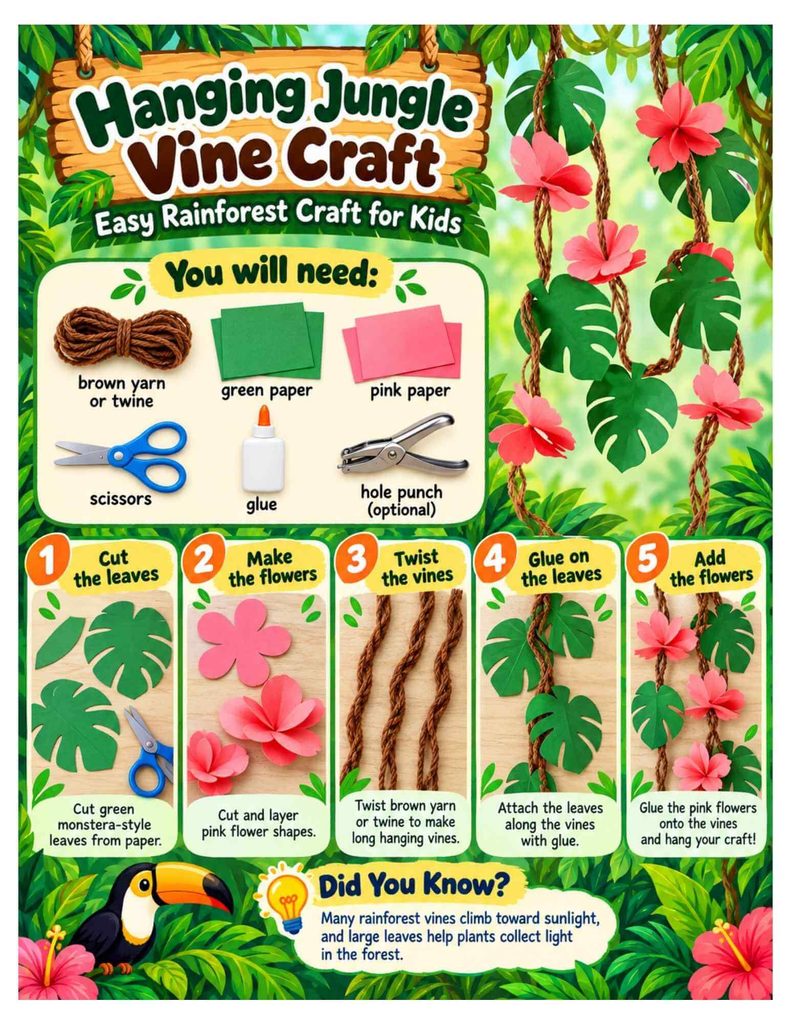
3. Hanging Jungle Vine Craft
Use brown yarn or twine to make long hanging vines decorated with green paper leaves and pink flowers.
Attach the vines near the top of the rainforest display to create a layered, three-dimensional effect.
Science connection: Many climbing plants use other plants for support to reach brighter parts of the forest.
4. Paper Chain Jungle Snake
Make a long, flexible jungle snake by joining green paper loops together.
Add a heart-shaped head, paper eyes, nostrils, and a red forked tongue.
Science connection: Different rainforest snakes use camouflage, climbing, and other adaptations to survive in their habitats.



5. Colorful Rainforest Frog
Students color, decorate, and cut out a rainforest frog using the printable frog template.
Display the finished frogs among large green leaves.
Science connection: Many tree frogs have specialized toe pads that help them cling to vegetation.
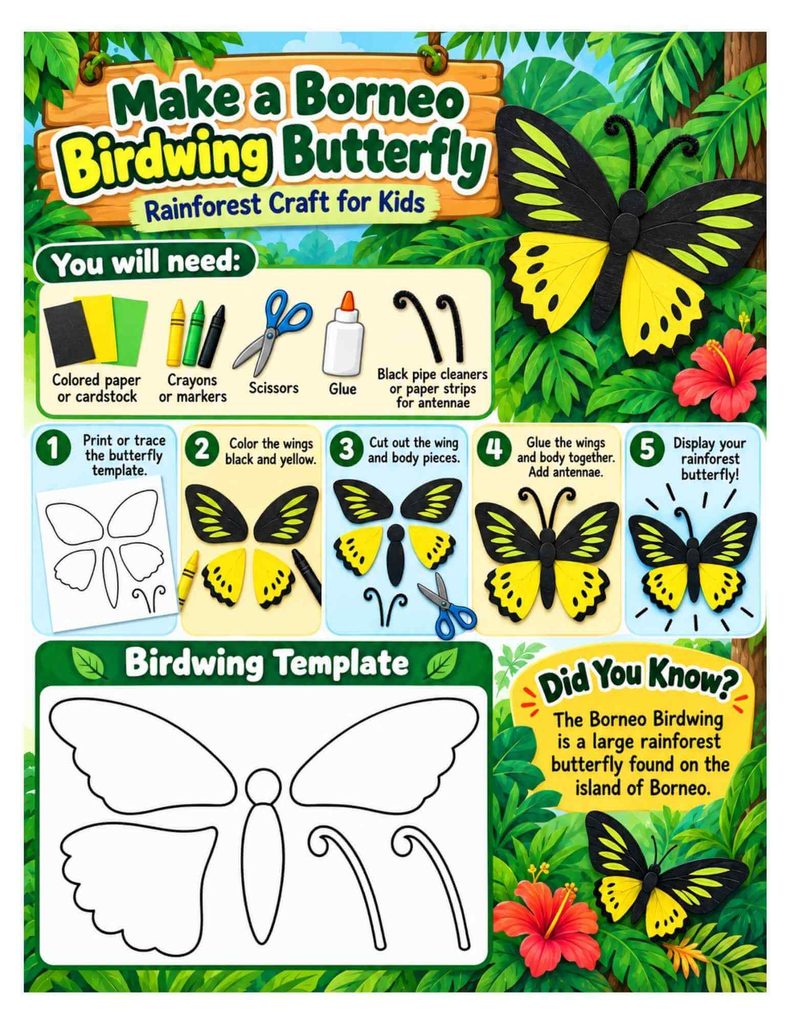
6. Borneo Birdwing Butterfly
Create a large black-and-yellow butterfly from colored paper.
Students assemble the wings, body, and antennae, then add bright markings.
Science connection: Birdwing butterflies are large tropical butterflies. Their distinctive wing patterns provide an opportunity to explore insect anatomy and biodiversity.
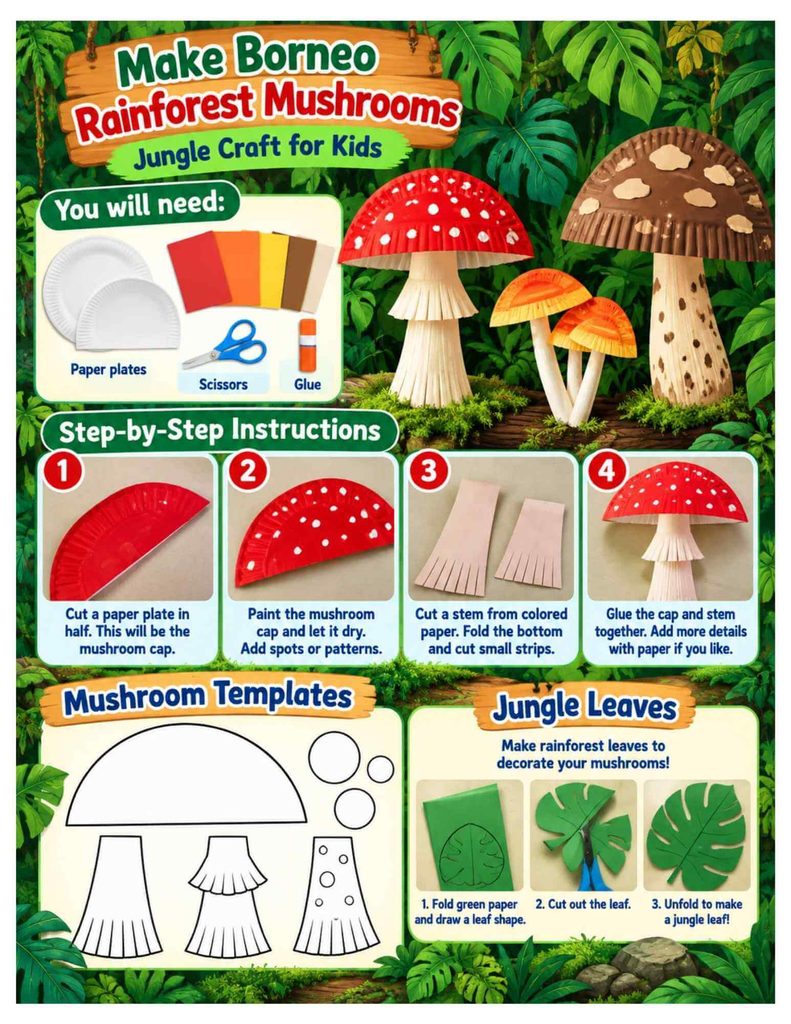
7. Paper Rainforest Mushrooms
Use paper plates and colored cardstock to make mushroom caps and stems.
Students can experiment with different cap shapes, colors, and sizes.
Science connection: Many rainforest fungi help decompose dead organic matter, returning nutrients to the ecosystem.
8. Veiled Stinkhorn Mushroom Craft
This unusual mushroom is a particularly interesting addition to the rainforest floor.
Create a rounded cap, long stem, and delicate net-like veil using paper.
Science connection: Some stinkhorn fungi produce odors that attract insects, which can help disperse their spores.


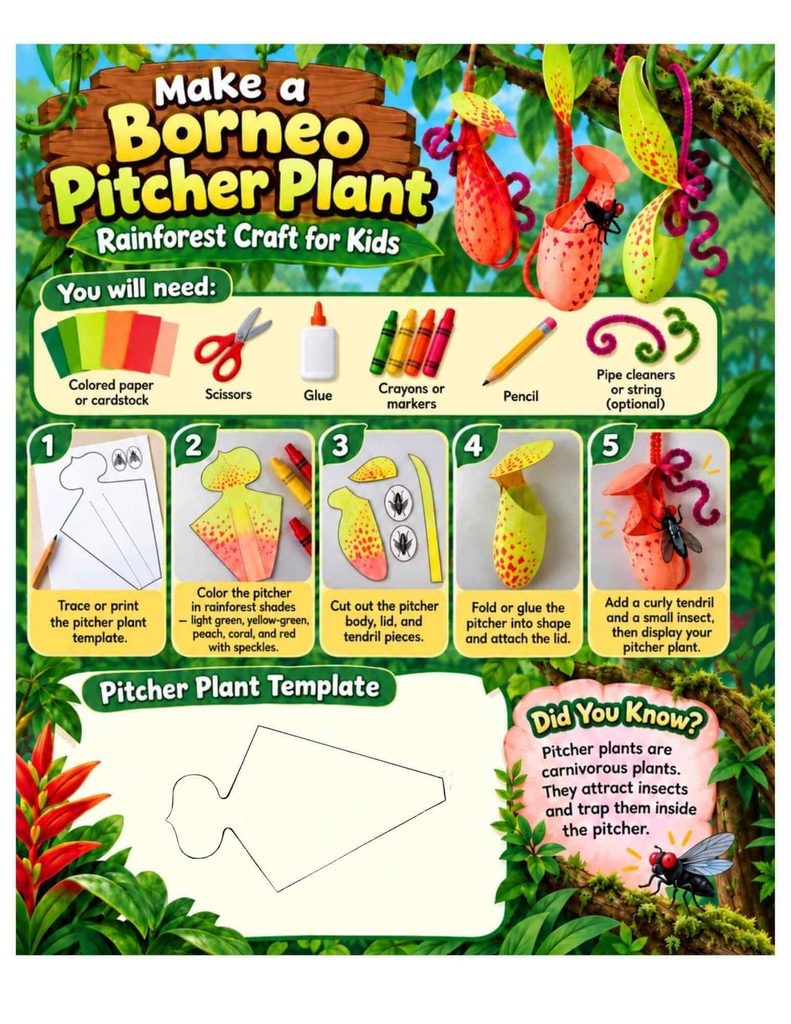
9. Tropical Pitcher Plant Craft
Use the printable pitcher plant template to create colorful hanging pitchers with lids and curling tendrils.
Decorate the pitchers with red, yellow, and green markings.
Science connection: Pitcher plants are carnivorous plants with modified leaves that trap insects. Some species obtain additional nutrients by digesting captured prey.
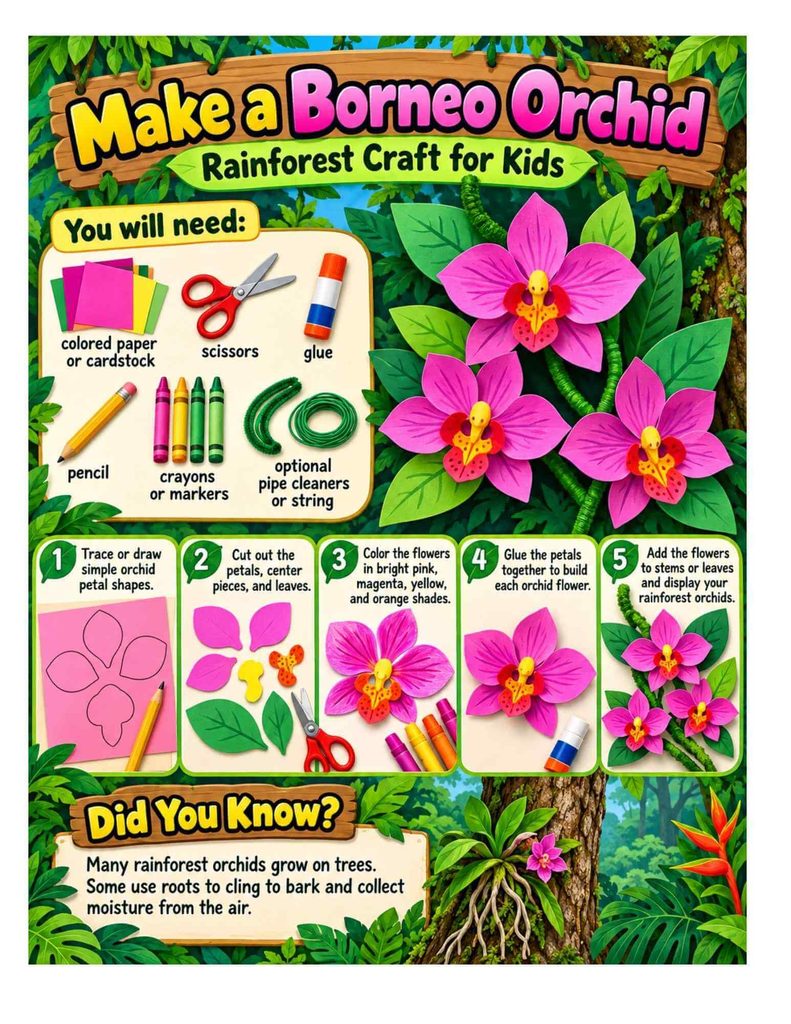
10. Rainforest Orchid Craft
Make bright paper orchids using pink, yellow, and orange cardstock.
Add green leaves and attach the finished flowers to tree trunks or branches.
Science connection: Many tropical orchids grow on trees as epiphytes. They use trees for support without taking nutrients directly from the tree.
How to Assemble Your 3D Rainforest Classroom Display
Once students have finished their individual crafts, bring everything together in one collaborative rainforest scene.
Step 1 – Create the background. Use a large piece of cardboard, poster board, or a classroom display panel. Add a tree trunk, branches, and green foliage.
Step 2 – Build the canopy. Attach hanging vines, butterflies, paper snakes, and tropical leaves toward the top.
Step 3 – Fill the understory. Position frogs, walking stick insects, orchids, and pitcher plants around the middle section.
Step 4 – Create the forest floor. Add paper mushrooms, a rafflesia flower, roots, moss, and crumpled-paper rocks.
Step 5 – Add depth and texture. Use folded paper tabs, layered leaves, and raised craft elements to give the display a three-dimensional appearance.
Encourage students to think about where each organism belongs and why.
Turn Your Rainforest Craft into a Science Lesson
A collaborative rainforest display is more than an art project. It can help students develop a better understanding of how living things interact with their environments.
Try these classroom discussion questions:
- Why does the rainforest floor receive less sunlight than the canopy?
- How does camouflage help some rainforest animals survive?
- Why do climbing plants grow toward brighter parts of the forest?
- What role do fungi play in a rainforest ecosystem?
- How do pitcher plants obtain nutrients from trapped insects?
For an additional activity, ask students to choose one organism from their display and explain one adaptation that helps it survive.
A Collaborative Rainforest Project for Elementary Classrooms
This project is especially effective when students work in small groups.
One group can make the canopy, another can create understory plants and animals, and a third can build the forest floor.
By combining their work, students create a shared classroom display that brings rainforest biodiversity to life.
The finished rainforest can be used as a science bulletin board, classroom decoration, habitat study, or visual reference during an ecosystems unit.
Bring the rainforest into your classroom! Combine simple crafts, printable templates, and hands-on science discussions to help students explore one of the world’s most diverse terrestrial ecosystems.