African elephants give students a concrete way to explore how an animal’s body, behavior, and habitat connect. This printable African elephant worksheet set helps Grades 3–4 students read about the savanna, identify elephant adaptations, sort foods, and explain how elephants affect the ecosystem.
The resource includes ten student pages and an answer key. Students begin with a short nonfiction reading, then practice comprehension, vocabulary, body-part identification, adaptations, habitat needs, diet, ecosystem relationships, and a comparison of elephants and giraffes. A final review page lets students show what they remember through questions, matching, true-or-false statements, and a draw-and-write response.
What Students Learn
The activities build several connected science ideas:
- Habitat and resources: Students identify African savannas, grasslands, and woodlands as elephant habitats and consider resources such as plants, water, and space.
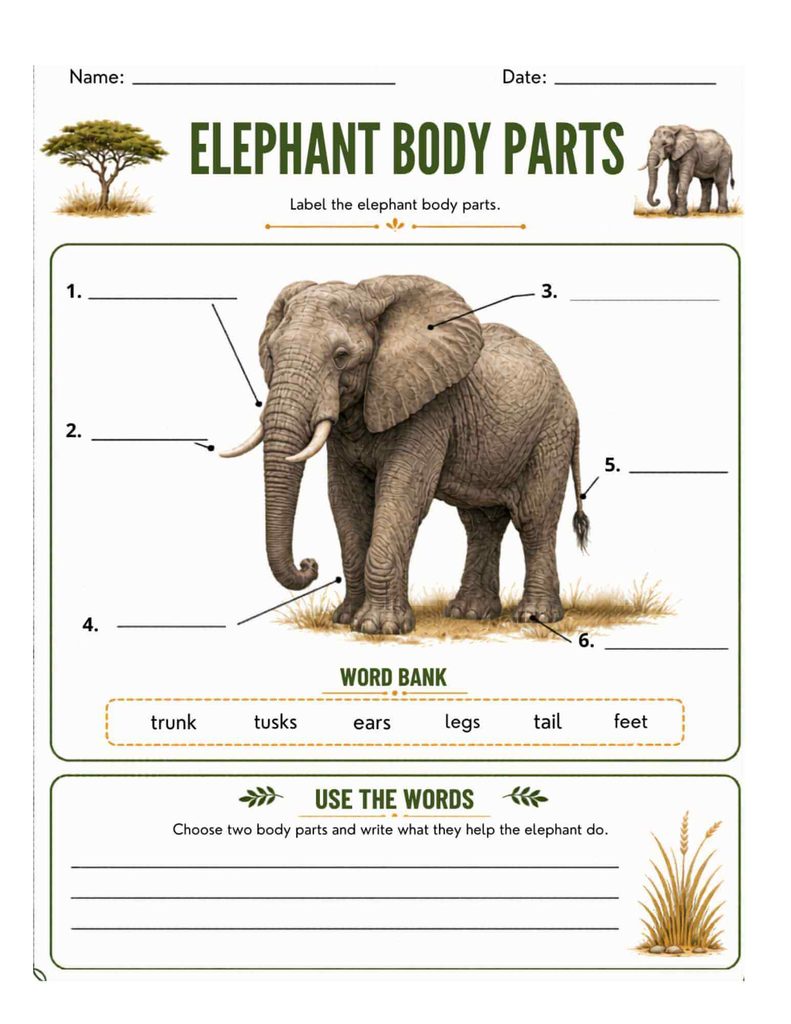
- Structure and function: Students connect large ears, a long trunk, tusks, thick skin, and large feet with ways an elephant can meet its needs.
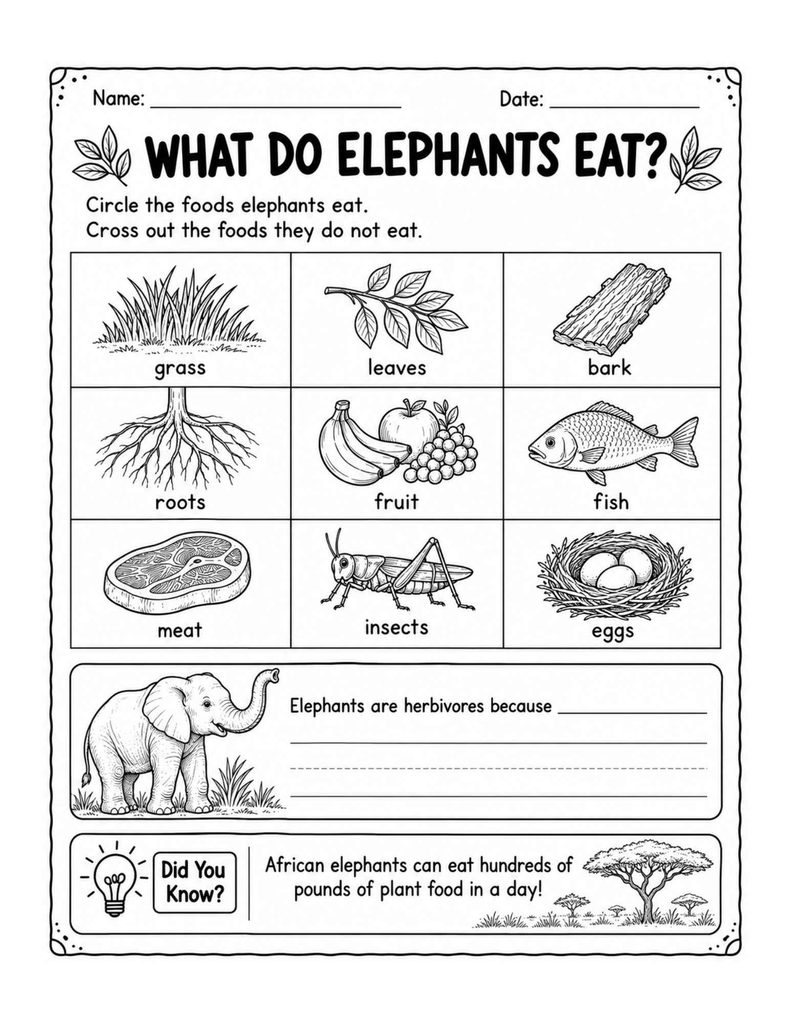
- Herbivore diets: A food-sorting activity asks students to identify plant foods and explain why elephants are herbivores.
- Ecosystem relationships: Students learn that elephants can spread seeds and change parts of their habitat.
- Science vocabulary: Students practice words such as trunk, tusks, herd, herbivore, savanna, and adaptation.
- Compare and contrast: A Venn diagram helps students compare an elephant and a giraffe using details from the resource.

How to Use the Activities in a Science Lesson
Start with a habitat question
Show students a map of Africa and a photograph of a savanna. Ask, “What would a large animal need to find here?” Invite students to name food, water, space, and shelter, then have them look for evidence in the reading and habitat chart.
A helpful teaching point is that savannas are not all treeless grasslands. African savanna elephants live in open and wooded savannas, among other habitats. Ask students to notice which plants and resources appear in the image and how those details support the animals living there.
Connect body parts to jobs
After students label the elephant’s body parts, make a class chart with three columns: body part, what it does, and evidence. Students can use the sentence frame, “The elephant’s ___ helps it ___ because ___.” This turns a matching activity into a short explanation supported by evidence.
Large ears help elephants release excess heat, while the trunk is used to handle food and water and communicate. The worksheet introduces tusks as tools for digging. For accuracy, explain that tusks are elongated upper incisor teeth and that not every elephant has visible tusks. “Tusks can help elephants dig” is a useful way to phrase the idea.
Make the food sort a reasoning activity
Before students circle and cross out foods, ask them to predict what an elephant eats and explain why. Then have them use the reading to check their ideas. Students can sort the pictured items into plant foods and not typical foods, then finish the sentence: “Elephants are herbivores because…”
For an extension, ask how an elephant’s menu might change when grasses are more or less available. African savanna elephants eat grass as well as other plants and fruits, and their food choices can vary with the season

Trace one ecosystem connection
The ecosystem page can lead to a quick cause-and-effect model. Students draw or write a sequence such as: elephant eats fruit → elephant travels → seeds are spread in a new place → a plant may grow. Then ask, “What might change for plants or other animals if fewer seeds were spread?”
Encourage students to use words such as may and could. Ecosystems are complex, and one change does not always produce the same result in every place. Elephants can help spread seeds and shape the habitats they live in.
Use the giraffe comparison for discussion or writing
The elephant-and-giraffe Venn diagram is a natural partner activity. Ask students to support each comparison with a detail from the pages: both animals live in Africa and are herbivores, while elephants have trunks and giraffes have long necks that help them reach leaves high in trees.
Students can turn one Venn diagram detail into a short paragraph or an oral report.

NGSS Connections for Grades 3–4
In NGSS-aligned classrooms, this resource offers useful connections:
- Grade 3, 3-LS4-3: Students use evidence about organisms’ needs and characteristics and their habitats. The reading, habitat chart, and animal comparison provide material for this discussion.
- Grade 3, 3-LS2-1: Extend the herd reading by asking how living in a group may help protect calves or help elephants cope with changes.
- Grade 3, 3-LS4-4: Add a single-change scenario, such as a water source becoming unavailable. Have students explain how that change could affect organisms and propose one evidence-based response.
- Grade 4, 4-LS1-1: The adaptations page connects visible structures with their functions. To deepen the work, ask students to make an evidence-based claim about how one body part supports survival.
These are instructional connections, not a claim that the packet alone covers every part of a performance expectation. A short discussion, model, or written explanation can help students show their reasoning.
Differentiation Ideas
For students who need support, preview the vocabulary with pictures, read the passage aloud, and allow partner talk before written responses. Sentence frames can help students explain what a body part does or how a habitat meets an animal’s needs.
For students ready for more, ask them to cite two details from the reading, explain a cause-and-effect relationship, or compare how an elephant and a giraffe reach plant food. The final review page can also be used as an independent check, small-group activity, or homework.
A Ready-to-Use Elephant Habitat Resource
These African elephant worksheets combine reading practice with science activities about adaptations, habitats, diet, and ecosystems. Use the pages together for a short savanna lesson, or choose individual activities for a science center, review day, or literacy connection.
Helpful Resources for Teachers
- WWF Teaching Tools About Elephants — A free Grades 3–5 toolkit with elephant facts, a classroom presentation, species cards, activities, videos, and quizzes.
- National Geographic Education: Grassland Biome — Teacher background on savannas and temperate grasslands, including how African savannas differ from grasslands in the United States. education.nationalgeographic.org
- WWF: African Savanna Elephants — A fact-checking reference for elephant habitats, diet, family groups, adaptations, and ecosystem roles. WWF
- NGSS Evidence Statements — Official guidance that helps teachers unpack what students should know and demonstrate for NGSS performance expectations. Next Generation Science Standards
NGSS standards referenced in the article: