Have you ever wondered why green leaves suddenly turn yellow and orange in the fall?
Those beautiful fall colors are connected to pigments inside the leaf—and a simple paper chromatography experiment can help children see some of those pigments for themselves!
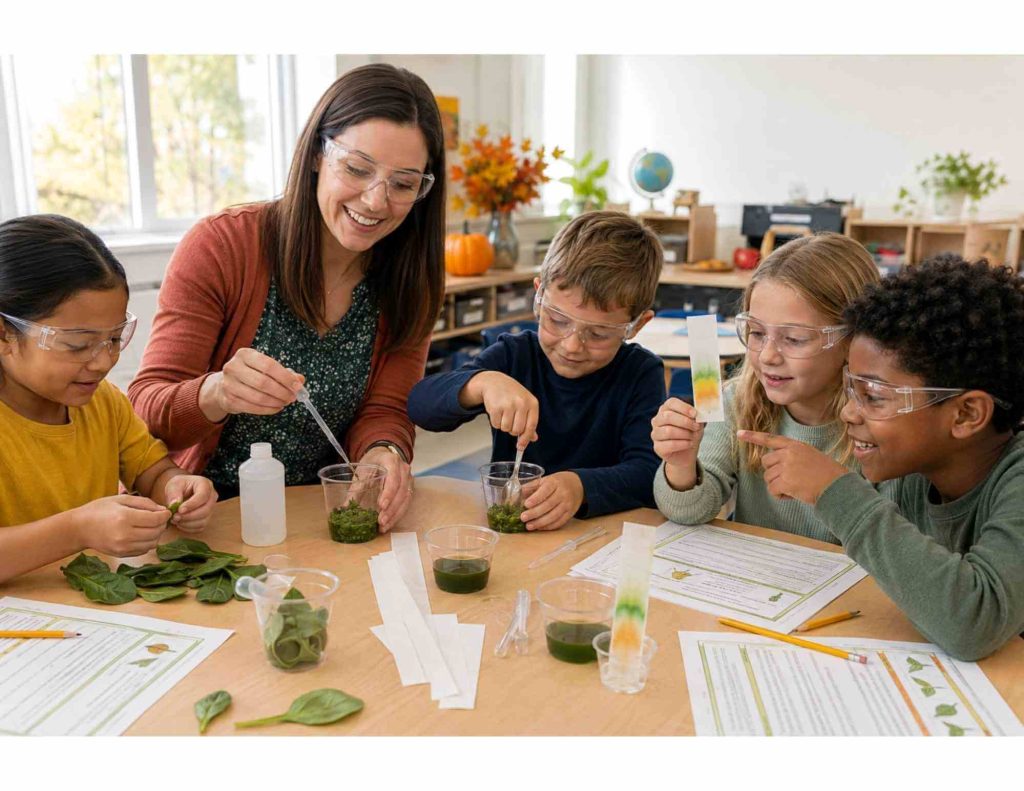
This leaf chromatography experiment for kids is a fun hands-on science activity for Grades 2–3. Students begin with a green leaf, separate its pigments on a paper strip, record their observations, and then repeat the investigation with a yellow or orange fall leaf.
Why Do Leaves Change Color in Fall?
During spring and summer, leaves contain a lot of chlorophyll, the pigment that makes them look green.
Green leaves also contain other pigments, including yellow and orange carotenoids. While chlorophyll is abundant, its strong green color can make these other colors difficult to see.
In fall, chlorophyll begins to break down. As the green fades, yellow and orange pigments can become much easier to see.
This makes leaf color change a wonderful seasonal science topic for young learners.
What Is Leaf Chromatography?
Chromatography is a method scientists use to separate mixtures.
In this simple classroom version, pigments from a leaf travel up a strip of paper with a liquid. Different pigments can move through the paper at different rates, creating separate bands of color.
For young scientists, it can feel almost like discovering a secret hidden inside an ordinary green leaf!
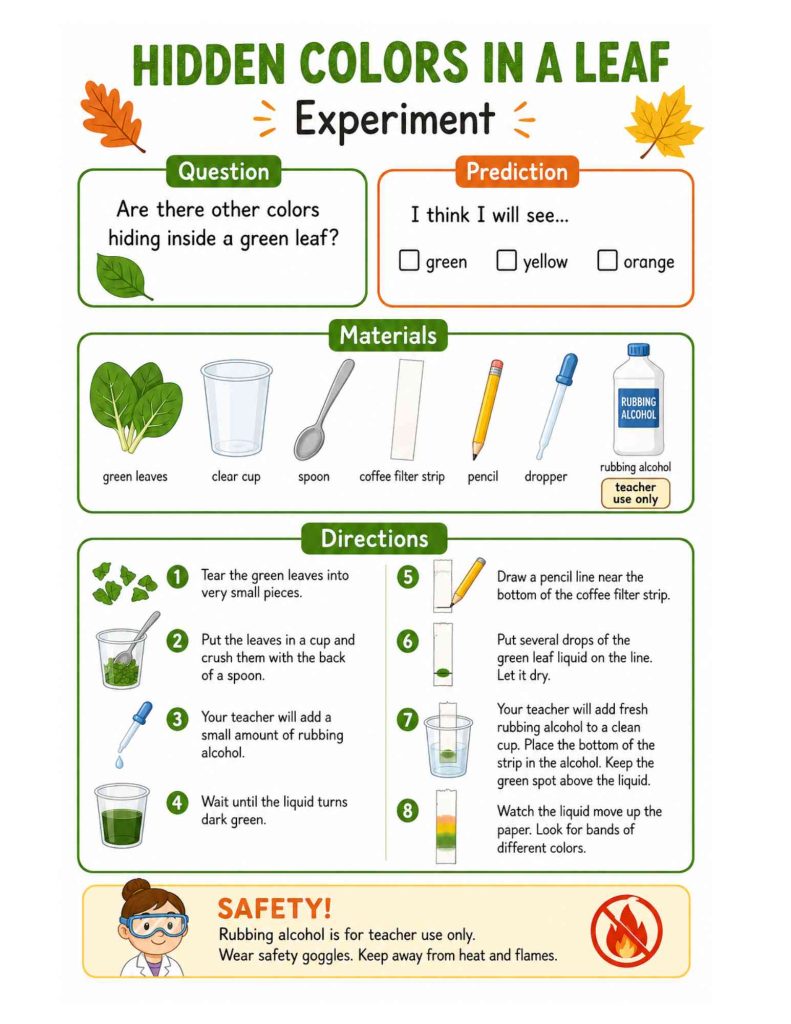
Materials
You will need:
- dark green leaves (spinach works especially well)
- a clear cup
- a spoon
- coffee filter strips
- a pencil
- a dropper
- rubbing alcohol — teacher use only
- safety goggles
For the extension activity, you will also need a yellow or orange fall leaf.
How to Do the Experiment
- Tear the green leaves into very small pieces.
- Place the pieces in a clear cup and crush them with the back of a spoon.
- Have the teacher add a small amount of rubbing alcohol.
- Wait until the liquid becomes dark green.
- Draw a pencil line near the bottom of a coffee filter strip.
- Place several drops of the green leaf liquid on the line. Allow the spot to dry.
- The teacher adds a small amount of fresh rubbing alcohol to a clean cup. Place the bottom of the paper strip in the alcohol, making sure the green pigment spot stays above the liquid.
- Watch as the liquid travels up the paper and look for bands of different colors.
Students may observe shades of green and yellow, and some samples may also produce yellow-orange or orange bands.
Results will vary—and that is part of the investigation!
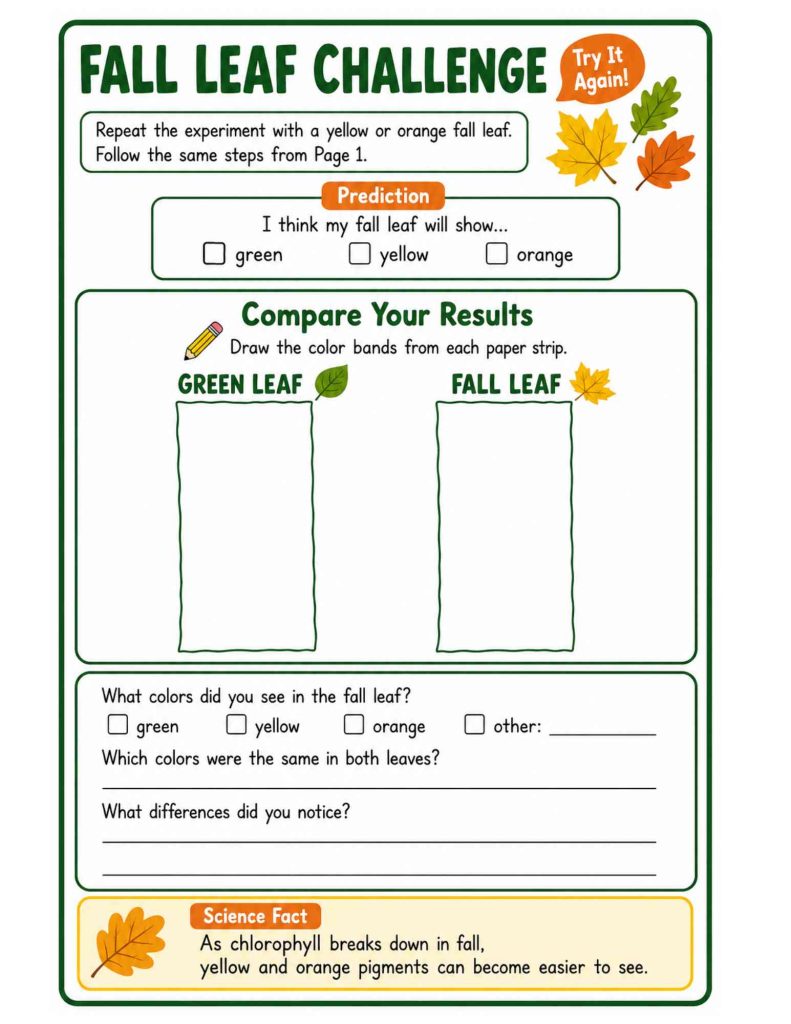
Green Leaf vs. Fall Leaf Challenge
After completing the experiment with a green leaf, try it again with a yellow or orange fall leaf.
Have students compare their two chromatography strips.
Ask:
Which colors appeared in both leaves?
What differences do you notice?
Did your fall leaf produce the colors you predicted?
The comparison helps move the activity beyond simply following experiment directions. Students are observing, comparing evidence, and thinking about how leaves change during fall
A Helpful Science Note for Teachers
It is common to tell children that all fall colors were “hiding” under the green chlorophyll during summer.
For yellow and orange carotenoid pigments, this is a useful Grade 2–3 explanation. However, not every fall color works exactly this way. Red and purple colors in some leaves are produced by pigments called anthocyanins, which may form as leaves change in the fall.
For this activity, focusing on green, yellow, and orange pigments keeps the science simple and age-appropriate.
Turn It Into a Complete Science Investigation
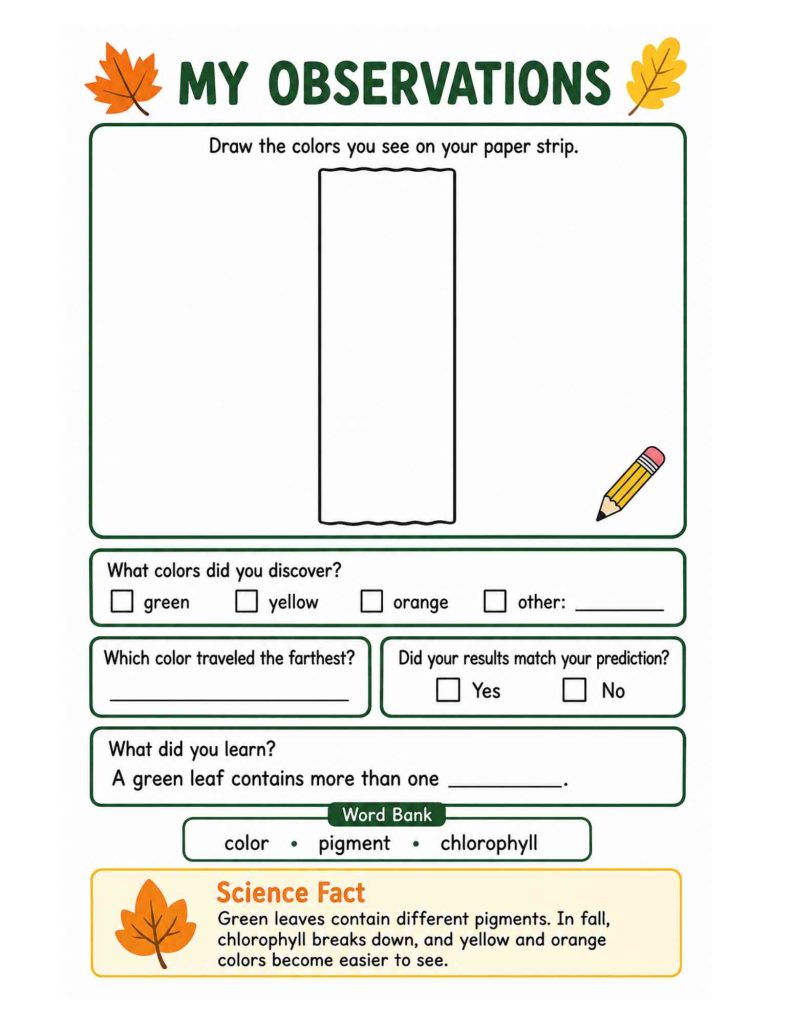
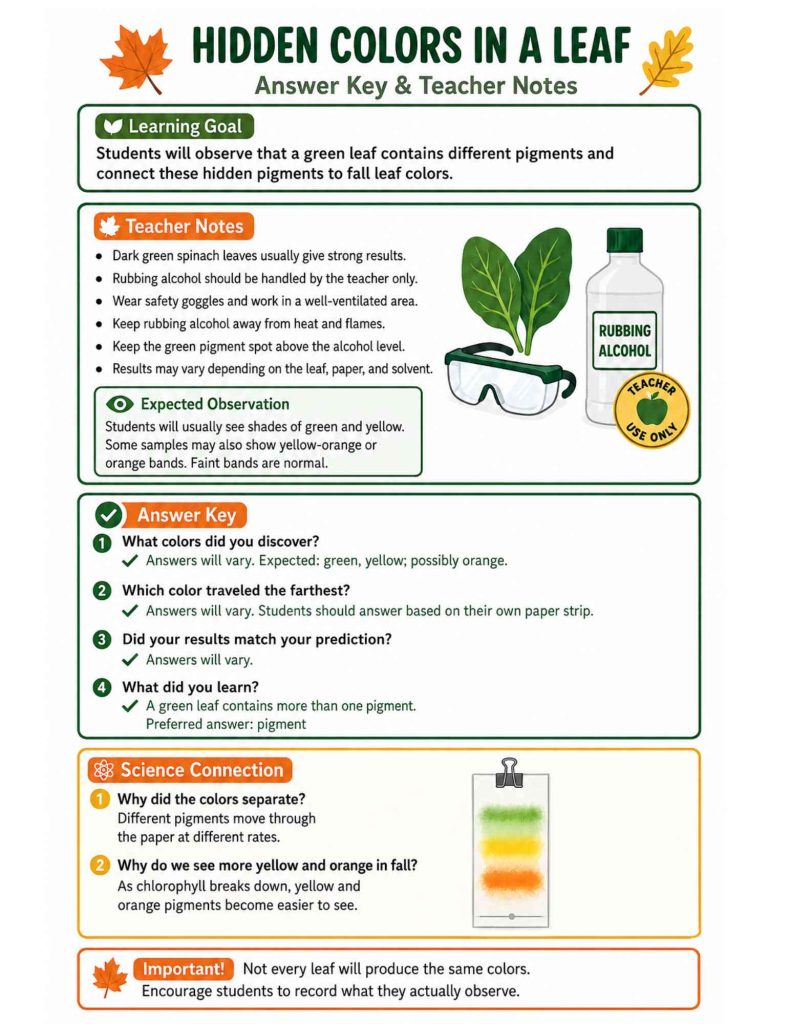
The Hidden Colors in a Leaf printable activity guides students through the entire investigation.
The 4-page activity includes:
- Page 1 – Hidden Colors in a Leaf: Experiment
Question, prediction, illustrated materials, and step-by-step directions - Page 2 – My Observations
A chromatography strip drawing area, observation questions, and science fact - Page 3 – Answer Key & Teacher Notes
Expected observations, teaching tips, safety information, and science connections - Page 4 – Fall Leaf Challenge
A green leaf vs. fall leaf comparison extension
It works especially well during a fall science unit, changing leaves lesson, plant unit, seasonal science center, or hands-on STEM activity.
Safety Reminder
Rubbing alcohol should always be handled by the teacher or another responsible adult. Use safety goggles, work in a well-ventilated area, and keep rubbing alcohol away from heat and flames.
Discover the Science Inside a Leaf
Sometimes the best science investigations begin with something children see every day.
With a few leaves, a paper strip, and a little curiosity, students can discover that a leaf is much more colorful than it first appears.
And when the leaves begin changing outside the classroom window, they will have a whole new way to think about those beautiful fall colors. 🍂